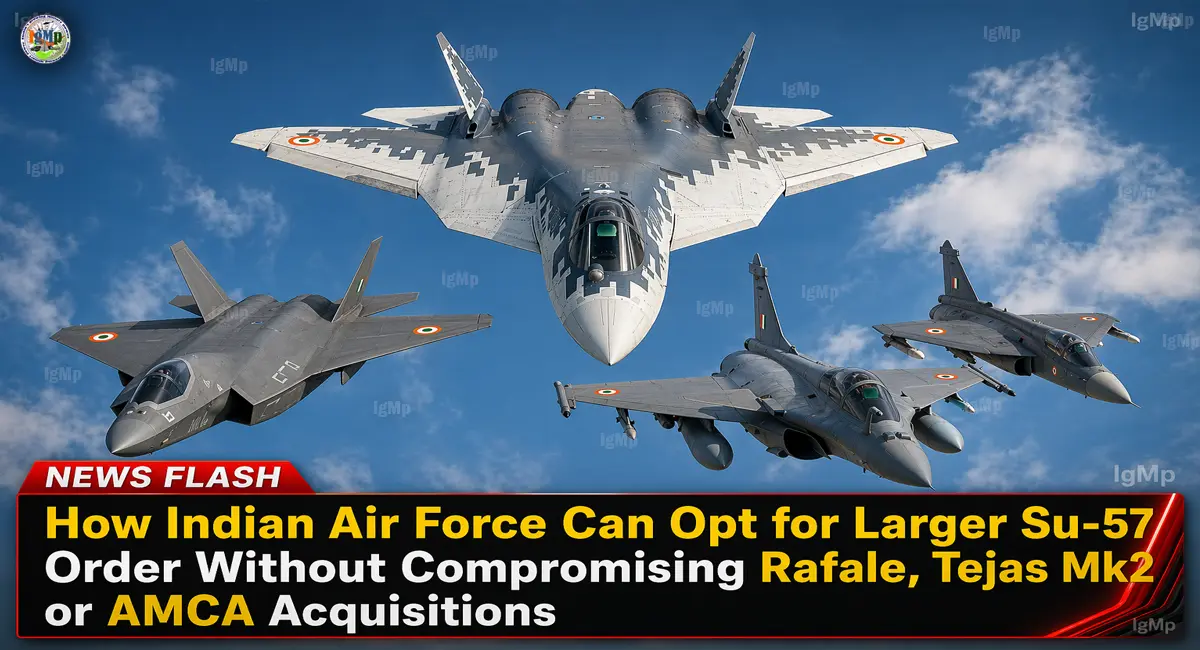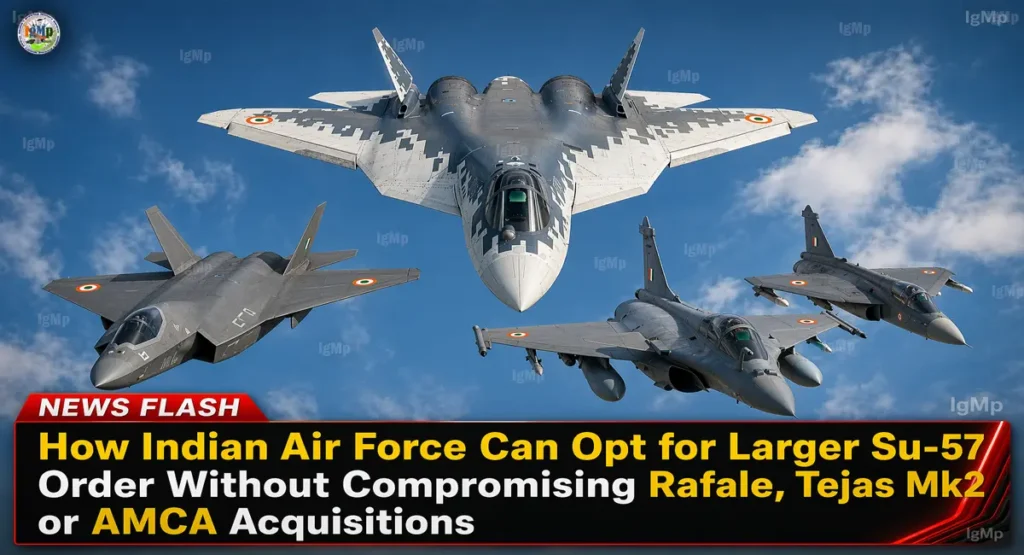
The Indian Air Force faces a hard numbers problem. Against an approved strength of 42 fighter squadrons, the service operates with barely around 29 effective squadrons. This is no longer a planning gap. It is a national security pressure point.
Even with the induction of Tejas Mk1A, future Tejas Mk2, and the long-term arrival of AMCA, a major capability vacuum remains. By 2035, Jaguars, older MiG-29s, Mirage-2000 fleets, and more than 100 early Su-30MKI airframes will approach retirement or major structural limits.
This creates what many analysts call the 2035 Airframe Cliff. The question is not whether India needs another large fighter program. The real question is how the Indian Air Force fills that gap without damaging indigenous projects.
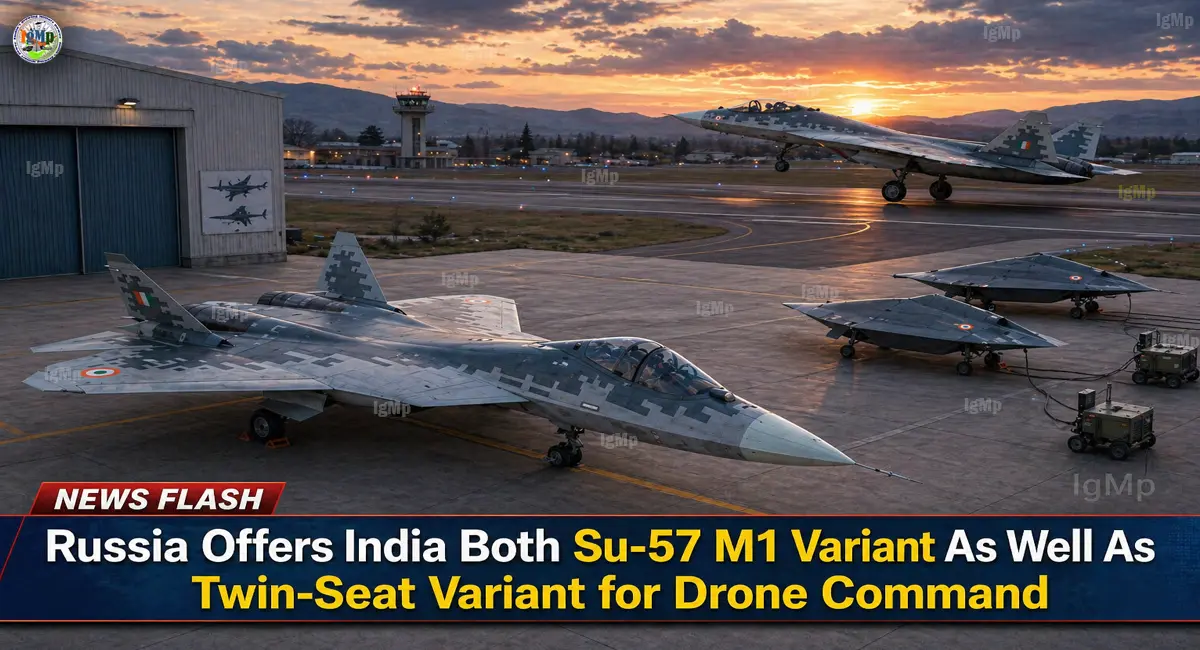
That is where the Su-57 enters the debate—not as a rival to Rafale or AMCA, but as a strategic heavyweight partner.
Why the Su-57 is not competing with Rafale or AMCA
The biggest mistake in public debate is treating the Su-57 as a replacement for Rafale or AMCA.
These aircraft serve different missions. The Rafale remains a multi-role precision strike platform with strong Western avionics and proven combat flexibility. The AMCA is designed as India’s future medium-weight stealth aircraft focused on deep penetration missions and low observable surgical strikes.
The Su-57, by contrast, fits the heavyweight category.
It works better as a stand-off missile carrier, capable of carrying long-range air-launched ballistic missiles, future hypersonic weapons like BrahMos-II, and large precision strike payloads over extended distances. It offers strategic reach, not just tactical penetration.
In simple terms, AMCA enters first and stays invisible. Su-57 stays farther back and delivers massive reach.
This is complementarity, not competition.
Comparison Table of Su-57 and AMCA
| Feature | Su-57 (Heavyweight) | AMCA (Mediumweight) |
|---|---|---|
| Role | Strategic Stand-off & ALBM Platform | Deep Penetration & Surgical Strike |
| Cost Basis | Make in India with source-code access | Indigenous with high software sovereignty |
| Availability | Immediate / Near-term through off-the-shelf + HAL | Mid-to-Long term, post-2030 |
| Replacement For | Early Su-30MKI / MiG-29 | Mirage-2000 / Jaguar / MiG-29 |
Why HAL Nashik makes the Su-57 plan financially realistic
The strongest argument for a larger Su-57 order is not only military. It is industrial.
The HAL Nashik facility already understands the Sukhoi ecosystem because of decades of Su-30MKI production, overhaul, and structural work. Moving toward Su-57 assembly is not a greenfield gamble. It is a brownfield expansion with lower cost and lower execution risk.
This matters because India has already built the ecosystem—trained manpower, tooling chains, logistics networks, and vendor support systems.
A proposed investment of nearly $5 billion into Nashik should not be seen as a procurement burden. It is a national aerospace asset. It supports stealth coating work, RAM (Radar Absorbent Material) manufacturing, structural integration, and future fifth-generation maintenance capability.
That industrial value stays in India long after the contract ends.
How software sovereignty changes the Su-57 equation
This is where the Rafale versus Su-57 debate becomes more serious.
The Rafale offers excellent performance, but deeper customization remains expensive because proprietary software access stays tightly controlled. Every major integration creates dependency.
The Su-57 discussion brings a different possibility—greater access to mission systems, source-level integration flexibility, and stronger control over RCS (Radar Cross Section) management, mission computers, and weapons architecture.
That matters for indigenous missiles like Astra variants, future stand-off weapons, and long-range strike systems. It also matters for LPI (Low Probability of Intercept) radar integration and sensor fusion under Indian operational doctrine.
This is not only about cost. It is about operational independence.
Force multiplication becomes stronger when the aircraft speaks the same language as the rest of the IAF’s Sukhoi infrastructure.
Analyst’s Take: Why Su-57 strengthens AMCA instead of hurting it
In our view, the Su-57 is not an alternative to AMCA. It is the bridge that protects AMCA’s timeline.
India cannot wait until the 2030s for stealth capacity while squadron strength keeps falling. The Air Force needs a heavy stealth platform sooner, especially against growing regional fifth-generation threats.
The Su-57 provides that immediate answer while AMCA matures as the long-term sovereign solution.
It also helps replace aging Su-30MKIs instead of forcing Rafale into a role it was never designed to fill.
The real strategy is simple: Rafale for precision flexibility, Su-57 for heavyweight reach, and AMCA for sovereign stealth dominance.
That three-layer structure gives the Indian Air Force something more important than numbers—it gives strategic balance for the next two decades.