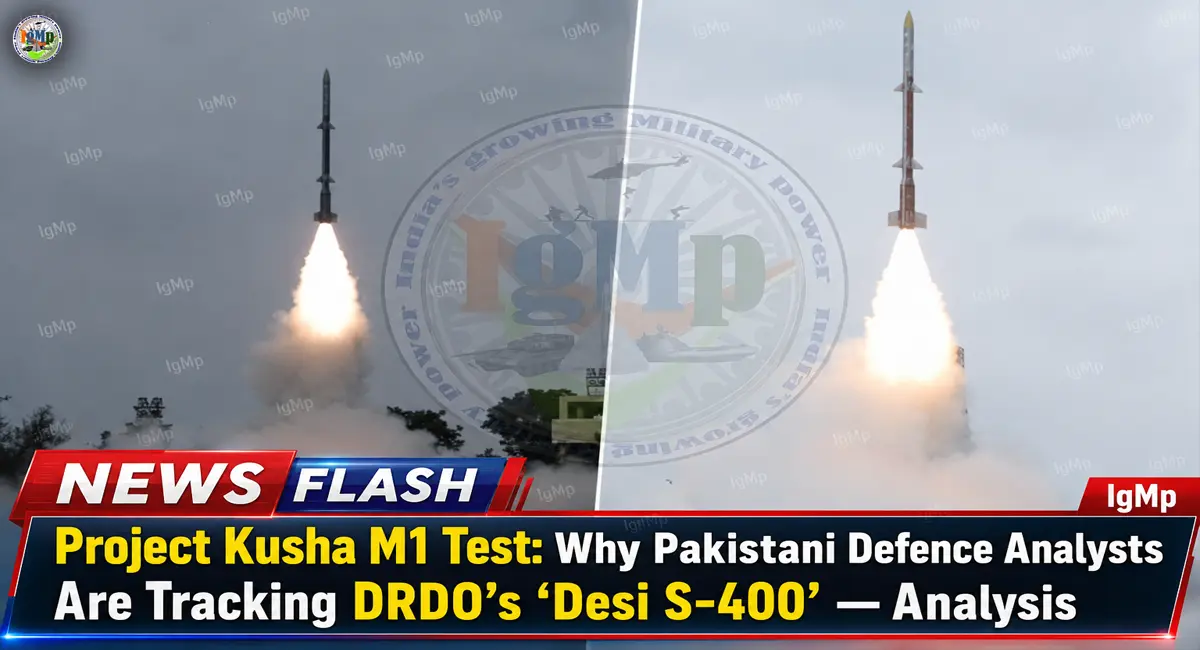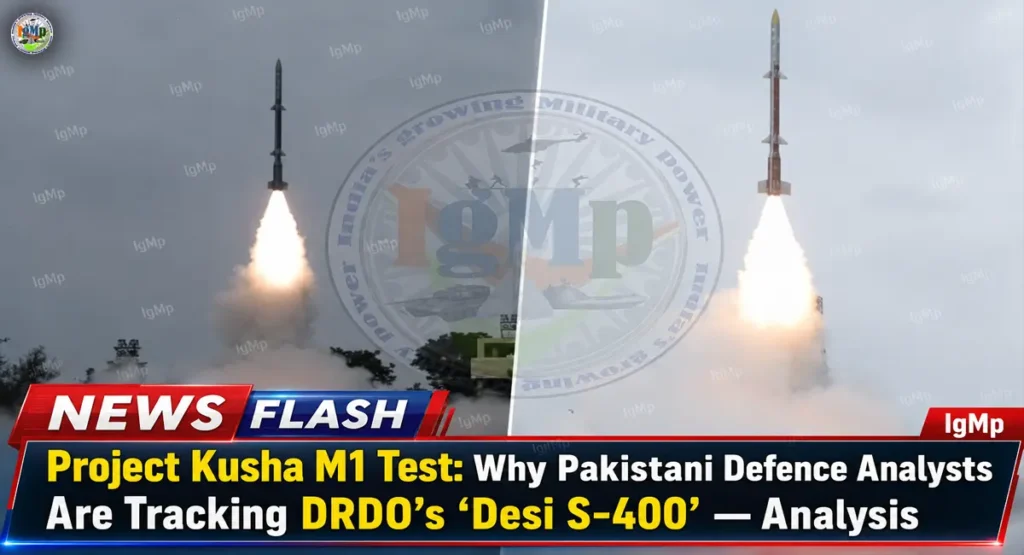
India’s Project Kusha crossed an important technological milestone on July 23, 2026, when the Defence Research and Development Organisation (DRDO) conducted the maiden flight test of its long-range surface-to-air missile system from APJ Abdul Kalam Island off the Odisha coast. The test involved an electronic target simulating a high-speed, high-altitude aerial threat and marks a significant step toward an indigenous long-range air-defence capability.
The significance extends beyond the missile itself. Project Kusha is emerging as a key long-range layer in India’s evolving multi-layered air-defence architecture, alongside systems such as the Russian S-400 and indigenous platforms. It is also being discussed in the broader context of Mission Sudarshan Chakra, India’s planned nationwide, networked defence architecture aimed at integrating surveillance and multiple defensive layers by 2035.
IgMp Strategic Takeaways
- The Milestone: DRDO successfully conducted the maiden flight test of the Project Kusha long-range SAM on July 23, 2026, validating a major step in India’s indigenous air-defence programme.
- Pakistani Strategic Calculus: The planned three-tier Kusha family—M1, M2 and M3—could complicate the Pakistan Air Force’s traditional assumptions about operating near Indian airspace if the system reaches its intended performance and is deployed at scale.
- Doctrine Shift: The likely response is not simply to seek greater aircraft survivability, but to place greater emphasis on stand-off weapons, electronic warfare, low-observable platforms and Suppression of Enemy Air Defences (SEAD).
Project Kusha M1 Test: Key Takeaways & Capabilities
Project Kusha is often described as India’s “desi S-400,” but the comparison needs qualification. The programme is intended to provide a domestic long-range surface-to-air capability against aerial threats, while the S-400 remains a broader imported system with its own capabilities and established operational maturity. Kusha is not simply a one-for-one replacement for the Russian system.
The planned Kusha family is built around three interceptor tiers:
| Feature | Project Kusha (M1/M2/M3) | S-400 Triumf |
|---|---|---|
| Primary developer | DRDO-led Indian development | Russia |
| Planned engagement range | M1: ~150 km; M2: ~250 km; M3: ~350–400 km | Up to ~400 km, depending on missile |
| Strategic role | Indigenous long-range air-defence layer | Established long-range air-defence system |
| Integration | Intended to complement India’s wider networked air defence | Integrated into India’s existing air-defence architecture |
| Supply-chain model | Greater scope for indigenous control | Dependent on foreign-origin system and support |
The M1 test is therefore important less because one interceptor has suddenly transformed India’s air-defence posture, and more because it demonstrates progress toward a scalable indigenous family of long-range interceptors. The published range figures for M1, M2 and M3 remain programme-level specifications rather than proof that every variant has already demonstrated its full operational envelope.
Pakistani Perspective: Penetration Corridors and SEAD Tactics
Islamabad is unlikely to view Kusha as an isolated missile test. Pakistani military planners would instead assess it as one component of a progressively denser Indian air-defence network.

The critical issue is operational access. A layered system combining long-range interceptors with medium- and short-range air defence can make predictable penetration routes more dangerous. For the Pakistan Air Force (PAF), that could increase the value of stand-off attack weapons, electronic warfare, decoys and intelligence, surveillance and reconnaissance capabilities designed to locate and suppress air-defence systems before committing expensive aircraft.
That does not mean Kusha will automatically close Pakistani “penetration corridors.” Air-defence effectiveness depends on far more than nominal missile range: radar coverage, terrain, command-and-control, sensor fusion, electronic countermeasures, interceptor availability and rules of engagement all matter.
The more consequential shift would come if Kusha is deployed in numbers and connected effectively with India’s broader air-defence command network. In that scenario, the PAF could face a more complex threat environment in which aircraft must contend with multiple engagement zones rather than a single defensive line.
The likely counter is a greater reliance on SEAD and DEAD operations, long-range precision weapons, electronic attack and low-observable aircraft. In other words, the competition would move from simply asking how far an interceptor can reach to asking whether an attacker can disrupt the entire kill chain—from detection and identification to tracking, engagement and battle-damage assessment.
Mission Sudarshan Chakra: Integrating S-400 with Indigenous Tiers
Project Kusha’s strategic value becomes clearer when viewed as part of India’s wider air-defence ambitions. Mission Sudarshan Chakra is intended to create a multi-layered, networked national security architecture, with air defence linked to broader surveillance and detection capabilities. Reporting has indicated plans involving radars, satellites and directed-energy technologies, alongside existing and future defensive systems.

In that architecture, Kusha could provide a crucial indigenous long-range layer while the S-400 continues to contribute its existing capabilities. The objective is therefore better understood as integration and redundancy, not a simple “S-400 replacement.”
For Pakistan, the strategic concern is the potential cumulative effect. A more resilient Indian air-defence network could force the PAF to expend greater effort and resources on intelligence preparation, electronic warfare and suppression missions before attempting high-value strikes.
The July 23 test does not, by itself, establish that this architecture is operational. But it does signal that India is moving from an air-defence model heavily dependent on imported long-range systems toward one in which indigenous interceptors could eventually occupy a major role.
That is the real reason Pakistani defence analysts are watching Project Kusha. The immediate question is not whether the M1 is India’s “new S-400.” It is whether Kusha becomes the long-range backbone of a much larger, networked air-defence ecosystem—one that could progressively narrow the operational freedom available to hostile aircraft and shift the balance toward stand-off warfare, electronic attack and increasingly sophisticated SEAD strategies.