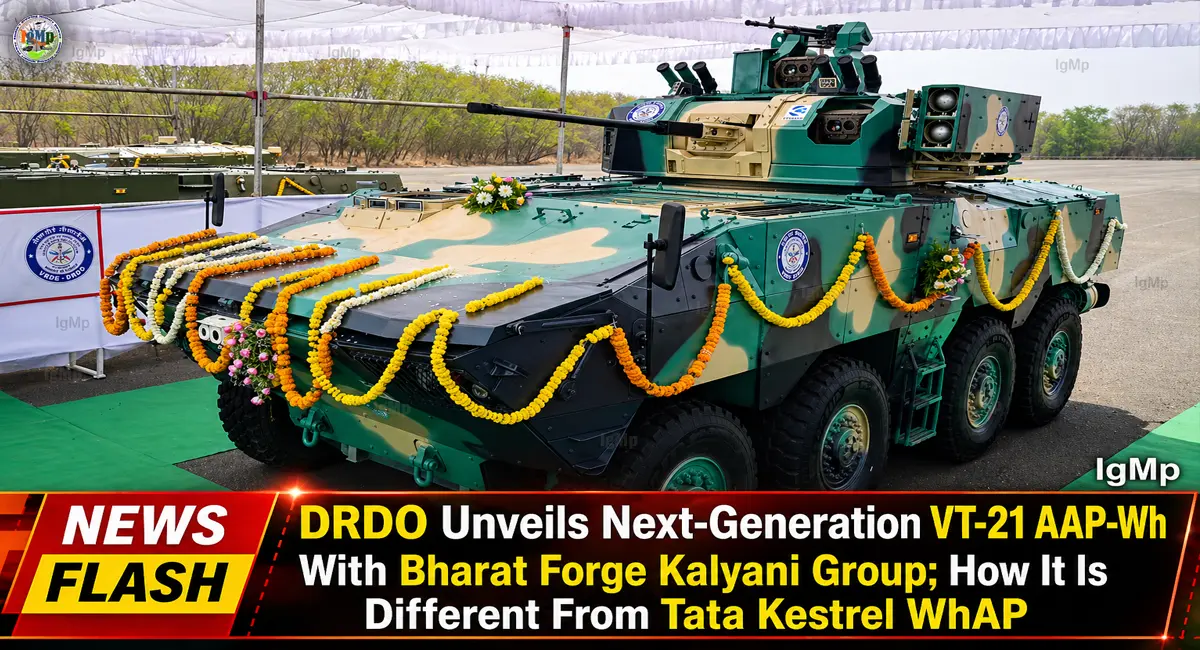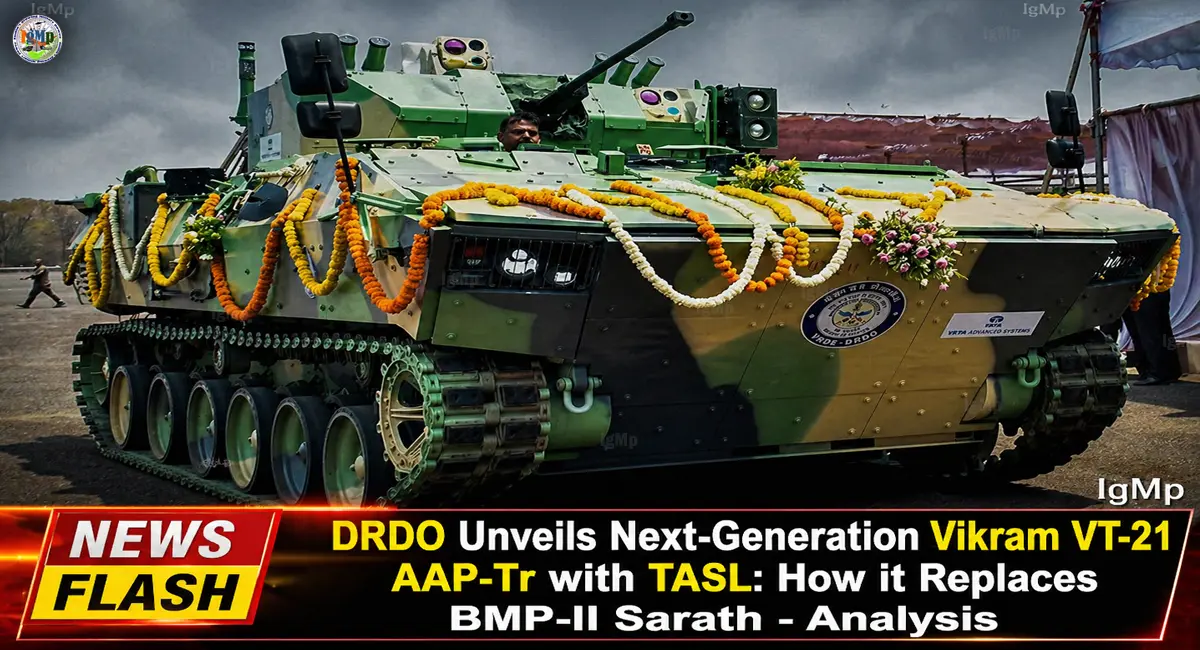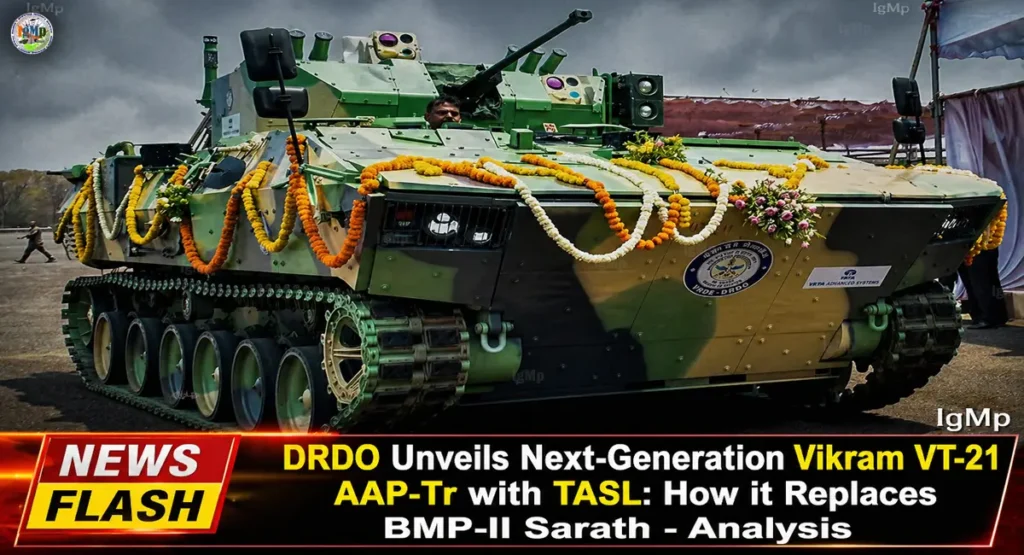
The Vikram VT-21 AAP-Tr (Tracked) is India’s next-generation Infantry Combat Vehicle developed by DRDO and Tata Advanced Systems Limited (TASL). Introduced in April 2026, it is designed to replace the ageing BMP-II Sarath, offering a 750hp engine, STANAG Level 5 protection, a crewless turret, and Nag Mk-2 missile integration.
This platform represents a major shift in India’s mechanized warfare doctrine. Instead of upgrading a 1980s-era vehicle again, the Army now wants a true Gen-2 tracked combat platform built for future battlefield conditions.
TASL serves as the Development cum Production Partner (DCPP) for the project, while DRDO leads the design effort through its combat vehicle research ecosystem. The goal is clear: create a survivable, heavily armed, and mobile infantry vehicle for plains, deserts, and high-altitude sectors.
The biggest advantage of the VT-21 AAP-Tr is not just better armour or stronger weapons. It is the move toward a safer battlefield design where crew protection becomes the first priority.
The Generational Leap: Vikram VT-21 AAP-Tr vs BMP-II Sarath
The BMP-II Sarath served the Indian Army for decades and proved reliable in multiple terrains. However, its design belongs to another era. Modern warfare demands stronger protection against drones, anti-tank missiles, mines, and urban combat threats.
The VT-21 AAP-Tr solves this gap by replacing legacy mobility and thin protection with a much stronger tracked platform. Its biggest battlefield improvement comes from the crewless turret, which keeps soldiers inside the protected hull during combat.
That single change improves survival rates far more than a simple armour upgrade. In the BMP-II, turret exposure created major operational risk during direct engagement.
The new platform also brings better firepower, stronger electronics, and improved battlefield awareness. It is not an upgrade of the BMP-II. It is a full generational replacement.
| Feature | BMP-II Sarath | Vikram VT-21 AAP-Tr |
|---|---|---|
| Engine Power | 300 hp | 750 hp |
| Turret Type | Manned Turret | Crewless Remote Turret |
| Protection | Limited Legacy Armour | STANAG Level 5 |
| ATGM Integration | Older Konkurs System | Nag Mk-2 (Prospina) |
| Hull Structure | Steel Armour | Composite CFRP + Advanced Hull |
This comparison explains why the Army sees the VT-21 AAP-Tr as a battlefield necessity rather than a modernization option.
VT-21 AAP-Tr vs BMP-II: Firepower and Nag Mk-2 Integration
Firepower defines whether an infantry combat vehicle can survive first contact. The VT-21 AAP-Tr improves this area significantly with its indigenous crewless turret and advanced missile integration.
The platform carries a modern 30mm cannon system supported by better fire control and battlefield optics. More importantly, it integrates the Nag Mk-2 (Prospina) anti-tank guided missile, giving it true tank-hunting capability.
This changes the vehicle’s role completely. The BMP-II mainly supported infantry movement and limited anti-armour action. The VT-21 AAP-Tr can actively shape the battlefield by engaging enemy armour before troops dismount.
The crewless turret also protects operators from direct exposure. This is the single most important safety improvement over the BMP-II and the clearest answer to why the VT-21 AAP-Tr matters.
Indian industry support also strengthens this system. Ammunition and integration support from domestic production chains reduce long-term dependence on imported battlefield systems.
How the VT-21 AAP-Tr Composite Hull Survives IED Blasts
Survivability is where the tracked platform shows its deepest engineering advantage. The vehicle uses advanced composite materials such as CFRP (Carbon Fiber Reinforced Plastic) along with specialized structural design for stronger blast resistance.
DRDO also uses the Vacuum Assisted Resin Transfer Moulding (VARTM) process in key sections. This manufacturing method improves structural strength while reducing excess weight. It is a high-expertise process rarely discussed outside specialist defence analysis.
This lighter but stronger hull improves both protection and mobility. The vehicle gains better resistance against mine blasts, roadside IEDs, and fragmentation attacks without carrying unnecessary weight.
It also supports STANAG Level 5 protection, which is critical in modern combat zones where underbody blast threats have become routine.
The 750 hp power-pack adds another major advantage. It gives the vehicle a stronger power-to-weight ratio, which becomes essential in high-altitude sectors like Ladakh, where the BMP-II’s 300 hp engine often struggled during demanding maneuvers.
This combination of mobility and protection makes the VT-21 AAP-Tr far more suitable for future conflict zones across India’s northern borders.