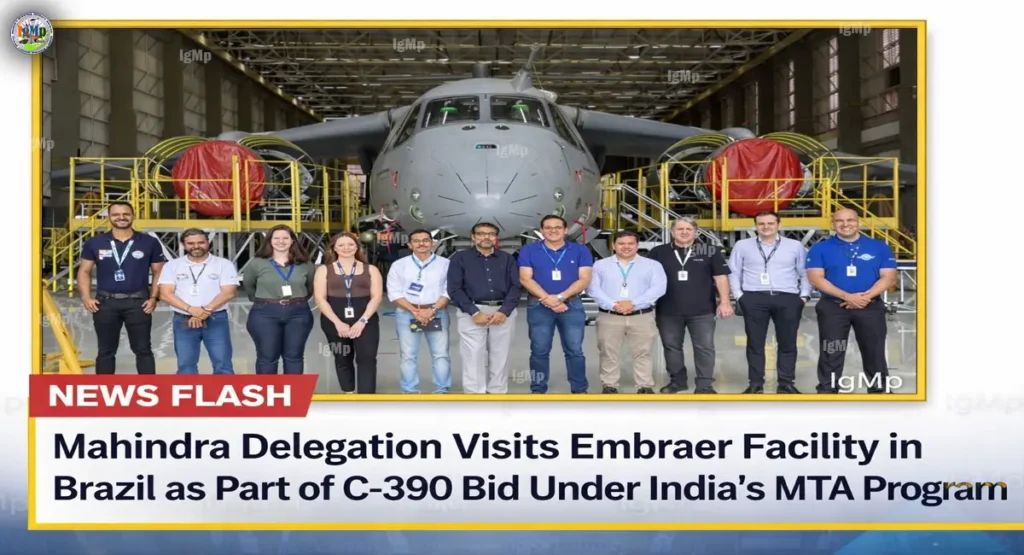
The Indian Air Force’s Medium Transport Aircraft (MTA) program may have just entered a decisive phase. The recent visit by a Mahindra delegation to Embraer’s advanced facility at Gavião Peixoto in Brazil is not just another industrial tour—it’s a signal. A strong one.
This isn’t about optics. It suggests that the C-390 Millennium bid is moving beyond paperwork and into execution-level alignment. And in a competition where operational capability must align with industrial strategy, that shift matters.
More Than a Platform—A Strategic Fit
At first glance, the C-390’s appeal is straightforward: a 26-ton payload combined with near jetliner speeds. But that’s only part of the story.
Speed matters.
In modern operations, it matters more than ever.
Compared to traditional turboprop transports, the C-390’s jet-powered design enables faster troop deployment, quicker disaster response, and reduced turnaround times. For a country like India—with diverse terrain ranging from high-altitude borders to island territories—that flexibility is not just useful, it’s essential.
But here’s where things get interesting: the aircraft is being positioned not just as a capability upgrade, but as an industrial opportunity.
| Feature | C-390 Millennium | C-130J Super Hercules | Airbus A400M |
|---|---|---|---|
| Payload | 26 tons | ~21 tons | ~37 tons |
| Speed | ~870 km/h (Jet) | ~670 km/h | ~780 km/h |
| Engine Type | Turbofan | Turboprop | Turboprop |
| Role Fit (IAF) | Ideal (Balanced) | Slightly Limited | Oversized |
| Industrial Offer | High (India ecosystem) | Limited | Moderate |
The comparison highlights a key reality: the C-390 sits in the “just right” zone. Not underpowered, not oversized.
The C-130J remains battle-proven, but its turboprop limitations in speed are increasingly relevant in time-sensitive operations. The A400M, on the other hand, offers significant lift—but at a cost and scale that may exceed India’s specific MTA requirement.
The C-390 bridges that gap.
Mahindra’s Role: The Real Game-Changer
If the aircraft is the headline, the industrial plan is the real story.
Mahindra Aerostructures is expected to play a central role in:
- Manufacturing structural components in India
- Establishing a regional Maintenance, Repair, and Overhaul (MRO) hub
- Integrating Indian suppliers into Embraer’s global supply chain
This isn’t a typical buyer–seller arrangement. It’s a long-term ecosystem play.
And that aligns directly with India’s “Atmanirbhar Bharat” push.
More importantly, it addresses a long-standing gap in Indian defense procurement: lifecycle independence. Building and maintaining aircraft domestically reduces long-term dependency and creates high-skill aerospace jobs.
The “Engine Sanctions” Debate — Reality vs Perception
One of the most frequently raised concerns is the C-390’s use of the V2500-E5 turbofan engine and its potential exposure to US export restrictions.
But the reality is more nuanced.
The V2500 is produced by International Aero Engines—a multinational consortium involving stakeholders from the US, UK, Germany, and Japan. This distributed ownership structure significantly reduces the likelihood of unilateral control.
Here’s the key point critics often miss:
The same engine family powers a large portion of the global Airbus A320 fleet.
Any restrictive action on this engine would not just affect military platforms—it would ripple across global civil aviation. That makes broad sanctions both economically and geopolitically difficult to enforce.
So while regulatory frameworks like ITAR and CAATSA exist, applying them in this context is far more complex than it appears on paper.
Strategic Implication for India
This deal, if finalized, could quietly reshape India’s military logistics doctrine.
Unlike earlier acquisitions that focused purely on capability, the C-390 proposal emphasizes industrial depth. The involvement of a private sector player like Mahindra signals a broader shift in how India is approaching defense manufacturing.
This is not just about replacing aging aircraft.
It’s about building capacity.
A domestic MRO hub for the C-390 could position India as a regional support center, especially as more countries evaluate the platform in Asia and the Middle East. Over time, this could evolve into an export and sustainment ecosystem—something India has long aimed for but rarely achieved at scale.
Final Take: A Balanced, Future-Ready Choice
The C-390 is not just competing—it is aligning.
It aligns with operational needs through speed and payload balance.
It aligns with industrial goals through local manufacturing and MRO potential.
And it aligns with long-term strategy by reducing dependency risks.
That combination is rare.
The IAF’s MTA decision will ultimately depend on multiple factors—cost, timelines, and geopolitical considerations. But if the current trajectory holds, the C-390 Millennium is no longer just a strong contender.
It is shaping up to be a very practical, very strategic choice.