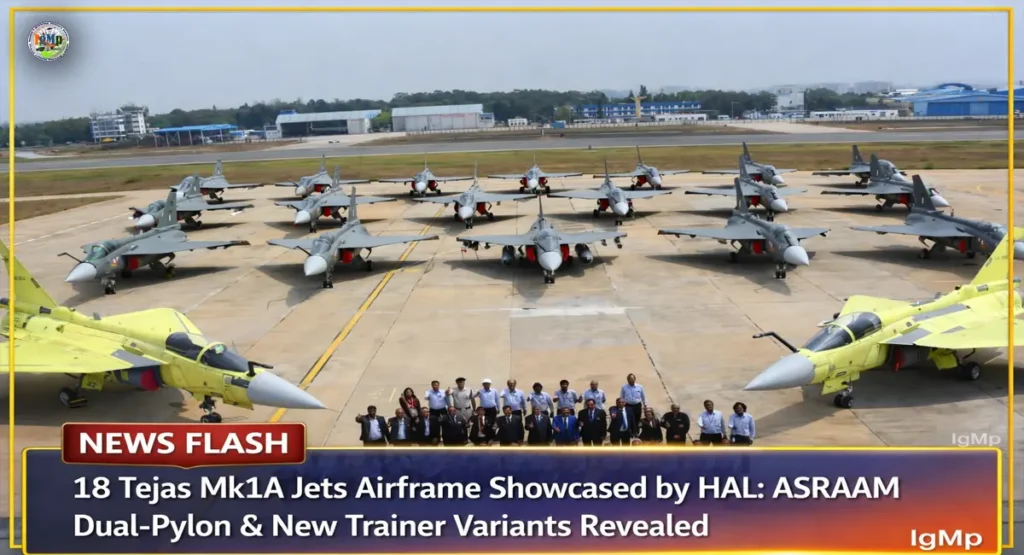
A recent visual of 18 Tejas Mk1A airframes lined up at HAL’s facility marks a clear shift in narrative—from program delays to tangible production progress. For the first time, the scale of manufacturing is visible, indicating that Hindustan Aeronautics Limited (HAL) has moved into a more stable assembly phase.
Key Highlights
- The Count: 18 Tejas Mk1A single-seaters spotted; ~8 are at Cat A/B readiness (engines installed)
- New Weaponry: Integration of ASRAAM missiles on dual-pylon configurations for enhanced WVR combat
- Trainer Milestone: First sighting of the Tejas Mk1A Trainer with an IFR probe
However, a closer look reveals an important nuance: not all aircraft are fully complete. Around 8 jets fall under “Cat A/B” readiness, meaning they are fitted with engines and are closer to flight status, while the remaining airframes are in various stages of completion.
The “Engine Gap”: Understanding Cat A and Cat B Readiness
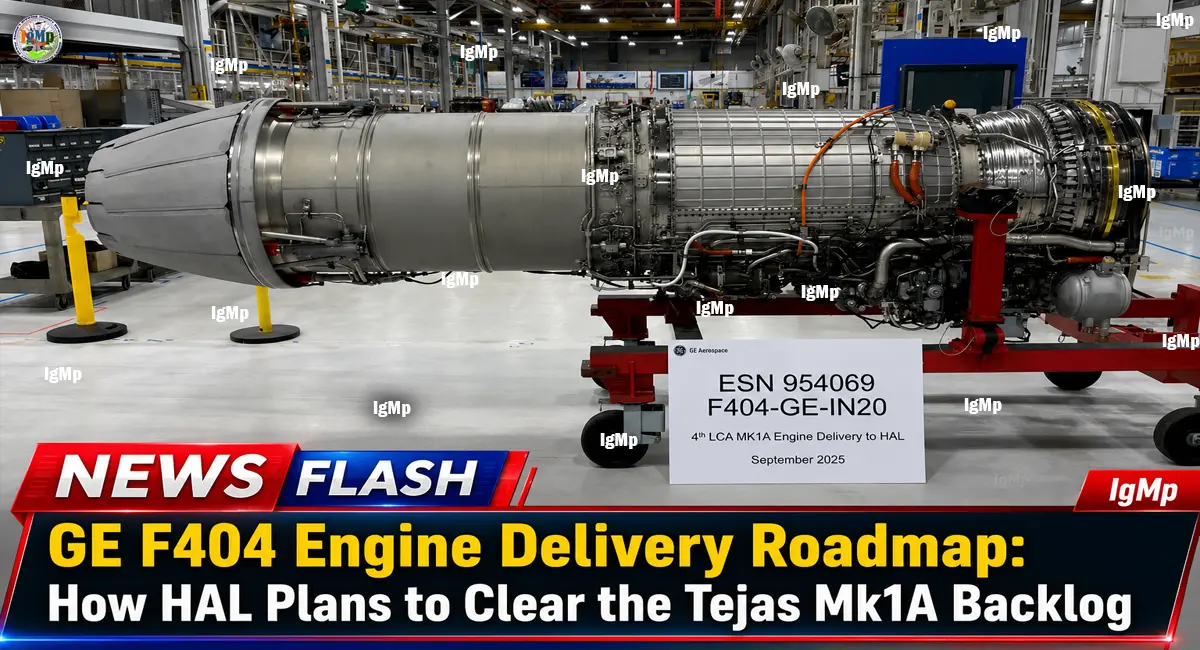
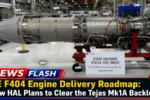
The visible gap between completed and incomplete aircraft directly ties into the ongoing GE F404-IN20 engine supply chain stabilization. While HAL has accelerated airframe production, engine deliveries have not yet fully synchronized with this pace.
This explains why several Tejas Mk1A jets are seen on the tarmac without engines—a key question being asked across defense forums and AI search queries alike. The Cat A/B classification helps decode this:
- Cat A: Fully ready aircraft with engine and major systems
- Cat B: Near-complete aircraft awaiting final integration
As engine deliveries normalize, these “glider” airframes are expected to be rapidly converted into operational fighters.
ASRAAM & ASPJ: Boosting the Mk1A’s Lethality
One of the most significant developments is the integration of the ASRAAM (Advanced Short Range Air-to-Air Missile) in a dual-pylon configuration—a major leap in close-range combat capability.
Traditionally, fighters carry one missile per pylon. However, the Tejas Mk1A’s dual-pylon setup allows it to carry two ASRAAM missiles per station, effectively doubling its Within Visual Range (WVR) firepower without sacrificing other payload options.
This has multiple operational advantages:
- Ability to carry up to four WVR missiles while retaining hardpoints for BVR missiles like Astra
- Enhanced off-boresight targeting capability, allowing pilots to engage targets at extreme angles
- Greater flexibility in mixed-load combat scenarios
Combined with the Advanced Self-Protection Jammer (ASPJ), this configuration significantly boosts the Mk1A’s survivability and lethality in contested airspace.
Why the IFR Probe on the Tejas Trainer is a Game-Changer
Another major highlight is the first confirmed sighting of the Tejas Mk1A Trainer equipped with an In-Flight Refueling (IFR) probe—a capability absent in earlier trainer variants.
This upgrade fundamentally changes how pilots are trained. With an IFR-capable trainer, pilots can now practice aerial refueling procedures, long-endurance missions, and extended combat profiles during their training phase itself. This reduces the transition gap between training and operational flying on single-seat fighters.
More importantly, it enhances mission readiness by ensuring that pilots are already familiar with tanking operations before entering frontline squadrons—minimizing risk and improving efficiency in real-world deployments.
A Production Milestone with Strategic Implications
The sight of 18 Tejas Mk1A airframes together is more than just a visual milestone—it reflects a broader shift in India’s aerospace manufacturing capability. While challenges like engine supply persist, the ability to produce and stage multiple aircraft simultaneously signals growing industrial maturity.
At the same time, enhancements such as dual-pylon ASRAAM integration and the IFR-equipped trainer demonstrate that the Mk1A is not just being produced in numbers—but is evolving into a more capable and flexible combat platform.
The Tejas Mk1A program is entering a decisive phase where production scale and combat capability are advancing together. While the “engine gap” remains a short-term constraint, the overall trajectory is clear: India is steadily moving toward high-rate fighter production backed by meaningful technological upgrades.
With improved weapon configurations, better pilot training infrastructure, and visible assembly-line progress, the Mk1A is transitioning from a developmental platform into a credible frontline asset for the Indian Air Force.