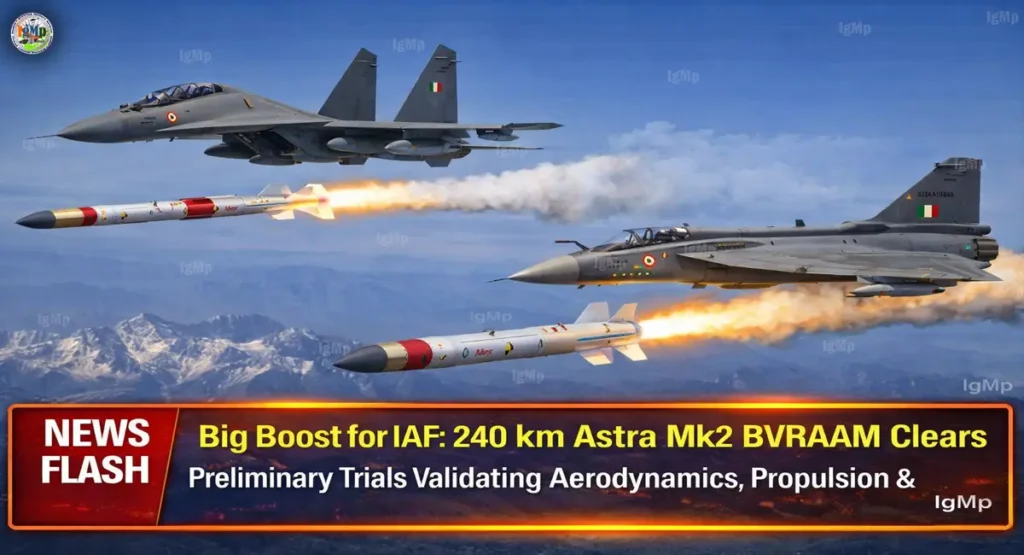
India has quietly crossed a major milestone in air combat capability, with preliminary trials of the Astra Mk2 air-to-air missile indicating a range of nearly 240 km. Developed by Defence Research and Development Organisation, this next-generation BVRAAM is designed to significantly extend the engagement envelope of the Sukhoi Su-30MKI and future indigenous platforms.
This development is not just about range. It reflects a broader shift in India’s air warfare doctrine toward long-range engagement, high-energy interception, and indigenous technological control. In practical terms, this allows the Indian Air Force to detect, track, and engage hostile aircraft well before they enter their own firing range—reshaping the dynamics of beyond-visual-range combat.
The 240km Milestone: What Changes in Air Combat?
A missile with a 240 km reach fundamentally alters aerial engagement strategies. At such distances, combat is no longer about maneuvering within visual range but about who can detect and strike first while maintaining situational awareness.
The Astra Mk2’s extended reach provides a critical advantage by enabling pilots to initiate engagements from safer stand-off distances. This reduces exposure to enemy air defenses and increases survivability during high-threat missions. Additionally, the missile incorporates a 2-way datalink, allowing continuous communication between the aircraft and the missile even after launch.
This capability introduces a new level of flexibility in combat. Pilots can adjust the missile’s trajectory mid-flight, reassign targets if the battlefield situation changes, and receive real-time updates on engagement status. In a network-centric warfare environment, where targets are mobile and electronic interference is common, this adaptability becomes essential rather than optional.
How the Dual-Pulse Motor Expands the No Escape Zone
The Astra Mk2’s performance is significantly enhanced by its dual-pulse solid rocket motor, a feature that directly impacts how effectively it can neutralize targets.
Unlike traditional single-pulse motors that expend all their energy early in flight, the dual-pulse system divides propulsion into two stages. The first pulse propels the missile toward the target area, while the second pulse activates during the terminal phase, closer to interception.
This design allows the missile to conserve energy during cruise and retain high speed when it matters most—during the final approach. The result is a substantial expansion of the No Escape Zone (NEZ), which defines the range within which a target cannot evade the missile.
The advantage is not just theoretical. A missile that retains high kinetic energy near the target is far more effective against maneuvering aircraft or those attempting to disengage. It ensures that even if the target performs evasive maneuvers, the interceptor still has the speed and agility required to complete the engagement.
AESA Seeker Tech: Seeing Through Electronic Warfare
A major technological leap in the Astra Mk2 is its indigenous AESA seeker, which represents a significant upgrade over earlier generation guidance systems.
This seeker uses digital beamforming, a method that allows the missile to electronically steer its radar beams with high precision. Unlike mechanically steered systems, this enables faster target acquisition, better tracking accuracy, and the ability to operate effectively in electronically contested environments.
The implications are substantial. The AESA seeker enhances resistance to jamming and improves the missile’s ability to detect targets with low radar signatures. In modern air combat, where electronic warfare systems are designed to confuse or blind incoming missiles, this level of resilience is critical.
Rather than relying solely on initial targeting data, the Astra Mk2 can continuously refine its tracking solution, ensuring higher accuracy even against advanced adversaries.
Astra Mk2 vs PL-15, PL-15E & Meteor: A Real Comparison
When compared to its global counterparts, the Astra Mk2 stands out not just for its range but for its operational flexibility and independence.
| Missile | Range | Key Feature | Limitation |
|---|---|---|---|
| Astra Mk2 | 240 km | Dual-pulse + AESA seeker | Indigenous integration phase |
| PL-15E (Export) | ~145 km | Long-range Chinese BVRAAM | Reduced export performance |
| PL-15 (China) | 200–300 km | Advanced long-range capability | Limited transparency |
| Meteor | 200+ km | Ramjet propulsion | End-use restrictions |
While the Chinese PL-15 offers comparable range on paper, its export variant used by Pakistan operates at reduced capability. The European Meteor, though highly capable, comes with strict end-use monitoring conditions that limit operational autonomy.
In contrast, the Astra Mk2 provides India with a long-range missile that is free from external restrictions and fully adaptable to domestic requirements. This independence is a critical factor in sustained combat readiness and strategic planning.
LCA Tejas vs Su-30MKI Integration: The Bigger Ecosystem
The Astra Mk2 is initially being integrated with the Sukhoi Su-30MKI, particularly under the upcoming Super Sukhoi upgrade program. This includes the integration of advanced avionics and the indigenous Virupaksha AESA radar, which will further enhance detection and engagement capabilities.
At the same time, efforts are underway to integrate the missile with the HAL Tejas Mk1A. This requires updates to flight control software and mission systems, but once completed, it will significantly boost the Tejas platform’s BVR combat capability.
By deploying the Astra Mk2 across multiple aircraft types, the Indian Air Force is moving toward a more unified and networked combat ecosystem, where different platforms can share targeting data and coordinate engagements seamlessly.
Mass Production Push: From Limited Buys to Scaled Firepower
Another important aspect of the Astra Mk2 program is the shift toward large-scale production. India is planning to induct these missiles in significant numbers, marking a departure from the earlier approach of limited foreign procurement.
This move toward indigenous mass production ensures not only cost efficiency but also operational sustainability. A larger inventory allows for better preparedness in prolonged conflict scenarios and reduces dependence on external suppliers during critical periods.
Strategic Insight
The Astra Mk2 represents a decisive step forward in India’s air combat capability. With its extended range, dual-pulse propulsion, advanced seeker technology, and real-time datalink, it is designed to operate effectively in modern, high-threat environments.
More importantly, it reflects a broader transition toward self-reliance and technological depth in defense manufacturing. As integration progresses across platforms like the Su-30MKI and Tejas, the missile will play a central role in shaping India’s future air dominance strategy.
In beyond-visual-range warfare, success is determined not just by how far a missile can travel, but by how effectively it can adapt, track, and strike at the critical moment.