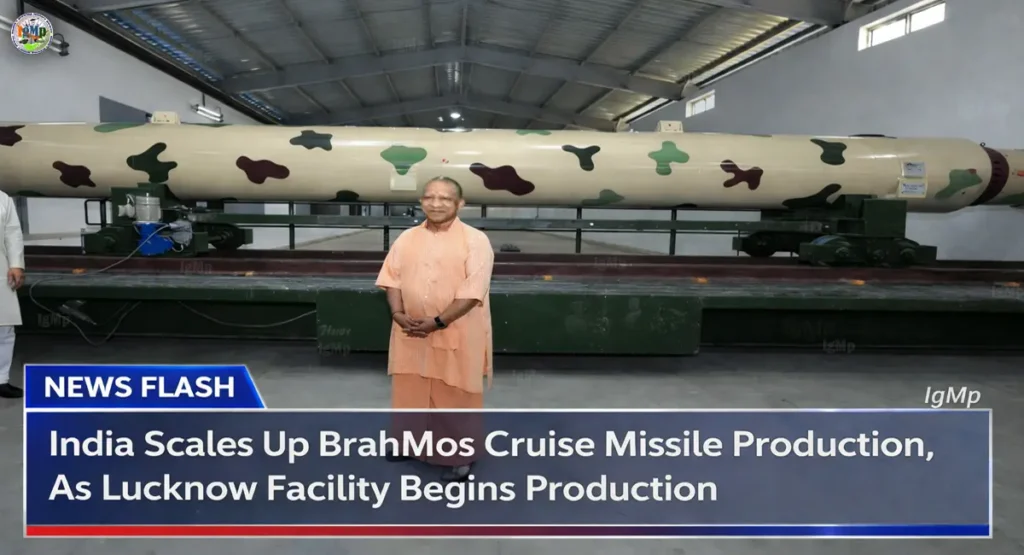
India has begun production of the BrahMos supersonic cruise missile at its new Lucknow facility. Reports confirm that the Indian Army received the first batch in April 2026. This development marks a clear shift toward high-rate indigenous defence manufacturing under Atmanirbhar Bharat. It also accelerates the transition to the lighter BrahMos-NG, which will expand deployment across multiple air platforms.
Why the Lucknow BrahMos Facility Matters for India’s Defence Strategy
Lucknow’s new unit changes how India produces advanced missiles. It focuses on scale rather than limited assembly. This approach allows faster output during both peacetime and conflict.
India now strengthens its ability to maintain large missile stockpiles. Modern conflicts demand sustained precision strikes over extended periods. This facility directly supports that requirement.
The plant also anchors the UP Defence Industrial Corridor. This corridor links multiple industrial nodes and suppliers into one ecosystem. Local MSMEs now contribute components, logistics, and support systems. This reduces dependency on external suppliers and improves supply chain resilience.
From a strategic perspective, this shift builds a deeper industrial base. It also prepares India for long-duration military operations where replenishment speed becomes critical.
What is BrahMos-NG and How Does It Change Air Combat Capability?
Definition: The BrahMos-NG is a compact, lighter supersonic cruise missile designed for higher speed, flexible deployment, and integration with smaller aircraft.
The current BrahMos missile delivers high impact but limits aircraft payload flexibility. Its weight restricts how many missiles a fighter can carry. The new NG variant solves this limitation.

Aircraft like the HAL Tejas will now carry this missile. This was not feasible with the earlier version. Even heavier platforms like Su-30MKI will carry more missiles per sortie.
| Feature | Current BrahMos | BrahMos-NG |
|---|---|---|
| Weight | ~3 Tonnes | ~1.5 Tonnes |
| Length | ~9 meters | ~6 meters |
| Speed | Mach 2.8 | Mach 3.5+ |
| Platforms | Su-30MKI (1–2) | Tejas / Su-30MKI (4–5) |
| Production | Hyderabad/Nagpur | Lucknow |
This improvement increases strike density without increasing mission risk. It allows aircraft to hit multiple targets in a single sortie.
How the Defence Corridor Builds a Self-Reliant Ecosystem
The UP Defence Industrial Corridor plays a central role in this expansion. Lucknow operates as a key node within this network. Other cities contribute manufacturing, assembly, and component supply.
This distributed model offers clear advantages. It improves production efficiency and reduces bottlenecks. It also enables faster scaling when demand rises.
Our analysis suggests that this ecosystem approach strengthens India’s defence autonomy. It ensures that production does not depend on a single facility or supplier. It also encourages private sector participation in high-value defence manufacturing.
Operational Lessons and Future Roadmap
Recent operational requirements have shaped this project’s urgency. Military planners now prioritize stockpile depth and rapid replenishment. These factors influence readiness during high-intensity scenarios.

The Lucknow facility directly addresses this need. It supports surge production when demand spikes. This capability plays a critical role in modern warfare.
The BrahMos-NG will further expand India’s strike options. It supports integration with future platforms like the AMCA. This ensures long-term relevance across evolving combat systems.
A few key developments will define the next phase:
- 2026 marks initial production and deployment
- 2027 may see full-scale BrahMos-NG manufacturing
- Future integration will expand across air and naval platforms
India now moves toward a model that combines speed, scale, and self-reliance. Lucknow’s BrahMos facility reflects that shift clearly.