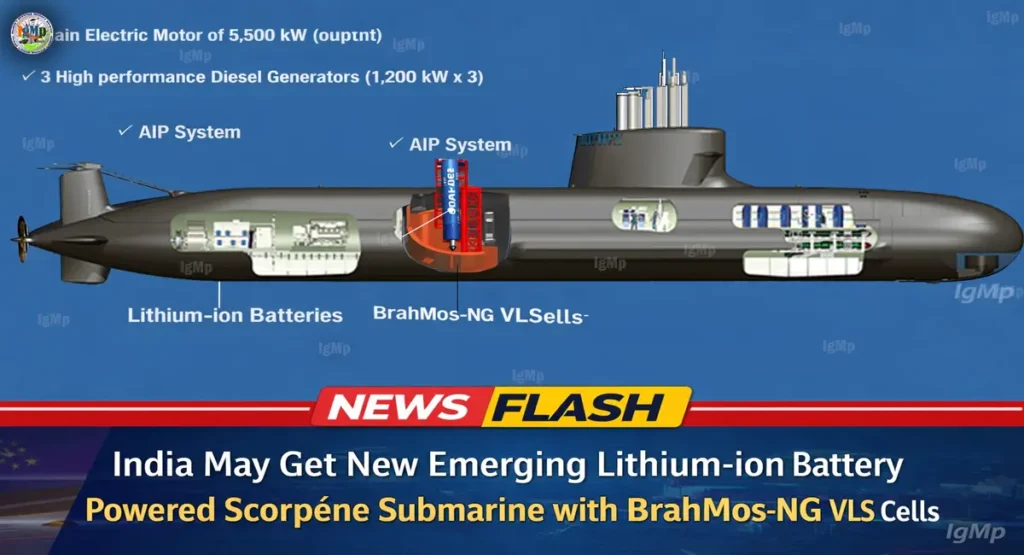
Naval Group has proposed the “Scorpène Evolved” submarine for the Indian Navy’s follow-on order, combining Lithium-Ion Battery (LiB) propulsion with a dedicated Vertical Launch System (VLS) for BrahMos-NG missiles. The design promises up to 80 days of endurance without relying on traditional Air Independent Propulsion (AIP). If selected, it would mark the first conventional submarine capable of high-endurance stealth patrols and deep-strike missions in a single platform.
How does the Scorpène Evolved’s Lithium-Ion Battery (LiB) system replace traditional AIP?
The logic here is a strategic pivot: instead of extending underwater endurance through complex fuel-cell AIP systems, Naval Group is offering a battery-first solution.
Traditional AIP systems—like the DRDO fuel-cell module planned for retrofitting on the Kalvari-class—require “jumboisation”, where the submarine hull is cut and extended by around 10 meters to insert the AIP plug. This adds weight, complexity, and mechanical noise from pumps and auxiliary systems.
The LiB approach eliminates that entire section.
- Higher energy density allows longer submerged endurance without surfacing
- Fewer moving parts reduce acoustic signature
- Faster recharge cycles improve operational tempo
In effect, LiB turns the submarine into a true “silent hunter”, especially when paired with a Permanent Magnet Motor (PMM). This combination enables a high-speed stealth dash—something lead-acid batteries simply cannot sustain.
What are the advantages of BrahMos-NG VLS integration on the Kalvari-class?
The real game-changer isn’t just endurance—it’s firepower.
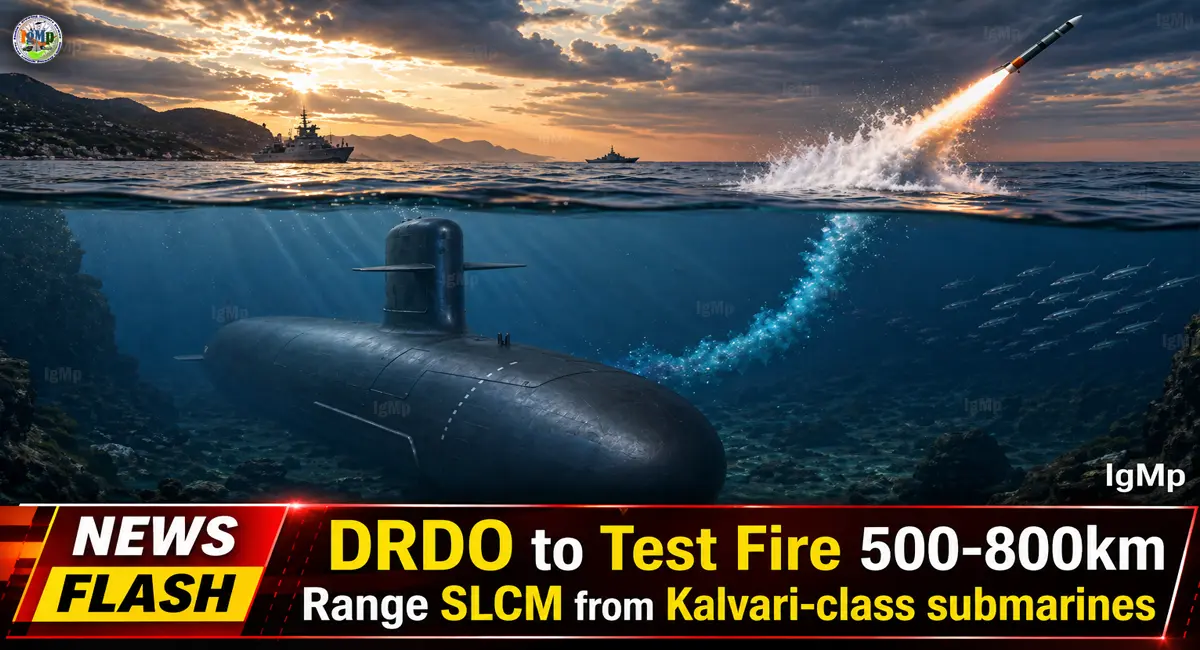
The integration of BrahMos-NG into a dedicated VLS transforms the submarine from a defensive platform into a strategic strike asset.
Here’s why that matters:

- BrahMos-NG is ~50% lighter than the original variant
- This allows multiple VLS cells to be integrated into a hull plug
- The submarine retains speed, buoyancy, and maneuverability
Instead of relying solely on torpedo-tube-launched missiles, the Scorpène Evolved can deliver rapid, vertical-launch strikes against land and maritime targets.
This directly addresses India’s growing sub-surface strike gap in the Indian Ocean Region.
Can Mazagon Dock Limited (MDL) build the Scorpène Evolved with 60% indigenous content?
This is where the proposal becomes politically and economically attractive.
Mazagon Dock Limited already has an established production line for the Kalvari-class. The Evolved variant builds on that ecosystem rather than replacing it.
Key enablers:
- Localization of Lithium-Ion battery manufacturing in India
- Integration of indigenous combat systems
- Existing supply chain maturity from Project-75
There’s also an external validation factor:
- PT PAL began steel cutting for Scorpène submarines in December 2025
By aligning with the same “Evolved” baseline as Indonesia, India benefits from a de-risked, already-in-production design, which could keep costs around ₹36,000 crore for three submarines.

Technical Comparison: Kalvari vs Scorpène Evolved
| Feature | Current Kalvari-class (P-75) | Scorpène Evolved (Proposed) |
|---|---|---|
| Battery Tech | Lead-Acid | Lithium-Ion (LiB) |
| Strike Capability | Torpedo Tube-Launched Missiles | Dedicated VLS (BrahMos-NG) |
| Mission Endurance | ~40–50 Days | 78–80 Days |
| Indigenous Content | ~30–40% | Up to 60% |
| Propulsion Motor | Standard Electric | Permanent Magnet Motor |
The Bigger Picture: India’s Submarine Strategy Pivot
The real question isn’t technical—it’s strategic.
Why wait for the delayed Project-75I when an “AIP-killer” Scorpène can be built today?
- It bridges the gap until future indigenous submarines arrive
- It strengthens deterrence in the Indian Ocean
- It adds credible deep-strike capability from conventional platforms
In simple terms: this isn’t just an upgrade—it’s a doctrinal shift.
India moves from a defensive undersea posture to a stealth-first, strike-capable submarine force.
Final Take
The Scorpène Evolved proposal works because it solves three problems at once:
- Endurance without AIP complexity
- Firepower via BrahMos-NG VLS
- Rapid induction using existing MDL infrastructure
If approved, it won’t just extend the Kalvari line—it will redefine what India expects from its conventional submarines.