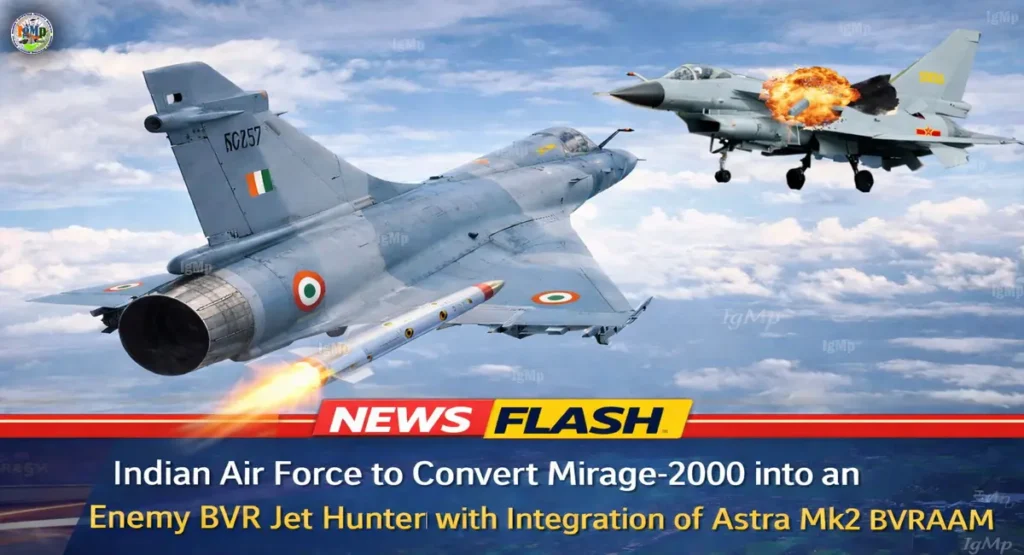
As per defence sources, an ongoing feasibility study between the Indian Air Force and Defence Research and Development Organisation (DRDO) is evaluating the integration of the Astra Mk2 BVRAAM onto the Mirage-2000 fleet, with projected engagement ranges extending between 180–240 km under optimal conditions. This expanded “sniper envelope,” achievable primarily in high-altitude launch profiles, could allow the IAF’s Vajra fighters to outrange most regional threats, including advanced Chinese systems like the PL-15. If these projections translate into operational capability, the upgrade would effectively reposition the Mirage-2000 into the ultra-long-range interceptor category, extending its combat relevance well into the next decade.
How does the 240 km range of Astra Mk2 change the IAF’s BVR doctrine?
The math for regional air combat has been rewritten in subtle but important ways.
At a projected engagement envelope of 180–240 km, the Astra Mk2 shifts the focus from reactive engagements to proactive dominance. Instead of entering contested airspace and responding to threats, aircraft equipped with such missiles can shape the engagement long before adversaries are in a position to respond effectively. The Mirage-2000, traditionally seen as a multirole platform with strong but conventional BVR capability, begins to function more like a long-range interceptor controlling engagement geometry.
This transition is not just about range, but about decision advantage. Pilots operating within this extended envelope gain the ability to engage targets earlier, force defensive maneuvers, and disrupt enemy formations before they can execute their own attack plans. In essence, air combat begins to favor the side that can see, track, and shoot first—well beyond traditional BVR distances.
Mirage-2000 vs. PL-15: Can the Astra Mk2 secure air superiority?
China’s PL-15 has long defined the upper tier of beyond-visual-range missile capability in the region. However, the Astra Mk2’s projected envelope begins to challenge that dominance—not necessarily by exceeding raw range in all conditions, but by optimizing how that range translates into actual combat effectiveness.
The defining factor here is the expansion of the No-Escape Zone (NEZ). At distances approaching 200 km, many missiles lose significant kinetic energy, reducing their ability to track and intercept maneuvering targets. The Astra Mk2’s dual-pulse propulsion system addresses this limitation by sustaining energy deeper into the engagement.

- The second pulse activates during the terminal phase, restoring speed and maneuverability
- This allows the missile to retain enough energy for high-G interception even at extended ranges
As a result, the Astra Mk2 is designed not just to reach distant targets, but to remain lethal when it gets there—an important distinction in real-world combat scenarios.
The Physics of 240 km: Understanding the dual-pulse motor advantage
The much-discussed 240 km figure is not a fixed operational range, but a performance ceiling achieved under specific flight conditions. High-altitude launches play a decisive role in enabling this capability.
At altitudes above 35,000 feet, the atmosphere is significantly thinner, which reduces aerodynamic drag and allows the missile to maintain higher speeds over longer distances. In this environment, the Astra Mk2 can cruise efficiently before activating its second pulse in the terminal phase, effectively extending both range and lethality.
Equally important is the missile’s guidance architecture. The Dassault Mirage 2000 uses its RDY-2 radar to provide mid-course updates, ensuring the missile remains on an optimal intercept path. As the engagement enters its final stage, the Astra Mk2’s onboard AESA seeker takes over, independently tracking and locking onto the target in the last 20–30 km. This transition is critical for maintaining accuracy at extreme distances where external guidance alone would be insufficient.
Technical Comparison: MICA vs Astra Mk1 vs Astra Mk2
| Feature | MICA (Current) | Astra Mk1 | Astra Mk2 (Projected) |
|---|---|---|---|
| Max Range | ~60–80 km | ~110–160 km | 180–240 km |
| Operational Class | Medium-Range | BVR | Ultra-Long Range (ULR) |
| Propulsion | Single Pulse | Single Pulse | Dual-Pulse Solid Motor |
| Primary Advantage | Dogfight Flexibility | Indigenous Supply | Standoff Dominance |
Why the Mirage-2000 is still relevant in 2026
Despite being a 4th-generation platform, the Mirage-2000 continues to demonstrate remarkable adaptability. Its aerodynamic performance, especially at higher altitudes, combined with ongoing avionics upgrades, makes it particularly well-suited for long-range interception roles.
Rather than viewing the aircraft as legacy equipment, the IAF is effectively repurposing it into a modern weapons platform capable of leveraging next-generation missiles. This approach allows India to extract greater value from existing assets while bridging capability gaps until newer platforms enter service.
The Bigger Picture: India’s Long-Range Air Combat Ecosystem
The Astra Mk2 is not being developed in isolation; it represents a key component of a broader shift toward long-range engagement capability within the Indian Air Force.
- Mirage-2000 can operate as a high-altitude interceptor
- Su-30MKI provides range, payload, and persistence
- Future platforms will further extend engagement distances
This layered approach ensures that India’s air combat doctrine evolves toward a model where range, sensor fusion, and missile performance collectively define air superiority, rather than platform generation alone.
The Astra Mk2’s projected 180–240 km envelope represents a significant evolution in India’s BVR capability, but its true impact lies in how it reshapes engagement dynamics rather than just extending range figures.
By expanding the No-Escape Zone, improving terminal performance, and enabling earlier engagement opportunities, the missile transforms how platforms like the Mirage-2000 can be deployed in contested airspace. If validated through trials, this combination of range and lethality could turn a proven but aging fighter into one of the most strategically valuable assets in the IAF’s inventory.