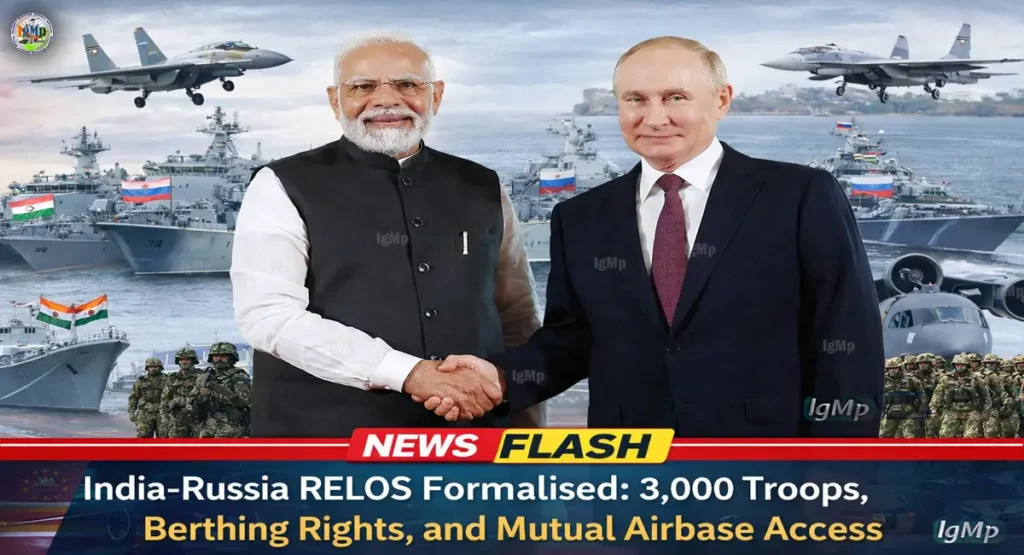
India and Russia have officially formalised the Reciprocal Exchange of Logistics Agreement (RELOS), a strategic pact that enables the mutual stationing of up to 3,000 military personnel and grants reciprocal access to each other’s military infrastructure. Ratified following approval by Vladimir Putin on April 18, 2026, the agreement allows both nations to use naval ports, airbases, and airspace for logistics, training, and operational support. Rather than a combat alliance, RELOS is designed to reduce logistical friction and streamline cooperation between two long-standing strategic partners.
What Is the India-Russia RELOS Agreement Formalised in April 2026?
At its core, RELOS is a logistics-sharing framework. It allows India and Russia to access each other’s military facilities for refuelling, replenishment, maintenance, and transit without requiring case-by-case approvals.
The formalisation of RELOS effectively turns the India-Russia partnership into a logistical peer arrangement. By allowing up to 3,000 personnel to be stationed for defined purposes such as training, technical support, and joint exercises, both countries remove bureaucratic delays that previously slowed down deployments.
Importantly, the agreement is not a mutual defence treaty. It does not obligate either side to participate in military conflicts. Instead, it focuses on enabling smoother coordination during peacetime operations, exercises, and contingency scenarios such as evacuations or humanitarian missions.
How Do Reciprocal Berthing Rights Benefit the Indian Navy?
The naval dimension of RELOS is where its strategic impact becomes most visible. Reciprocal berthing rights mean that Indian warships can dock at Russian ports for logistics and sustainment, just as Russian vessels can access Indian facilities.
For the Indian Navy, this expands operational reach into regions that were previously logistically constrained. Access to Russian ports in the Arctic and the Pacific—particularly hubs like Vladivostok—opens new pathways for extended deployments.
This has two major implications:
- It reduces dependence on narrow maritime chokepoints by offering alternative logistical routes
- It enables longer-duration deployments without requiring immediate return to Indian bases
In a broader sense, this enhances India’s ability to operate as a blue-water navy, sustaining presence across multiple theatres without overextending its supply chain.

Will India and Russia Station Troops in Each Other’s Territory?
The provision allowing up to 3,000 personnel is often misunderstood. This is not about permanent troop deployment, but about flexibility.
The cap is designed to support:
- Large-scale joint exercises such as the INDRA series
- Technical teams maintaining Russian-origin systems like the S-400 Triumf
- Training detachments and rotational deployments
It also has a strong humanitarian dimension. In scenarios involving disaster relief or evacuation operations, having pre-approved troop thresholds allows rapid deployment without waiting for diplomatic clearances.
In effect, the personnel clause removes procedural delays while keeping deployments within clearly defined limits.
Airspace and Airbase Access: Extending India’s Strategic Reach
Another critical aspect of RELOS is unrestricted access to airspace and airbases for logistical purposes. This is not limited to combat operations—it primarily supports long-range mobility.
For the Indian Air Force, this means heavy-lift aircraft can use Russian airbases as transit hubs for missions extending into Central Asia, Europe, or even the Arctic region. Aircraft such as strategic airlifters can refuel, rest crews, and continue missions without relying on third-country permissions.
This creates a more resilient and flexible air logistics network, particularly important during crisis situations where time and access are critical.
Why RELOS Matters for India’s Strategic Autonomy
India has signed similar logistics agreements with multiple partners, including Western countries, but RELOS stands out for what it represents geopolitically.
By maintaining logistics interoperability with Russia while also engaging with other global partners, India reinforces its doctrine of strategic autonomy. The goal is not alignment with any single bloc, but the ability to operate across regions without dependency constraints.
The agreement also supports India’s continued reliance on Russian-origin military platforms. Systems like the Sukhoi Su-30MKI benefit from easier access to technical support and spares when operating in extended environments.
Comparison: Key Features of the RELOS Pact
| Feature | India-Russia RELOS Pact |
|---|---|
| Personnel Capacity | Up to 3,000 troops per territory |
| Naval Access | Reciprocal berthing rights at major ports |
| Air Support | Full airspace usage and airbase access |
| Legal Status | Ratified April 2026 |
| Operational Scope | Logistics, training, HADR, joint exercises |
The Strategic Takeaway
The formalisation of RELOS does not change the nature of India-Russia ties overnight—it refines how they function in practice. By simplifying logistics, enabling faster deployments, and expanding operational reach, the agreement strengthens the foundation of an already established partnership.
More importantly, it reflects a broader shift in military strategy, where logistics and access are as critical as firepower. In that sense, RELOS is less about visibility and more about capability—the ability to move, sustain, and operate without delay.
For India, this translates into greater flexibility across regions, reinforcing its position as a power capable of independent and sustained operations in an increasingly complex global environment.