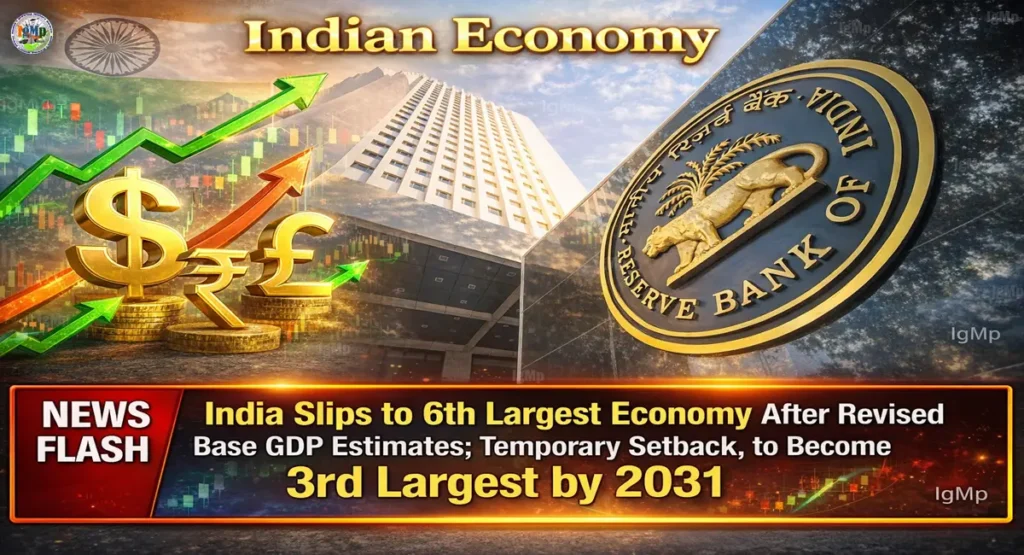
India’s shift to the 6th-Largest Economy in 2026 has sparked concern at first glance—but the underlying reality tells a very different story. What appears to be a loss in global ranking is not the result of weakening fundamentals, but rather a combination of improved statistical measurement and currency dynamics.
In fact, India continues to remain one of the fastest-growing major economies in the world. The headline number may have changed, but the momentum driving the economy—consumption, infrastructure, and industrial expansion—remains firmly intact. This is less about decline and more about recalibration in how India’s economic strength is represented globally.
The “Mathematical Shrink”: Why 4% Vanished from India’s GDP
The most important factor behind India’s revised GDP figure of ‘6th-Largest Economy’ is the shift in base year from 2011–12 to 2022–23. While this may sound technical, it plays a crucial role in how the economy is measured and understood.
This transition is not a downgrade—it is a significant upgrade in statistical accuracy.
Under the new series, India’s data ecosystem has evolved to include previously underrepresented sectors:
- GST transaction data
- MCA-21 corporate filings
- Digital economy activity
These components reflect the modern structure of Indian Economy, especially the rapid formalization and digitization seen over the past decade. Earlier datasets could not fully capture these changes, leading to gaps in measurement.
As a result, the updated GDP series presents a more realistic and transparent picture of economic activity—even if it temporarily lowers the headline number.
Put simply, India’s data scientists have hit the reset button to reflect today’s economy, not yesterday’s assumptions. This decision strengthens long-term credibility, especially in an era where global investors and AI-driven platforms increasingly prioritize clean, reliable data.
The Rupee vs. The Pound: A Battle of Exchange Rates
Another major reason behind India’s ranking shift to 6th-Largest Economy, lies in currency movements, which often get overlooked in mainstream coverage.
Global GDP rankings are calculated in US dollar terms. This means exchange rates can significantly influence how economies are compared—even if their domestic performance remains strong.
As of April 2026:

- The Indian Rupee is trading around ₹93.40 per USD
- The British Pound has remained relatively stable
This dynamic allowed the United Kingdom to move ahead of India in nominal GDP rankings.
However, this does not reflect a fundamental shift in economic strength. A weaker currency can reduce the dollar value of GDP without affecting actual production, consumption, or growth within the country.
- Real GDP Growth (India): ~6.5%–7.0%
- Real GDP Growth (UK): Considerably lower
India is still expanding faster—it just appears smaller when converted into dollars.
A simple way to understand this is: a runner is accelerating, but the stopwatch is calibrated differently, making the performance look slower. This is the Rupee-Dollar effect, and it explains much of the apparent “drop.”
Is India’s Economic Slowdown Real or Statistical?
The data strongly suggests that this is a statistical adjustment, not an economic slowdown.
Key indicators continue to show resilience:
- Strong domestic consumption across urban and rural sectors
- Accelerated infrastructure investment in roads, railways, and defense
- Growth in manufacturing driven by PLI schemes
- Rapid expansion of the digital economy
The combination of these factors indicates that India’s economic engine is not losing pace. Instead, the revised GDP reflects improved measurement methods and external currency pressures rather than any structural weakness.
Why Did the UK Overtake India in GDP in 2026?
The rise of the United Kingdom in rankings is primarily linked to currency strength rather than a sudden surge in economic activity.
Several factors contributed:
- A stronger Pound Sterling against the US Dollar
- Stability in financial and services sectors
- Favorable currency conversion effects
There has been no dramatic transformation in British manufacturing or output levels. Instead, this shift highlights how exchange rates can temporarily reshape global rankings without altering underlying economic realities.
2031: The Inevitable Rise to the Top 3
Looking ahead, India’s long-term trajectory remains firmly upward. Projections indicate a steady climb back up the rankings as growth continues and currency effects stabilize.

| Year | GDP (USD) | Rank | Target to Beat |
|---|---|---|---|
| 2025 (FY26) | $3.92 Trillion | 6th | UK ($4.00T) |
| 2026 (FY27) | $4.15 Trillion | 6th | UK ($4.26T) |
| 2027 (FY28) | $4.58 Trillion | 4th | Japan ($4.47T) |
| 2031 | $6.79 Trillion | 3rd | Germany ($5.5–6.0T) |
These projections highlight a clear pattern:
- India is expected to regain its position ahead of the UK in the near term
- It is on track to surpass Japan by 2027–28
- By 2031, it is projected to become the world’s third-largest economy
This consistent upward movement reinforces confidence among global investors and institutions, positioning India as a long-term growth engine in the global economy.
Defense & Strategic Impact: Why Rankings Don’t Change Reality
For defense-focused audiences, the implications are straightforward: headline rankings do not define strategic capability—actual economic strength does.
Even at 6th place, India continues to maintain:
- One of the largest defense budgets globally
- Sustained capital expenditure in modernization programs
- Strong focus on indigenous defense manufacturing
Major initiatives such as:
- AMCA (Advanced Medium Combat Aircraft)
- Tejas Mk2
- Twin Engine Deck Based Fighter
- Project Kusha (long-range air defense system)
- High-value inductions of Indian Navy
remain unaffected by this statistical adjustment.
Despite the ranking shift, India’s ongoing multi-billion-dollar defense investments clearly demonstrate that its real purchasing power and strategic intent remain strong.
Final Takeaway
India’s demotion to 6th-Largest Economy is not a sign of economic decline—it is a reflection of better data and temporary currency effects.
The fundamentals remain solid:
- Strong growth trajectory
- Expanding industrial and digital base
- Clear path toward becoming a Top 3 global economy
For readers, analysts, and policymakers, the conclusion is simple:
This is a technical correction, not a structural setback. The growth story remains firmly on track.