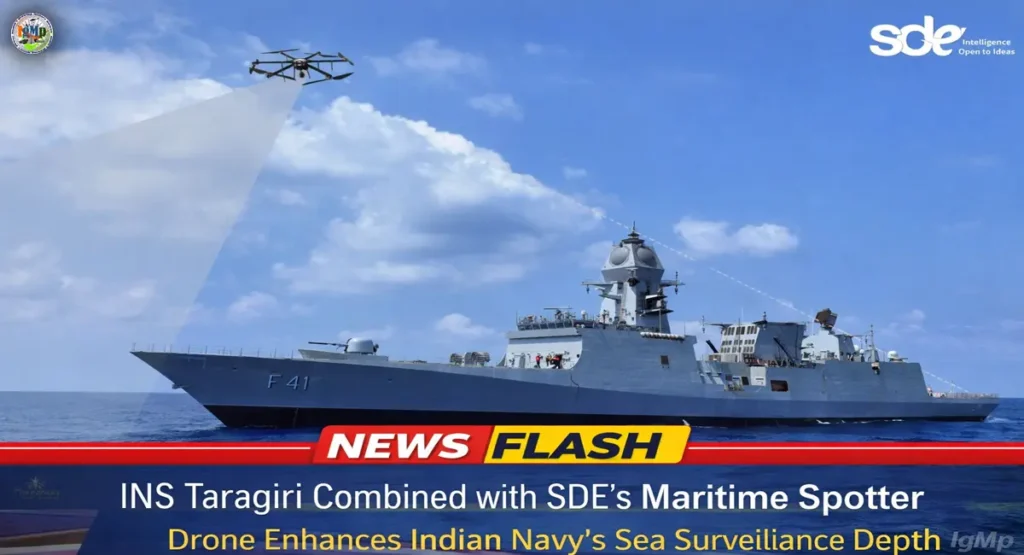
INS Taragiri (F41), a Project-17A stealth frigate built by Mazagon Dock Shipbuilders Limited, integrates a Maritime Spotter Drone made by Sagar Defence Engineering (SDE) that significantly extends its surveillance reach beyond traditional radar limits. Acting as an elevated sensor hub, the drone feeds real-time targeting data into the ship’s combat system, improving detection and engagement timelines. This combination enhances India’s ability to monitor and respond to threats across the Indian Ocean Region with greater precision and speed.
How does the maritime spotter drone close the radar horizon gap?
The biggest limitation of any surface warship is the radar horizon, which is constrained by the curvature of the Earth. Even advanced AESA radars onboard modern frigates cannot detect low-flying or distant threats beyond a certain range. This creates what naval planners have long referred to as the “horizon gap.”
On INS Taragiri, the embarked maritime drone directly addresses this limitation by functioning as an elevated sensor hub. Operating at altitude, it scans a far wider area than ship-based sensors and relays real-time intelligence back to the vessel. This effectively extends the ship’s surveillance envelope well beyond its organic radar capability.
Our analysis of the Project-17A platform suggests that integrating such drones is not just an incremental upgrade but a structural solution to a long-standing operational constraint. Instead of detecting threats at the edge of engagement range, Taragiri can now identify, track, and classify them much earlier, allowing commanders to make informed decisions with greater time and clarity.
How is the drone integrated into INS Taragiri’s combat system?
The real transformation lies in how the drone’s data is used once collected. INS Taragiri is built around a modern Combat Management System (CMS), which integrates inputs from multiple sensors and converts them into actionable combat data.
Tactical Integration and Sensor-to-Shooter Loop
The drone’s ISR feed is directly linked to the CMS, enabling a seamless sensor-to-shooter loop. This means that a target detected by the drone can be rapidly processed, tracked, and engaged using onboard weapons without delay. The integration is further supported by the ship’s advanced onboard systems, including CODOG propulsion for operational flexibility and an Integrated Platform Management System (IPMS) for efficient control.

- Drone data feeds directly into the CMS for real-time targeting
- Enables faster engagement using systems like BrahMos and MRSAM
This tight integration reduces reaction time significantly. Instead of relying on sequential detection and engagement steps, Taragiri can execute near-simultaneous tracking and targeting, which is critical in high-threat environments.
What is the operational impact in modern threat environments?
The relevance of this capability becomes clearer when viewed against current maritime challenges. Today’s naval battlespace includes not just traditional warships but also asymmetric threats such as drones, fast attack craft, and piracy networks.
Asymmetric Threats and Real-World Context
In regions like the Red Sea, Houthi drone attacks have demonstrated how low-cost aerial threats can challenge even advanced naval platforms. Similarly, piracy incidents in the Indian Ocean Region demand persistent surveillance and rapid response capabilities.
- Early detection of drones and small vessels before they pose a direct threat
- Enhanced situational awareness during missions like the MV Ruen anti-piracy operation
In such scenarios, drone-assisted ISR allows commanders to assess threats from a safe distance. For boarding operations, this reduces uncertainty and improves the safety of sailors by providing real-time visual intelligence before engagement.

The result is a shift from reactive to proactive operations, where threats are identified and managed before they escalate.
Why INS Taragiri represents India’s future naval doctrine
INS Taragiri is not just another addition to the fleet; it represents a broader doctrinal shift toward network-centric and indigenous warfare capabilities. With a displacement of around 6,670 tonnes and nearly 75% indigenous content, the ship reflects India’s push for self-reliance under the IDDM framework.
Indigenous Strength and Strategic Integration
Built by Mazagon Dock Shipbuilders Limited, the frigate integrates advanced systems and weapons into a cohesive combat platform. It is also designed to operate within a larger ecosystem that includes long-range missiles, air defence systems, and future programs like Project Kusha.
Rather than functioning as a standalone asset, Taragiri operates as a node in a wider maritime network, contributing to surveillance, deterrence, and strike capabilities across the Indian Ocean Region. This aligns with India’s MAHASAGAR vision of maintaining maritime dominance through integrated and technologically advanced forces.
Ultimately, the addition of a maritime spotter drone transforms the ship’s operational profile. By extending its vision, accelerating targeting, and enhancing survivability, INS Taragiri becomes a true force multiplier—one that strengthens India’s ability to secure its maritime interests in an increasingly contested environment.