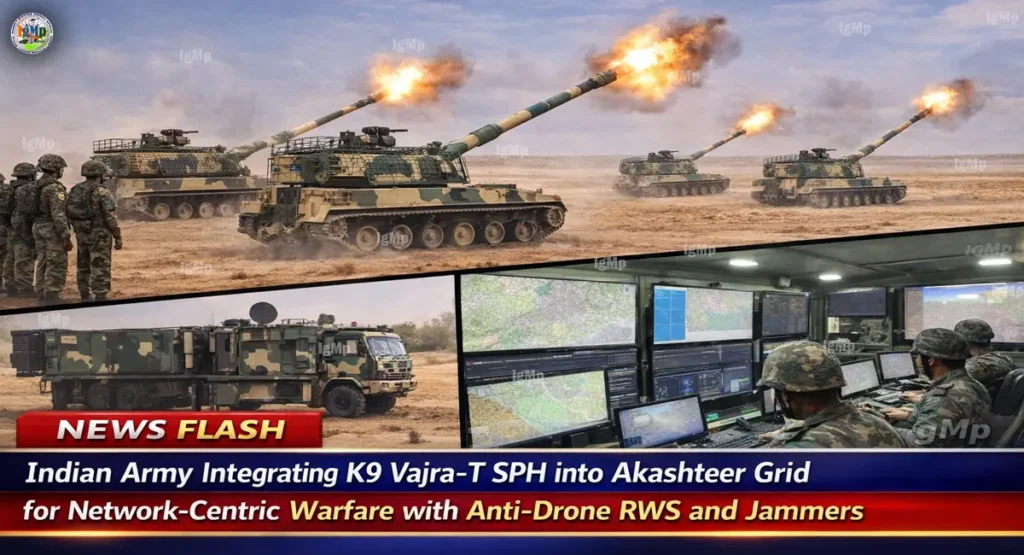
The Indian Army is transforming its K9 Vajra-T 155mm Self-Propelled Howitzer (SPH) into a networked battlefield node capable of surviving the modern drone threat.
Lessons from the Russia-Ukraine war have forced armies to rethink artillery survivability. Cheap FPV drones and loitering munitions now hunt expensive armored platforms. Systems like the Lancet and Harop have shown how vulnerable traditional artillery can be when deployed without layered drone defence.
To counter this threat, the Indian Army plans to integrate the K9 Vajra-T into the Akashteer battlefield air defence network while adding anti-drone protection systems. The goal is simple: turn the howitzer from a static artillery platform into a digitized hunter-killer with its own drone shield.
The Neural Link: Connecting the K9 Vajra-T to the Akashteer Grid
The biggest upgrade does not sit on the turret. It lies in the network.
Project Akashteer forms the backbone of the Indian Army’s network-centric air defence architecture. It connects radars, command nodes, and weapon systems into a single real-time combat grid.
Once linked to Akashteer, the K9 Vajra-T receives early warnings of incoming aerial threats. The system can detect drones, loitering munitions, and helicopters approaching the artillery battery.
This reduces the traditional sensor-to-shooter delay. The howitzer crew gains precious seconds to respond before a drone attack arrives.
Q: How does Akashteer improve the K9 Vajra’s survivability?
A: It provides real-time 360-degree early warning by linking the howitzer to the Army’s centralized air defence grid.
This network integration reflects India’s growing emphasis on digital battlefield awareness and multi-domain combat operations.
The Hard-Kill Layer: Remote Weapon Station and Airburst Ammunition
Early warning alone cannot stop an incoming drone. The K9 must also fight back.
The Indian Army plans to equip the Vajra-T with an indigenous Remote Weapon Station (RWS). This system mounts a machine gun on the turret and allows the crew to engage aerial threats without exposing themselves.

The RWS uses electro-optical sensors and stabilized targeting. The gunner can track small drones and fire controlled bursts.
Crew safety remains a major advantage. The machine gunner operates the weapon from inside the armored hull rather than standing exposed on the turret.
The Army also studies programmable airburst ammunition for close-range drone interception. Such rounds explode near the target and scatter fragments across the drone’s flight path.
Together, these upgrades give the K9 a hard-kill defensive layer against low-flying drones.
The Soft-Kill Shield: Electronic Warfare and Drone Jamming
Hard-kill weapons form only one layer of protection. Electronic warfare adds another defensive ring.
The Indian Army is expected to integrate anti-drone jammers similar to systems used in the D4 counter-drone suite developed by Bharat Electronics Limited.
These systems disrupt the radio frequencies used by hostile drones.
A jammer can break the control link between the operator and the drone. Once the signal collapses, the drone either crashes or returns to its launch point.
This electronic bubble protects artillery units operating near the frontline. It also reduces the risk of drone swarm attacks targeting artillery batteries.
Are “Cope Cages” Enough to Save the K9 Vajra from FPV Drones?
Armies across the world have experimented with “cope cages”, the metal grid structures mounted on armored vehicles to block drone strikes.

These cages provide limited protection. They may deflect certain top-attack munitions. However, modern FPV drones can still maneuver around them.
The Indian Army therefore prefers a layered defence strategy instead of relying on passive armor alone.
| Threat | Countermeasure | Outcome |
|---|---|---|
| FPV Drones | Remote Weapon Station | Hard-kill interception |
| Loitering Munitions | Electronic Jammers | Soft-kill disruption |
| Drone Swarms | Akashteer Early Warning | Faster response |
This layered approach reflects a broader shift toward drone swarm defence and situational awareness.
Analyst Note: Building a Digitized Artillery Fortress
The modernization of the K9 Vajra-T signals a deeper doctrinal shift inside the Indian Army.
Artillery no longer operates as an isolated firepower asset. It now functions as a networked combat node inside a digital battlefield grid.
Akashteer acts as the brain. Jammers and RWS systems form the shield.
Together they create a digitized fortress around India’s 155mm artillery units.
This transformation aligns with India’s broader push for Atmanirbharta in defence technology. Indigenous companies such as Bharat Electronics Limited (BEL) are expected to play a key role in supplying counter-drone systems.
As drone warfare evolves rapidly, artillery survivability will depend on speed, awareness, and layered defence rather than armor alone.
The K9 Vajra-T upgrade marks India’s first major step toward that future.