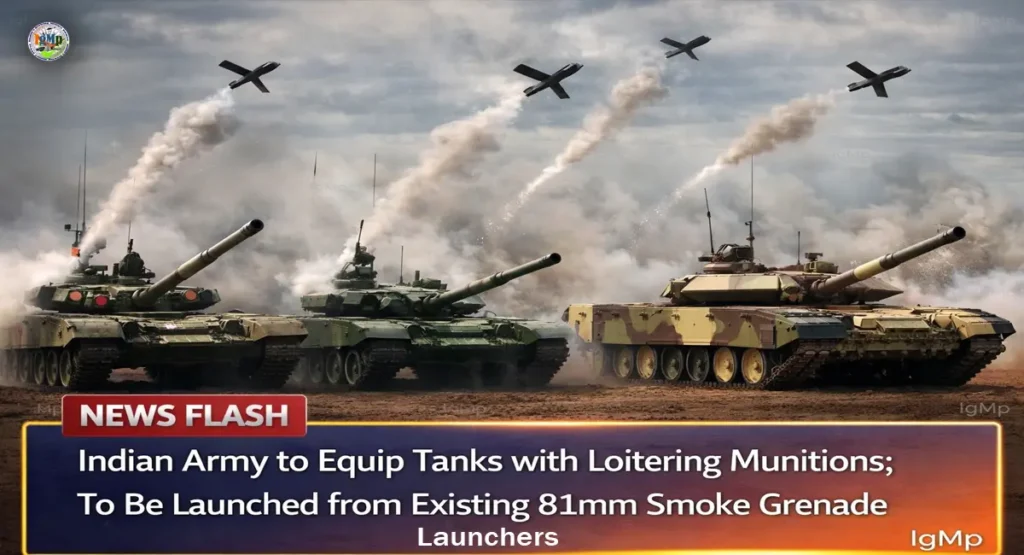
The Indian Army is equipping tanks with loitering munitions because modern battlefields are increasingly dominated by Non-Line-of-Sight (NLOS) ambushes and anti-tank teams operating in defilade positions. Traditional tank optics and line-of-sight engagement limits make it difficult to detect and neutralize such threats before they strike.
Lessons from Ukraine and Nagorno-Karabakh have demonstrated that even heavily armored platforms are vulnerable when situational awareness is limited. By integrating organic BLOS capabilities, tanks can now scout beyond terrain obstacles, identify hidden threats, and engage them proactively—without relying on external drone units or artillery support.
Quick Specs & Purpose
- Platform: T-72, T-90, and Arjun Mk1A MBTs
- Launch Interface: Standard 81mm smoke grenade dischargers (Tucha system)
- Core Need: Organic Beyond Line of Sight (BLOS) strike and reconnaissance capability
- Nodal Agency: iDEX under DISC 14 challenge
This transforms the tank from a purely direct-fire platform into a self-contained reconnaissance-strike system, significantly increasing survivability and battlefield awareness.
The Engineering Challenge: From Smoke to Strike
The most innovative aspect of this program lies in its use of existing 81mm smoke grenade launchers, commonly known as the Tucha system, as deployment tubes for loitering munitions.
This creates a unique engineering challenge. The munition must fit within an 81mm diameter (~3.1 inches) while being robust enough to survive the high-G launch forces generated by a standard smoke discharger. Once ejected, it must safely clear the turret, deploy its wings or rotors, and transition into stable powered flight—all within seconds.
Crucially, this entire process must occur without any crew exposure, allowing the tank to remain fully protected under armor. This “launch-from-within” capability is what makes the concept both tactically powerful and operationally viable.
Zero-Modification Integration: The iDEX DISC 14 Requirement
At the heart of this initiative is the iDEX (Innovations for Defence Excellence) DISC 14 challenge, which places a strict emphasis on zero-modification integration.
This means the loitering munition system must work with existing launcher hardware, without requiring structural changes to the tank turret or fire control systems. Such a requirement dramatically simplifies deployment across the Army’s large fleet of T-72, T-90, and Arjun Mk1A tanks.
By avoiding costly retrofits and downtime, the Army can achieve rapid scalability—turning thousands of legacy platforms into networked, drone-enabled combat systems with minimal logistical disruption.
Key Design Constraints: Safety, Compatibility, Survivability
To meet operational requirements, the system must overcome several critical constraints:
- Launch Survivability: Electronics and airframe must endure high acceleration during ejection
- Compact Form Factor: Full system must fit within the 81mm launcher envelope
- Autonomous Deployment: Immediate stabilization and flight transition post-launch
- System Compatibility: Seamless integration with legacy Tucha launchers across multiple tank types
These constraints make the program technically demanding—but also highly rewarding if successfully executed.
A Tactical Shift for Indian Army Armoured Corps
This initiative signals a broader shift in armored warfare doctrine. Instead of relying solely on armor thickness and firepower, the focus is moving toward information dominance and pre-emptive engagement.
For platforms like the Arjun Mk1A, which already feature advanced fire control and protection systems, the addition of loitering munitions further enhances their role as multi-domain combat nodes. It also aligns with a larger trend of integrating unmanned systems directly into frontline platforms.
The Indian Army’s push to deploy loitering munitions through existing 81mm smoke grenade launchers represents a rare combination of innovation, practicality, and scalability. By leveraging the iDEX DISC 14 framework and enforcing zero-modification requirements, the solution turns a legacy defensive system into an offensive reconnaissance tool.
If successfully implemented, this could redefine how tanks operate in modern warfare—shifting from reactive platforms to proactive hunters capable of detecting and neutralizing threats beyond the line of sight.