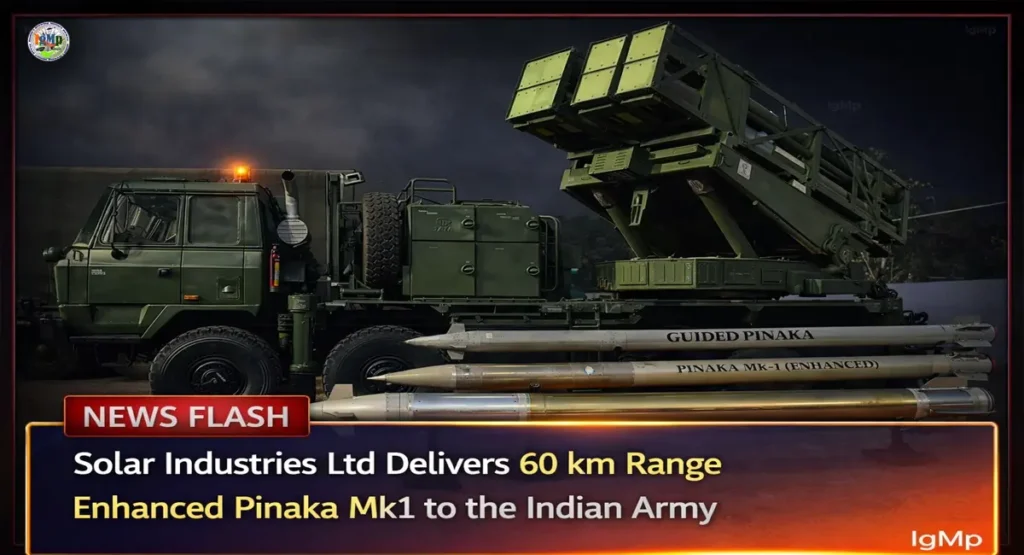
In a major milestone for India’s defense sector, Solar Industries has become the first private company to deliver a fully integrated Pinaka Mk1 Enhanced rocket artillery system to the Indian Army. Traditionally dominated by public sector units and DRDO-led programs, this development signals a clear shift towards private sector participation in high-end military hardware.
This move aligns with India’s broader push for self-reliance, but more importantly, it demonstrates that private firms are now capable of delivering complex, mission-critical systems at scale. Companies like Larsen & Toubro and Tata Power SED have already contributed to the Pinaka ecosystem, but Solar’s delivery marks a transition from component supplier to full-system integrator.
At a Glance
- Manufacturer: Solar Industries Ltd (Solar Defence & Aerospace)
- System: Pinaka Enhanced Mk1 (MBRL)
- Range Upgrade: Increased from 37.5 km to up to 60 km
- Key Achievement: First Indian private sector company to deliver a complete rocket artillery system to the Army.
From 37.5 km to 60 km: Extending the Army’s Strike Envelope
The Enhanced Pinaka Mk1 significantly expands the artillery’s operational reach. The original system had a strike range of 37.5 km, but the upgraded variant now extends this to 45–60 km, depending on mission profile and payload configuration.
This increase allows the Indian Army to engage targets deeper inside contested zones while remaining outside the effective range of many enemy artillery systems. The system retains its core strength—rapid area saturation—while improving both reach and precision.
A standard Pinaka battery, typically consisting of six launchers, can deliver a devastating salvo capable of saturating an area of approximately 800,000 square meters in under a minute, making it highly effective against troop concentrations, logistics hubs, and staging areas.
Pinaka Mk1 vs Enhanced Mk1 (Solar Variant)
| Feature | Pinaka Mk1 (Legacy) | Pinaka Enhanced Mk1 (Solar) |
|---|---|---|
| Strike Range | 37.5 km | 45–60 km |
| Salvo Rate | 12 rockets / 44 sec | 12 rockets / 44 sec |
| Target Area | ~1000m × 800m | Enhanced range & accuracy |
| Tech Features | Standard tracking | AGAPS & advanced tracking |
The Role of AGAPS: Why “Stop-to-Fire” Time Matters in 2026
A key technological upgrade in the Enhanced Pinaka system is the integration of the AGAPS (Automated Gun Aiming and Positioning System). This system significantly reduces the time required to transition from movement to firing position—commonly referred to as “stop-to-fire” time.

In modern artillery warfare, speed is survival. AGAPS minimizes the human-in-the-loop delay, enabling faster target acquisition, automated alignment, and rapid launch readiness. This is critical in counter-battery scenarios, where enemy radars attempt to detect and neutralize firing units within seconds of launch.
By shortening this response window, AGAPS directly enhances the system’s survivability and combat effectiveness.
Shoot-and-Scoot: Staying Ahead of Counter-Battery Fire
The Enhanced Pinaka Mk1 is designed around the “shoot-and-scoot” doctrine, a key requirement in 2026 battlefield environments. After firing a salvo, the launcher can quickly relocate before enemy counter-battery systems can lock onto its position.
This mobility, combined with automated targeting and extended range, allows Pinaka units to operate in a highly dynamic and survivable manner, reducing exposure while maintaining sustained firepower.

Major Moment For Indian Defence Manufacturing
The delivery of the Enhanced Pinaka Mk1 by Solar Industries marks a turning point in India’s defence manufacturing landscape. It is not just an incremental upgrade in artillery capability—but a clear signal that private industry is now ready to lead in complex weapons systems.
With extended range, faster deployment through AGAPS, and modern shoot-and-scoot capabilities, the system strengthens the Indian Army’s artillery arm while redefining how such platforms are developed and delivered.
In 2026, this is more than a weapons upgrade—it is a structural shift in India’s defence ecosystem, where private sector innovation is becoming a frontline force multiplier.