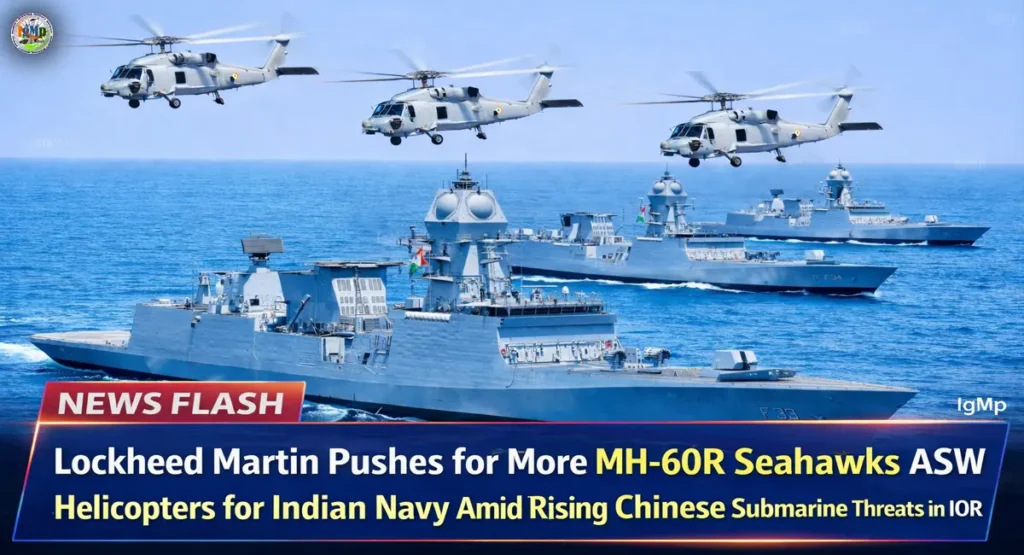
American defence giant Lockheed Martin has highlighted the urgent need for India to expand its fleet of MH-60R Seahawk helicopters, calling them a critical force multiplier for the Indian Navy. The company has signalled that additional Seahawks could significantly boost India’s anti-submarine and maritime surveillance capabilities at a time when undersea competition in the Indian Ocean Region (IOR) is intensifying.
While the current 24-aircraft fleet is already being sustained under a ₹7,995 crore support agreement signed in late 2025, a follow-on order of around 12 more units is increasingly being seen as essential to support India’s expanding surface fleet and future carrier operations.
Comparison: MH-60R Seahawk vs Sea King
| Feature | MH-60R Seahawk (Romeo) | Sea King (Retiring) |
|---|---|---|
| Max Speed | ~270 km/h | ~208 km/h |
| Sensors | Multi-mode radar + Digital MAD | Analog sonar + limited radar |
| Weapons | Hellfire missiles / Mk 54 torpedoes | Older Mk 46 torpedoes |
| Systems | Integrated mission system / data links | Manual plotting / basic comms |
| Availability | High (global standard) | Declining due to age |
Why Does the Indian Navy Need More Than 24 MH-60R Seahawks?
The operational math is straightforward: more warships require more embarked helicopters.
India’s frontline surface fleet is expanding with platforms like the Visakhapatnam-class destroyer and Nilgiri-class frigate, each designed to carry multi-role helicopters for anti-submarine and anti-surface warfare. A 24-helicopter fleet, while significant, begins to look stretched when distributed across multiple carrier groups, destroyer squadrons, and independent deployments.
The commissioning of a second Seahawk squadron—INAS 335 “Ospreys”—in 2025 has already created the operational backbone for expansion. What’s missing now is numerical depth. A follow-on order of 12 helicopters would allow the Navy to maintain availability across simultaneous deployments, training cycles, and maintenance rotations without degrading combat readiness.
How the MH-60R ‘Romeo’ Counters Submarine Threats in the IOR
The MH-60R Seahawk is not just a replacement for older platforms—it represents a generational leap in anti-submarine warfare (ASW).
Unlike legacy helicopters, the Romeo integrates a fully networked combat system that allows it to operate as part of a wider maritime kill chain. Its sensor suite combines multi-mode radar, advanced dipping sonar, and—crucially—a Digital Magnetic Anomaly Detection (MAD) system, which was integrated into operational workflows around 2025. This allows the helicopter to detect subtle disturbances caused by submerged submarines, even in complex littoral environments.
Its combat effectiveness comes from how these systems work together:

- Real-time data fusion enables faster target detection and classification
- Networked operations allow seamless sharing with ships and maritime patrol aircraft
- Precision weapons, including lightweight torpedoes, provide rapid engagement capability
In the context of increasing submarine activity in the Indian Ocean, particularly from extra-regional navies, the Seahawk acts as the forward-deployed “hunter,” extending the sensor and strike reach of surface ships far beyond the horizon.
The Carrier Battle Group Factor: Protecting INS Vikrant
The importance of additional Seahawks becomes even clearer when viewed through the lens of carrier operations.
For a carrier like INS Vikrant, survivability depends heavily on maintaining a continuous anti-submarine screen. This requires multiple helicopters operating in rotation to ensure 24/7 coverage against potential underwater threats.
In practical terms, a single carrier battle group needs at least 8–10 ASW helicopters to maintain persistent surveillance, accounting for sortie rates, maintenance downtime, and crew cycles. With only 24 helicopters in total, sustaining such coverage across multiple task forces becomes difficult.
This is where the additional 12-unit acquisition becomes critical—not as an expansion luxury, but as an operational necessity.
Will India Choose MH-60R Over Indigenous IMRH for Immediate Needs?
India’s long-term plan includes indigenous solutions like the IMRH (Indian Multi-Role Helicopter), but timelines remain a key factor. Developing, testing, and deploying a new platform takes years, particularly for complex ASW roles that require sensor integration and maritime certification.
In contrast, the MH-60R Seahawk is already fully operational within the fleet, with trained crews, established logistics, and proven interoperability with existing naval assets.
The likely approach is not a binary choice but a phased one—continue inducting proven platforms to meet immediate operational gaps while indigenous systems mature in parallel.
Sustainment Deal: The ₹7,995 Crore Backbone
A key but often overlooked aspect of the Seahawk story is the sustainment agreement signed in late 2025. Valued at ₹7,995 crore, this deal ensures long-term maintenance, logistics, and operational availability for the existing fleet.
This matters because availability—not just acquisition—determines real combat power. Globally, the Seahawk platform maintains high readiness rates, often exceeding 90 percent, a significant improvement over ageing legacy helicopters.
By securing sustainment first, the Navy has effectively laid the groundwork for scaling up the fleet without creating logistical bottlenecks.
The Strategic Takeaway
The expansion of the MH-60R Seahawk fleet is not just about adding numbers—it’s about aligning air assets with a rapidly growing surface fleet and an increasingly contested underwater domain.
India’s naval strategy is evolving toward distributed, networked operations where ships, submarines, and aircraft operate as a single integrated force. In that framework, the Seahawk is the aerial predator—hunting submarines, protecting carriers, and extending the Navy’s reach into contested waters.
With new warships entering service and undersea threats rising, the case for a follow-on order is less about future planning and more about keeping pace with the present.