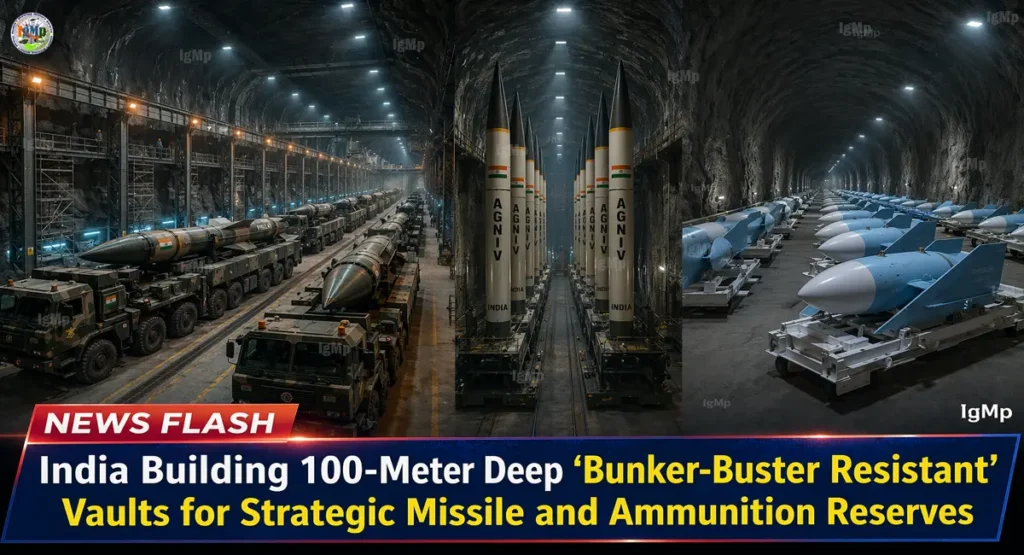
India is steadily pushing some of its most critical military assets underground. At carefully chosen strategic nodes along the northern and western fronts, ultra-deep rock caverns or ‘Bunker-Buster Resistant’ Vaults—estimated to reach depths of 80 to 120 meters—are being developed to store strategic missiles and high-value ammunition.
Built with engineering expertise from National Hydroelectric Power Corporation, these facilities reflect a clear shift in thinking: in an era of precision strikes and deep-penetration weapons, survivability is no longer optional—it has to be engineered from the ground up.
Can India’s Underground Caverns Survive a MOP-Class Strike?
The benchmark for hardened military storage today is defined by weapons like the GBU-57 Massive Ordnance Penetrator, designed to destroy deeply buried targets. Any new infrastructure meant to protect strategic assets must account for this level of threat.
India’s approach goes beyond simply digging deeper, even though depths of up to 120 meters already exceed the penetration range of most conventional bunker-busters. The real protection comes from how these caverns interact with the surrounding geology and how they are internally structured.
Key survivability factors include:
- Natural rock overburden that absorbs and disperses shockwaves
- Layered geological formations that weaken blast energy as it travels downward
- Segmented internal chambers that prevent total facility failure from a single hit
Instead of aiming for unrealistic “invulnerability,” the design focuses on reducing the probability of a successful strike to extremely low levels—even against advanced munitions.
The Agni-V Connection — When Offense Shapes Defense
The strategic logic behind these underground vaults becomes clearer when viewed alongside India’s evolving strike capabilities. Developments linked to a deep-penetration role for the Agni-V suggest a growing focus on targeting hardened enemy infrastructure.
That shift creates a natural counter-requirement. If India is developing the ability to strike targets buried deep underground, it must assume adversaries are pursuing similar capabilities. The response is not incremental—it is structural and forward-looking. This is where the need for ‘Bunker-Buster Resistant’ Vaults comes from.
This is where land-based hardening connects directly with sea-based deterrence. Platforms like INS Aridhaman ensure survivability at sea, while underground caverns protect assets on land. Together, they form a layered deterrence system designed to function even under sustained attack.

Why Vertical-Shaft Storage Is a Game Changer
A major shift in India’s storage philosophy is the move toward vertical-shaft configurations instead of traditional horizontal tunnels. This transition is driven by the realities of modern surveillance and targeting technologies.
Horizontal tunnels often reveal themselves through visible entrances or recurring thermal signatures. Vertical shafts, by contrast, can be concealed within natural terrain, significantly reducing their detectability.
The advantages are both practical and strategic:
- Minimal surface visibility, making satellite detection far more difficult
- Lower thermal and electromagnetic signatures, reducing tracking risks
- Improved blast resistance, as vertical geometry helps dissipate energy
- Better concealment within terrain folds, avoiding obvious entry points
This approach transforms storage infrastructure from something that merely resists attack into something that is also harder to find in the first place.
The NHPC–Army Engineering Partnership
The involvement of National Hydroelectric Power Corporation highlights how civilian engineering expertise is being adapted for strategic use. With decades of experience in tunneling through complex Himalayan geology, NHPC brings capabilities that go far beyond basic excavation.
Their role allows for precise geological selection and structural reinforcement, ensuring that these caverns remain stable over long periods while also being capable of absorbing external shocks. The focus is on durability under both natural stress and wartime conditions.
At the same time, these facilities are expected to integrate advanced security systems, including:

- Seismic sensors to detect underground intrusion or drilling activity
- Phased-array monitoring systems for perimeter surveillance
- Hardened access controls to prevent sabotage or unauthorized entry
This combination of engineering and security ensures that the caverns are not just strong, but also actively defended.
Beyond Bombs: The NBC Shield Advantage
While bunker-buster resistance is the most visible feature, these underground ‘Bunker-Buster Resistant’ Vaults/facilities are designed with a broader threat spectrum in mind. Modern warfare includes risks from nuclear, biological, and chemical environments, where survivability depends on isolation as much as structural strength.
By placing assets deep within dense rock formations and sealing them within controlled environments, these caverns can maintain operational integrity even under extreme conditions. This ensures that strategic missile systems remain deployable when they are needed most, reinforcing the credibility of deterrence.
India’s Expanding ‘Underground Shield’ Strategy
The development of ultra-deep ‘Bunker-Buster Resistant’ Vaults missile cum ammunition storage is part of a wider national shift toward underground resilience. Similar thinking can be seen in energy security, particularly in the expansion of reserves at the Padur Strategic Petroleum Reserve.
Across sectors, a consistent pattern is emerging:
- Critical assets are being moved below ground
- Infrastructure is being designed for low visibility and high survivability
- Redundancy is being built into systems to ensure continuity during conflict
This reflects a broader doctrine where survivability is not an afterthought, but a foundational principle.
Comparison: Traditional Ammo Dumps vs Ultra-Deep Caverns
| Feature | Standard Ammo Dump | Ultra-Deep Cavern (2026) |
|---|---|---|
| Depth | Surface–5 meters | 80–120 meters |
| Survival Rating | Conventional artillery/airstrikes | Designed for bunker-buster-class threats |
| Detection Risk | High (visible to satellites) | Low (terrain-shielded, concealed shafts) |
| Storage | Small arms, shells | Strategic missiles & reserves |
| Engineering | Concrete bunkers | NHPC-engineered rock caverns |
The Strategic Takeaway
What is emerging is not just a modernization effort, but a deeper shift in how military resilience is built. In a battlespace defined by precision targeting and deep-strike capabilities, protecting critical assets has become just as important as deploying them.
India’s move toward ultra-deep underground storage reflects a long-term approach to deterrence—one that prioritizes survivability, redundancy, and operational continuity. By combining hardened land-based infrastructure with mobile and sea-based systems, the country is building a strategic posture designed not just to respond to conflict, but to endure it.