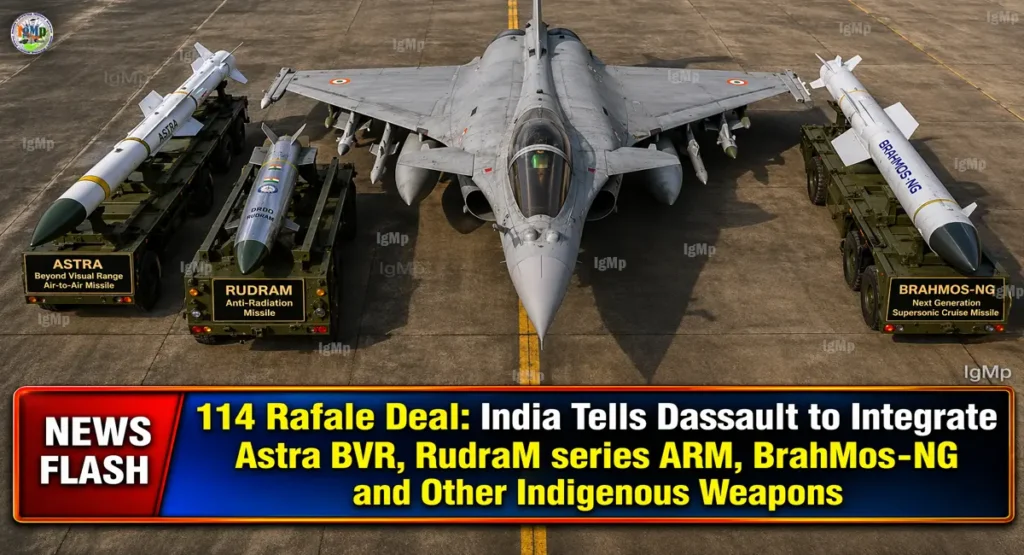
The Indian Air Force (IAF) is no longer negotiating just for aircraft—it is negotiating for control. In the proposed 114-jet deal for the Dassault Rafale under MRFA, India has pivoted away from its earlier demand for sensitive source codes toward a more strategic solution: a “Hardwired Interface Control Document (ICD)” clause as we have reported in our last article on 10th April. This shift reflects a deeper doctrinal change—India wants open architecture combat platforms, not sealed “black boxes.”
At the same time, New Delhi is pushing for F4+ and F5 standards, ensuring that the Rafale remains relevant well into the 2030s. The result is a high-stakes negotiation where technology sovereignty, indigenous weapons integration, and geopolitics intersect.
ICD vs Source Code: The “Digital Handshake” Strategy
Dassault will never hand over Rafale’s source code—and India knows that now.
Instead, the IAF has pushed for a Hardwired ICD, which acts as a “digital handshake” between the aircraft and indigenous weapons. In simple terms, the ICD defines how systems communicate—without exposing their internal logic.
This allows Indian scientists to integrate missiles like the Astra Mk2 without requiring French engineers to access sensitive missile algorithms. At the same time, India does not need access to Rafale’s proprietary flight control software.
The IAF is effectively saying:
“We don’t need your secrets. We need guaranteed compatibility.”
Our analysis suggests this is a major shift. The IAF is tired of paying “integration taxes” every time it adds a new weapon. The ICD framework ensures plug-and-play capability, reducing dependency on foreign OEMs over the aircraft’s lifecycle.
Astra Mk2 & BrahMos-NG: Redefining Rafale’s Combat Role
Astra Mk2: Meteor-Class Reach, Indian Control
The Astra Mk2, with a projected 220 km range, transforms the Rafale into a long-range air dominance platform comparable to Meteor-equipped jets—but at a significantly lower cost-per-shot.
Once integrated, the IAF gains:
- Full control over upgrades and production
- Independence from foreign missile supply chains
- Scalability for future variants
This is not just a missile—it is strategic autonomy in air combat.
BrahMos-NG: Supersonic Strike Without Compromise
The BrahMos-NG is the second pillar of India’s push.
Unlike the heavier BrahMos-A carried by the Su-30MKI, the NG variant is significantly lighter, allowing the Rafale to carry it without sacrificing maneuverability.
This creates a unique capability:
- Supersonic stand-off strike (300 km+)
- Retained agility in contested airspace
- Multi-role flexibility (strike + air combat)
In effect, the Rafale becomes a dual-role hunter—capable of both air superiority and deep strike missions in a single sortie.
Beyond Astra & BrahMos: The Full Indigenous Strike Stack
| Indigenous Weapon | Type | Key Advantage on Rafale |
|---|---|---|
| Astra Mk2 | BVRAAM | 220 km range; independence from foreign supply |
| BrahMos-NG | Cruise Missile | Supersonic strike with reduced weight |
| RudraM-III | Anti-Radiation | High-speed SEAD/DEAD capability |
| GAURAV | Glide Bomb | Long-range precision strike |
This table highlights a critical shift:
The Rafale is no longer just a French jet—it is becoming an Indian weapons platform.
F4+ to F5: Future-Proofing the Rafale Fleet
The IAF is not buying for today—it is buying for 2040.
F4+ Standard: The “Mini-AWACS” Rafale
The F4+ upgrade introduces advanced sensor fusion and network-centric warfare capabilities. It allows the Rafale to act as a data node, sharing targeting information across platforms in real time.
Think of it as a “mini-AWACS”—extending battlefield awareness beyond individual aircraft.
F5 Standard: Enter the Loyal Wingman Era
The F5 standard is where things get transformative.
Designed to support Manned-Unmanned Teaming (MUM-T), the Rafale will be capable of controlling drones such as the Dassault nEUROn.
By pushing for F5 standards—at least for the final batch of jets—the IAF ensures:
- Compatibility with future drone swarms
- Relevance in next-generation warfare
- Seamless integration into AI-driven combat networks
Our analysis suggests this is a forward-looking move to align Rafale with 6th-generation warfare concepts.
The Russian Factor: Why France Is Hesitating
There is a geopolitical layer to this negotiation.
The BrahMos-NG carries Russian technological lineage, and France is cautious about allowing deep integration that could create “software proximity” risks. In simple terms, Paris does not want Russian-linked systems interacting too closely with Rafale’s sensitive architecture.
This explains the friction:
- India wants full integration freedom
- France wants to protect its intellectual property and strategic ecosystem
Balancing these interests is now the core challenge of the MRFA deal.
The Bigger Picture: From Black Boxes to Open Platforms
This Rafale negotiation is part of a broader trend.
Just as the Indian Army rejected the Stryker in favor of indigenous systems, the IAF is now pushing for open, customizable combat platforms.
The message is clear: India is no longer buying finished products—it is building adaptable ecosystems.
And in the Rafale deal, the real victory will not be the number of jets acquired—
but the freedom to arm them on India’s own terms.