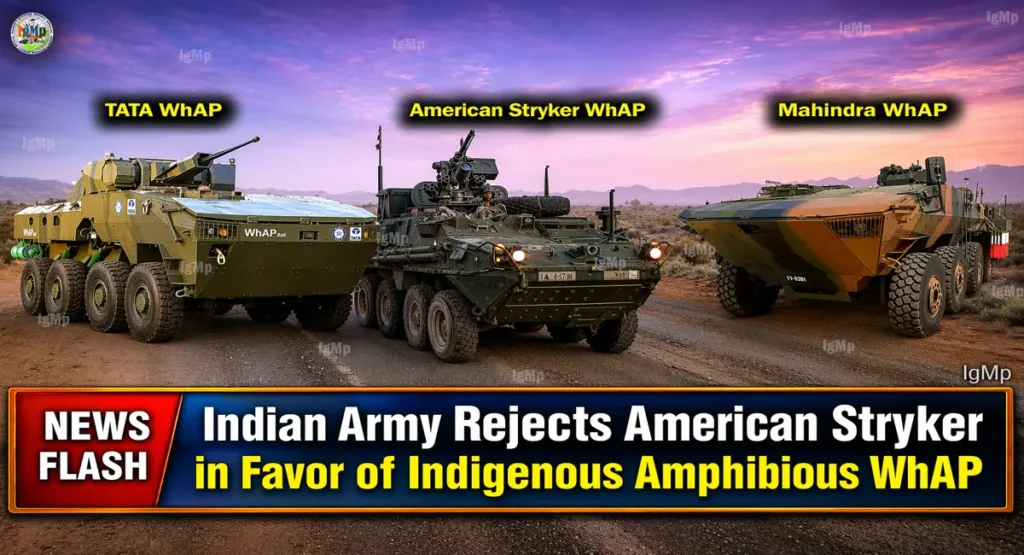
The Indian Army has delivered a decisive verdict after high-altitude trials in Eastern Ladakh—rejecting the American Stryker in favor of India’s indigenous WhAP. The trials exposed critical limitations in the Stryker’s 350 hp engine under oxygen-deprived conditions, directly impacting mobility and combat readiness. In contrast, India’s WhAP ecosystem—developed by DRDO with industry partners—demonstrated superior performance through higher power output, native amphibious capability, and terrain-specific design.
More importantly, this is not just a platform-level decision—it reflects a doctrinal shift toward a multi-vendor indigenous ecosystem tailored for Himalayan warfare under the Atmanirbhar Bharat framework.
Why the 350hp Stryker Engine Failed the Ladakh Test
At altitudes exceeding 14,000 feet, engine efficiency drops sharply due to low oxygen levels. The Stryker’s 350 hp engine struggled to maintain mobility under combat loads, limiting maneuverability and operational endurance.
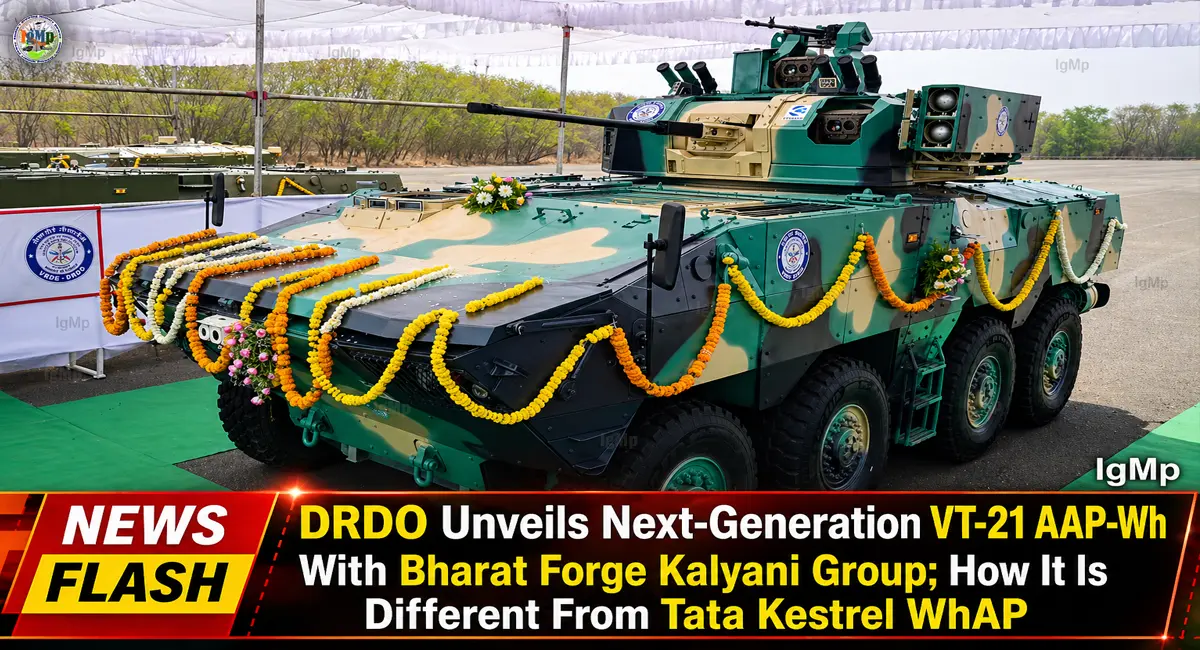
By comparison, the Tata-developed WhAP variant—often referred to as the Kestrel—is powered by a 600 hp Ashok Leyland/Cummins engine, delivering a far superior power-to-weight ratio.
Our analysis suggests this translates into real tactical advantage: better gradient climbing, faster response under fire, and sustained mobility without engine strain. In Ladakh’s harsh terrain, these are not performance bonuses—they are survival requirements.
The Amphibious Edge: A Decisive Battlefield Differentiator
The WhAP’s native amphibious capability proved to be the decisive factor.
Equipped with rear-mounted hydrojets, it can cross rivers like the Shyok without external preparation. This allows rapid maneuver across riverine obstacles—critical in LAC scenarios.
The Stryker, however, lacks inherent amphibious capability and relies on add-on kits, making it slower and operationally restrictive.

In a fast-moving high-altitude conflict, this difference could determine who controls key river valleys first.
Generation Shift: Tata Kestrel vs Mahindra WhAP
Tactical Differentiation: Generation 1 vs Generation 2
The Indian Army is not relying on a single platform—but an evolving ecosystem:
- Tata Kestrel (Generation 1): The heavy-duty backbone. Designed as a BMP replacement, it emphasizes firepower, troop capacity, and amphibious assault capability.
- Mahindra WhAP (Generation 2): The refined specialist. More compact and lighter, it is optimized for niche roles like CBRN reconnaissance and protected mobility.
This dual-track evolution gives India flexibility that imported platforms cannot match.
Tata vs Mahindra WhAP: Technical Comparison
| Feature | Tata Advanced Systems (Kestrel) | Mahindra Defence Systems |
|---|---|---|
| Primary Focus | Heavy IFV / Infantry Carrier | Compact & Specialist Roles |
| Engine Power | 600 hp | Optimized (~26 hp/tonne) |
| Amphibious Speed | ~10 km/h | ~8 km/h |
| Design Priority | High troop capacity (10–12) | Reduced weight, agility |
| Key Roles | Amphibious assault, BMP replacement | CBRN Recon, protected mobility |
Compact Power vs Heavy Firepower: Design Fine-Tuning
The Mahindra variant introduces a critical advantage—compactness.
Its slightly smaller footprint makes it better suited for narrow Himalayan roads and urban counter-insurgency scenarios, where larger platforms like the Kestrel may face maneuverability constraints.
There’s also a protection vs weight trade-off. While Tata’s 600 hp engine delivers brute force, Mahindra focuses on higher efficiency and agility, enabling longer patrols with potentially lower fuel consumption.
Another key differentiator is turret philosophy:

- Tata Kestrel has been widely tested with the BMP-2’s 30mm turret, ensuring logistics commonality.
- Mahindra WhAP emphasizes Remote Controlled Weapon Stations (RCWS), offering a more digital, crew-safe combat interface.
Multi-Vendor Indigenous Ecosystem vs One-Size-Fits-All
This is where the Indian approach fundamentally outclasses the Stryker.
The American platform is a “one-size-fits-all” solution. The Indian model is a multi-vendor indigenous ecosystem:
- Tata delivers heavy amphibious firepower
- Mahindra delivers agile, specialized capability
Together, they create a layered combat fleet optimized for diverse missions—from river crossings to reconnaissance.
Our analysis suggests this ecosystem approach aligns with India’s evolving high-altitude warfare doctrine, complementing programs like the Zorawar Light Tank and enabling rapid deployment across complex terrain.
The Bigger Picture: A Strategic Shift
The rejection of the Stryker is not about rejecting foreign technology—it’s about choosing battlefield relevance over brand value.
In Ladakh, where terrain dictates tactics, India has prioritized power, amphibious mobility, and adaptability.
The result is clear: A shift from imported uniformity to indigenous specialization.