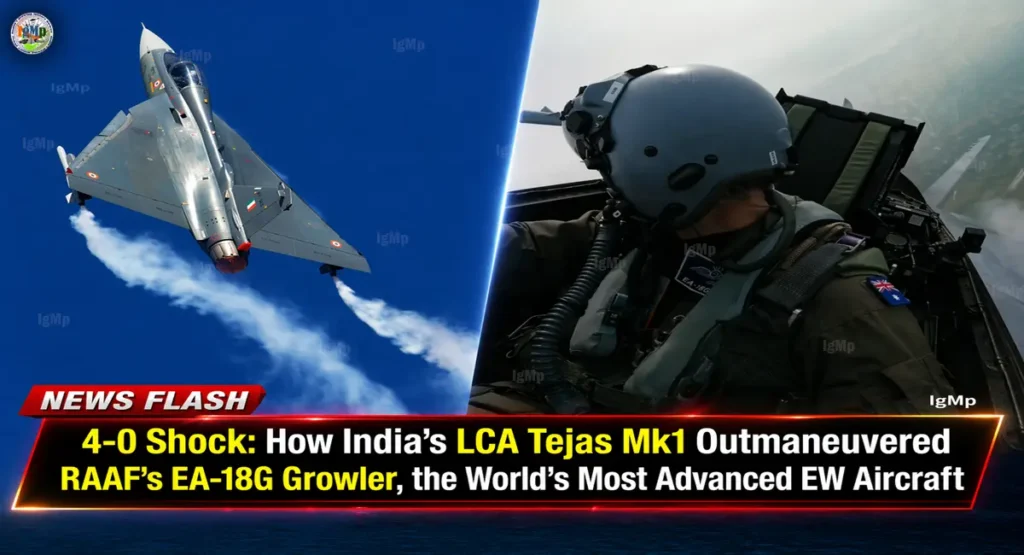
Reports emerging from Exercise Tarang Shakti 2024 indicate that India’s HAL LCA Tejas Mk1 may have achieved a 4-0 kill ratio against the Boeing EA-18G Growler operated by the Royal Australian Air Force (RAAF). While such outcomes in multinational exercises are often shaped by controlled scenarios and training objectives, the claim has gained traction because it highlights a deeper and more relevant point: how contrasting aircraft design philosophies perform when forced into the same combat envelope.
Rather than viewing this as a headline-grabbing upset, the engagement is better understood as a case study in air combat physics, mission specialization, and tactical execution. The LCA Tejas Mk1, designed as a lightweight, agile interceptor, was operating in a domain where the Growler—despite being one of the world’s most advanced electronic warfare platforms—was not optimized to dominate.
Technical Insight: Why the “4-0” Is Plausible
| Feature | LCA Tejas Mk1 | EA-18G Growler |
|---|---|---|
| Primary Role | Light multi-role / dogfighter | Electronic warfare / SEAD |
| Radar | EL/M-2032 (mechanical) | AN/APG-79 (AESA) |
| Size & RCS | Small, low visual signature | Large, twin-engine |
| Strength | High agility (WVR combat) | BVR jamming & standoff |
This comparison makes it clear that the engagement was inherently asymmetrical. The Growler excels in beyond-visual-range electronic attack missions, whereas the Tejas is optimized for close-in maneuvering combat, where size, aerodynamics, and pilot input dominate outcomes.
The Physics of the Dogfight: Where Tejas Gains the Edge
The EA-18G Growler, derived from the Super Hornet platform, carries additional electronic warfare payloads such as the ALQ-99 jamming pods. These systems are invaluable in suppressing enemy air defenses, but they come at the cost of increased drag, weight, and reduced agility.
In contrast, the Tejas Mk1 benefits from a fundamentally different design philosophy. Its relaxed static stability (RSS) configuration, combined with a clipped delta wing, allows it to achieve high instantaneous turn rates and rapid nose-pointing ability. In a within-visual-range engagement, this translates into quicker positional advantage—often the deciding factor in simulated kills.
The result is not surprising from a physics standpoint: a lighter aircraft with superior agility will consistently outperform a heavier, mission-loaded platform in a turning fight.
A HAL Tejas sliding onto the six of a Boeing EA-18G Growler looks great on video. pic.twitter.com/T8IB8gAgFd
— Alpha Defense™🇮🇳 (@alpha_defense) April 14, 2026
Electronic Warfare vs. Tactical Restraint
Another layer to this engagement lies in the electromagnetic spectrum. The Growler’s core strength—its powerful jamming capability—relies on actively emitting signals to disrupt adversary systems. However, in a close-range scenario, this very emission can act as a beacon, revealing its presence.
The Tejas, on the other hand, can operate with a degree of electronic silence, using passive detection methods or minimal emissions to track targets. This creates an interesting dynamic where the Growler’s attempt to dominate the electronic domain may inadvertently provide cues to a smaller, more agile opponent operating quietly.
This “emission vs. detection” interplay is increasingly relevant in modern air combat, where who reveals themselves first often loses the advantage.
Squadron-Level Context and Operational Reality
The RAAF’s No. 6 Squadron RAAF is among the most capable electronic warfare units globally, specializing in suppression of enemy air defenses and electronic attack missions. Opposing them, Indian Air Force units such as No. 45 Squadron IAF and No. 18 Squadron IAF have been steadily building expertise in operating the Tejas in complex, high-tempo environments.
This context reinforces that the outcome is not merely about platforms, but also about training alignment with mission roles. When each side is pushed outside its primary specialization, performance gaps can emerge quickly.
Strategic Skepticism: Interpreting the 4-0 Claim
It is essential to approach such results with measured skepticism. Air exercises are designed to test specific doctrines and capabilities, often under predefined constraints. The Growler may not have been allowed to fully exploit its stand-off jamming advantage, or the engagement may have been deliberately structured to simulate close-range combat scenarios.

Therefore, the reported score should not be seen as a definitive comparison of capability, but rather as an illustration of how scenario design influences outcomes. It highlights where Tejas excels, rather than proving superiority across all combat conditions.
Future Trajectory: Expanding the Tejas Advantage
Looking ahead, the evolution of the Tejas platform adds another dimension to this discussion. The upcoming Mk1A variant will incorporate the indigenous Uttam AESA radar, significantly enhancing its beyond-visual-range capabilities.
This upgrade will allow the aircraft to operate more effectively in contested electromagnetic environments while maintaining its inherent agility advantage. If the current platform already demonstrates strength in close combat, the addition of advanced radar technology could enable it to compete more effectively across the full spectrum of aerial engagements.
Strategic Insight
The “4-0” narrative from Tarang Shakti 2024 is ultimately a reflection of context, design, and tactics converging in a specific combat scenario. The Tejas Mk1 leveraged its agility, smaller signature, and tactical discipline to gain an advantage over a platform built for a fundamentally different role.
Rather than a simple victory story, this engagement underscores a broader truth in modern air warfare: capability is situational, and dominance depends on how well an aircraft’s design aligns with the fight it is forced to take.