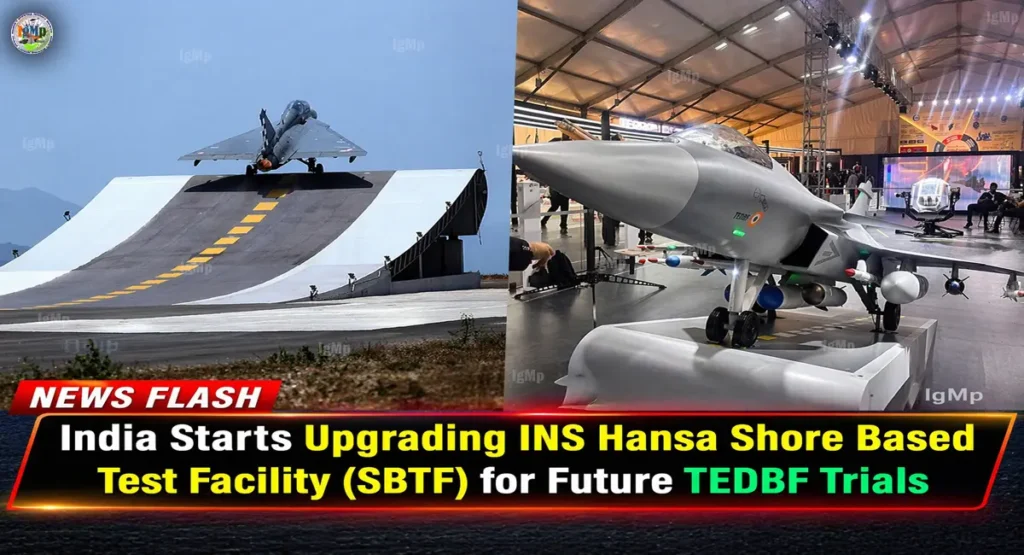
India has initiated a critical upgrade of the Shore-Based Test Facility (SBTF) at INS Hansa, signaling a decisive transition in naval aviation—from the lightweight Naval LCA era to the much heavier and more capable Twin Engine Deck Based Fighter.
Originally designed to support a 13-ton class aircraft like the Naval LCA, the SBTF is now being re-engineered to handle a 26-ton carrier fighter. This near doubling of aircraft weight is not a minor upgrade—it represents a fundamental shift in how India prepares for next-generation carrier operations. In effect, this marks the end of the N-LCA testing phase and the beginning of infrastructure readiness for TEDBF, years before its expected rollout in 2027–28.
SBTF 2.0 Upgrade Checklist: What’s Changing
To meet the demands of a heavier and more powerful aircraft, the SBTF is undergoing a series of highly targeted technical upgrades:
- Energy Absorption:
Upgraded high-pressure air compressors to support arrestor gear handling for 26-ton class landings - Precision Tracking:
RF-based instrumentation recalibrated for millimeter-level trajectory measurement during takeoff and landing - Real-Time Analytics:
Integration of PCI-based data acquisition cards for compatibility with advanced “Iron Bird” simulation systems - Safety Enhancements:
High-capacity rescue systems and fire suppression tailored for General Electric F414 engine operations
This structured modernization ensures that the SBTF evolves into a true “Land-Based Aircraft Carrier” simulation environment, capable of replicating real deck conditions with high fidelity.
The Hidden Backbone: Why “Soft Starters” Matter
One of the most overlooked yet crucial upgrades involves the installation of “soft starters” for the INS Hansa SBTF’s high-pressure air compressors. At first glance, this may appear like a routine electrical enhancement—but it is, in fact, central to the facility’s long-term reliability.
The arrestor gear system, which brings landing aircraft to a halt, relies heavily on these compressors to rapidly reset and recharge between landings. When a 26-ton aircraft like TEDBF lands at high speed, it generates enormous kinetic energy that must be absorbed and dissipated instantly.
During the expected 1,000+ landing and takeoff cycles in the TEDBF testing phase, these compressors will operate under extreme stress. Without soft starters:
- Motors would experience sudden current surges
- Mechanical wear and overheating would increase
- System reliability during high-frequency trials would degrade
Soft starters ensure a gradual ramp-up of motor speed, reducing electrical and mechanical stress. This not only prevents burnout but also guarantees that the arrestor system can sustain continuous, high-tempo testing cycles—a non-negotiable requirement for carrier certification.
Engineering for a 26-Ton Fighter: The TEDBF Challenge
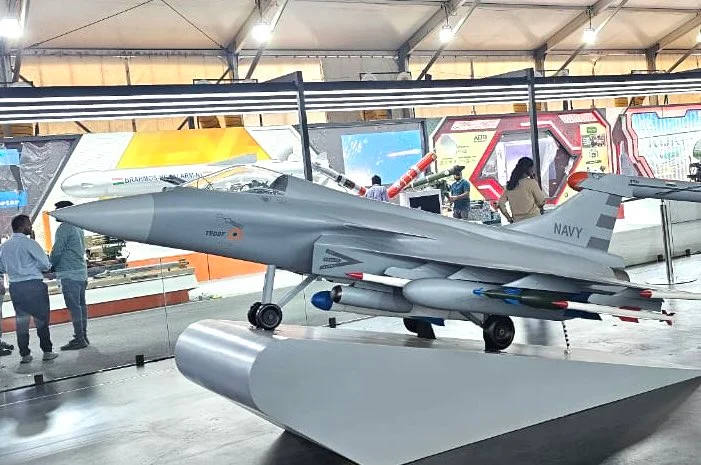
The TEDBF, being developed by Aeronautical Development Agency, represents a major leap in capability over the Naval LCA. With twin engines, higher payload capacity, and greater range, it is designed to operate as the Indian Navy’s primary carrier-borne fighter.
However, this increase in capability comes with proportional demands on infrastructure:
- Higher landing speeds require stronger arrestor systems
- Increased mass demands greater energy absorption capacity
- Twin-engine operations necessitate enhanced fire safety protocols
The INS Hansa SBTF upgrades are therefore not optional—they are foundational prerequisites for TEDBF’s development timeline.
Strategic Outlook: Eliminating Infrastructure Lag
A key takeaway from this upgrade program is its timing. By modernizing the SBTF in 2026, the Indian Navy is ensuring that infrastructure is ready before the aircraft arrives—a significant departure from past patterns where platform development often outpaced testing readiness.
Notably, the SBTF at INS Hansa is Asia’s only operational facility of its kind, making it a strategic asset not just for India but for the broader region. Its evolution into a TEDBF-capable testbed positions India among a select group of nations with indigenous carrier aviation testing ecosystems.
This proactive approach eliminates what is often referred to as “infrastructure lag”, where delays in testing facilities can stall entire programs. Instead, India is aligning its timelines so that when TEDBF prototypes begin trials, the SBTF is already fully certified and operational.
The upgrade of INS Hansa’s SBTF is far more than a technical tender—it is a strategic enabler of India’s future carrier power. From handling the transition from a 13-ton to a 26-ton aircraft, to integrating advanced analytics and resilient mechanical systems, the facility is being transformed into a cornerstone of naval aviation capability.
In many ways, the success of the TEDBF program will depend not just on the aircraft itself, but on the robustness of the ecosystem supporting it. With these upgrades, India is ensuring that its “land-based aircraft carrier” is ready—well before the next generation of fighters takes to the deck.