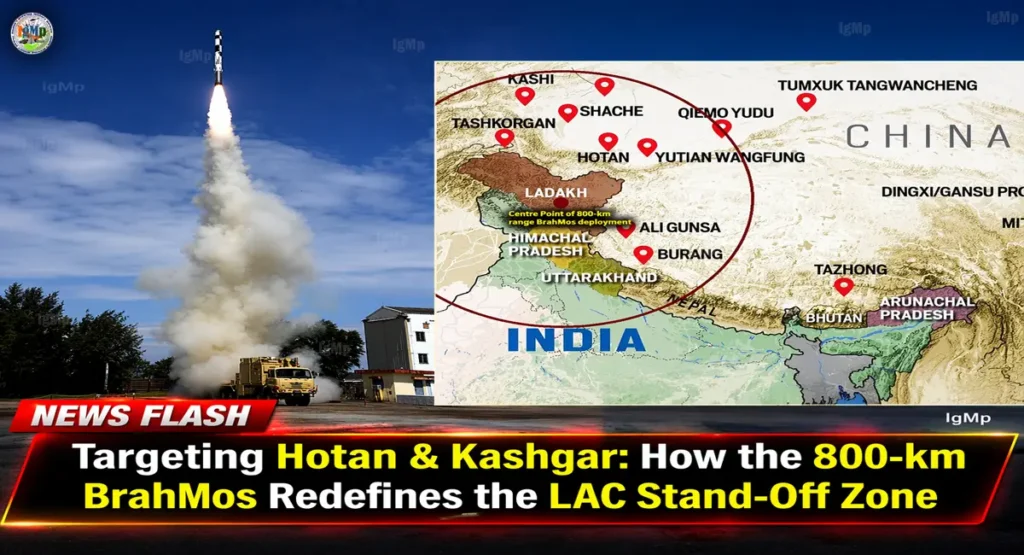
India’s extension of the BrahMos cruise missile range to 800 km is not just an incremental upgrade—it is a doctrinal shift in how New Delhi can impose deterrence across the Line of Actual Control (LAC). Moving beyond earlier 290 km and 450 km variants, the extended-range BrahMos-ER fundamentally alters the geospatial balance in Tibet and Xinjiang by bringing critical PLA infrastructure into persistent threat range.
Strategic Impact: The Xinjiang–Tibet Connection
The real significance of the 800 km variant emerges when mapped against high-value PLA logistics corridors and airbases.
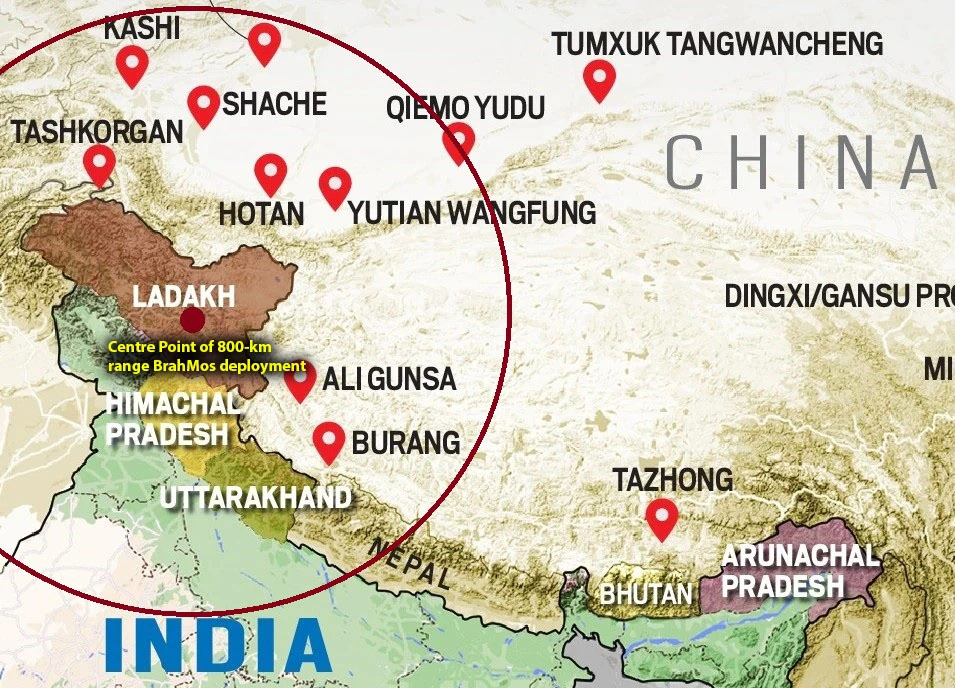
From forward sectors such as Tawang in Arunachal Pradesh or Eastern Ladakh, the upgraded BrahMos can now hold at risk:
- The G219 Highway — the arterial road connecting Xinjiang to Tibet, essential for PLA logistics and rapid troop movement
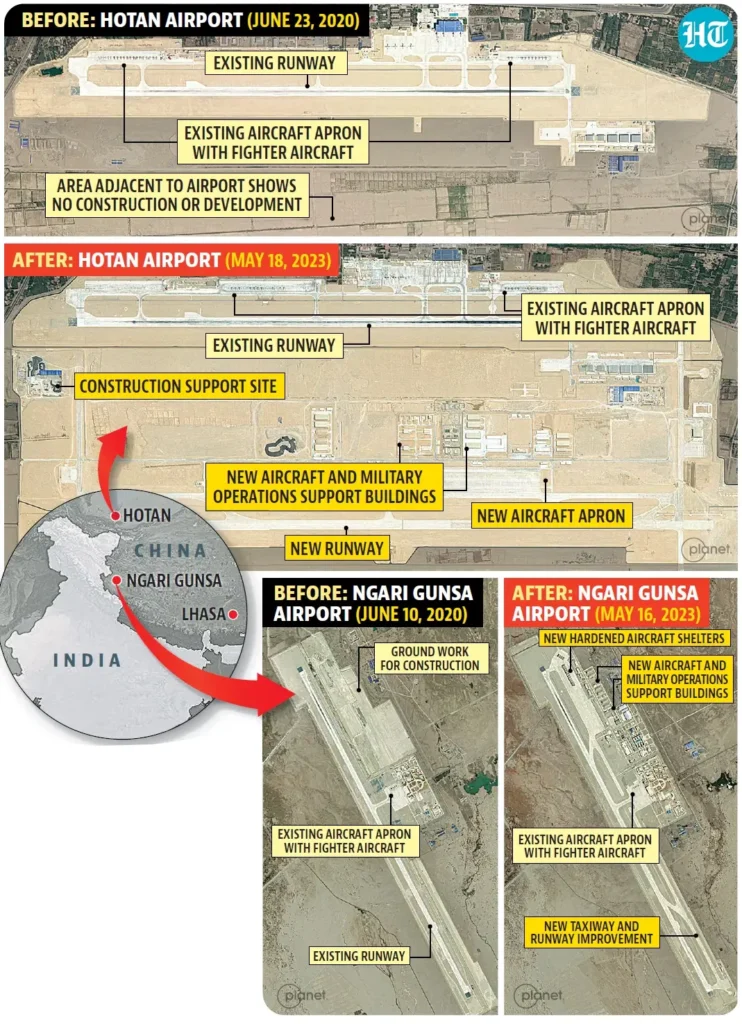
- Hotan Airbase — a key forward operating base for PLA Air Force fighters and UAVs
- Kashgar (Kashi) logistics nodes — crucial staging points for reinforcements and supplies
This transforms these assets into “persistent threat zones”, where any buildup or movement can be rapidly targeted within minutes. Unlike slower systems, BrahMos’ Mach 2.8–3.0 speed compresses enemy reaction time, making interception significantly more difficult.
Technical Snapshot: BrahMos (800 km Variant)
| Parameter | Specification |
|---|---|
| Range | 800 km+ |
| Speed | Mach 2.8 – 3.0 |
| Flight Profile | Sea-skimming / terrain-hugging |
| Launch Platforms | Land-based TELs, naval vessels, air-launched variants (Su-30MKI integration evolving) |
| Guidance | Advanced INS + satellite navigation + indigenous seeker |
| Strategic Role | Precision strikes on hardened, time-sensitive targets |
The extended range is believed to be enabled by improved fuel efficiency in the ramjet engine, lighter composite structures, and advancements in indigenous guidance systems—reducing dependence on external technologies while improving accuracy.
BrahMos vs. Pralay: The Integrated Rocket Force Synergy
India’s emerging Integrated Rocket Force (IRF) concept relies on a “High-Low mix” of strike systems, where BrahMos plays a critical role alongside other missiles.
- BrahMos (Supersonic Cruise Missile)
- Designed for high-value, time-sensitive targets
- Ideal for command centers, airbases, and hardened bunkers
- Speed ensures minimal enemy reaction window
- Pralay missile (Quasi-Ballistic)
- Used for saturation strikes
- Maneuverable trajectory helps defeat missile defense systems
- Nirbhay cruise missile (Subsonic Long-Range)
- Enables deep penetration and loitering attacks
- Suitable for sustained strikes on logistics and infrastructure
This layered approach ensures that enemy defenses are overwhelmed through speed, unpredictability, and volume, rather than relying on a single missile type.
Editor’s Perspective: Escalation Control Through Distance
One of the most underappreciated advantages of the 800 km BrahMos is its contribution to escalation control and survivability.
With extended range, India no longer needs to deploy missile batteries close to the LAC. Launchers can now be positioned:
- Deep behind mountain ranges
- Within second-line defensive zones
- Outside the effective reach of enemy drones and artillery
This makes them significantly harder to detect and target—effectively rendering them “un-huntable” in a high-intensity conflict scenario.
In strategic terms, this allows India to increase strike capability without increasing forward troop presence, reducing escalation risks while strengthening deterrence.

The Bigger Picture: Offensive-Defensive Integration
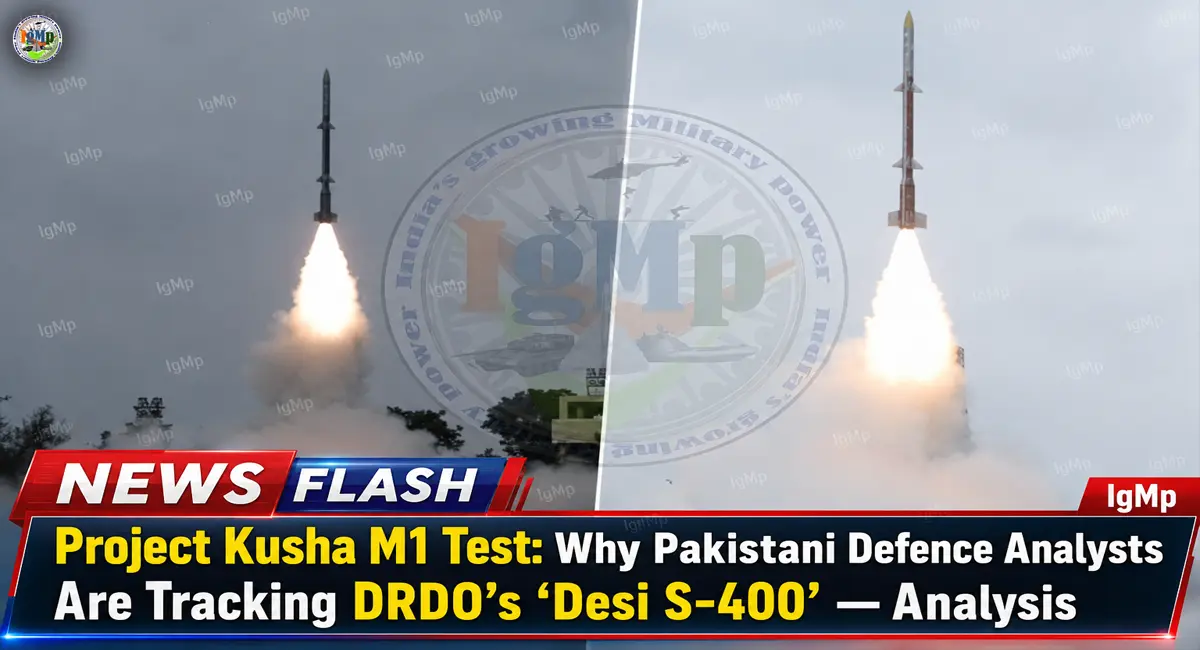
The BrahMos upgrade also complements India’s growing air and missile defense network. Systems like S-400 Triumf and indigenous programs such as Project Kusha form the defensive shield, while BrahMos and IRF assets serve as the offensive spear.
This dual-layered architecture reflects a shift toward network-centric warfare, where detection, targeting, and strike capabilities are tightly integrated.
The 800 km BrahMos is not merely about range—it is about reshaping the battlespace. By bringing critical PLA infrastructure like the G219 Highway and Hotan Airbase within rapid strike distance, India gains the ability to disrupt logistics, degrade air operations, and impose costs deep inside adversary territory.
More importantly, it achieves this while enhancing survivability and maintaining escalation control—hallmarks of a mature deterrence strategy in a high-altitude, high-stakes theater like the LAC.