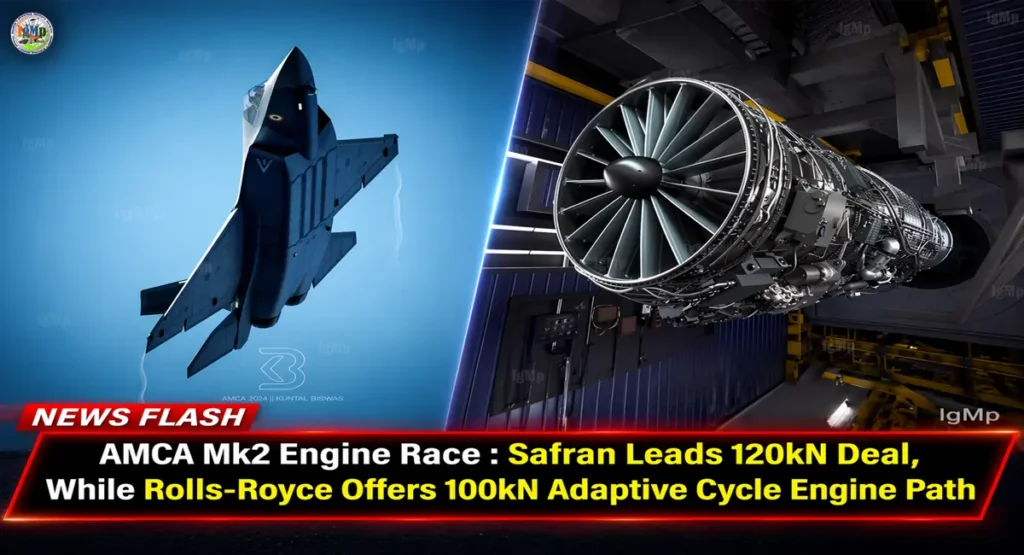
India’s “Two-Track” engine strategy for the Advanced Medium Combat Aircraft Mark 2 or the AMCA Mk2 version has now entered a more defined “Modular Architecture” phase, moving beyond the policy-level alignment reported by us in February. What was earlier a parallel evaluation of Safran and Rolls-Royce proposals is now evolving into a structured comparison between sovereignty-driven engine development and future-ready modular propulsion ecosystems.
At the center of this shift is a critical question: should India prioritize full intellectual property control for a 5th-generation engine, or invest in a scalable architecture that bridges into 6th-generation propulsion technologies?
Quick Comparison: Safran vs Rolls-Royce AMCA Mk2 Engine Proposals
| Feature | Safran Proposal (2025–26) | Rolls-Royce Proposal (2026) |
|---|---|---|
| Thrust Class | 110–125 kN | 120 kN+ (Scalable) |
| Technology | Adaptive Cycle (planned integration) | Variable Cycle Engine (VCE), GCAP-derived |
| IP Status | Full Transfer of Technology (ToT) | Joint development, modular IP |
| Core Advantage | Sovereignty & domestic manufacturing | 6th-gen ready modular “swap-in” core |
This structured divergence is what defines the current phase—not just competing engines, but competing philosophies of airpower development.
Variable vs Adaptive Cycle: The Core Technology Divide
To understand the difference, it is essential to break down the propulsion architectures both companies are offering:
- Variable Cycle Engine (Rolls-Royce)
- Dynamically adjusts bypass ratio
- Switches between high-thrust combat mode and fuel-efficient cruise mode
- Optimized for multi-role flexibility and future upgrade paths
- Adaptive Cycle Engine (Safran)
- Introduces a third stream of airflow
- Enhances thermal management and fuel efficiency
- Improves cooling for advanced avionics and stealth systems
In simple terms, Rolls-Royce is offering dynamic performance switching, while Safran is focusing on efficiency and thermal optimization—both critical for a stealth fighter, but with different long-term implications.
The “Marinization” Factor: A Hidden Strategic Layer
One of the most significant yet underreported aspects of the Rolls-Royce proposal is its emphasis on a “marinized” engine core. This is not just about naval compatibility—it signals alignment with India’s broader aviation ecosystem, particularly the Twin Engine Deck Based Fighter.
A marinized engine must withstand:
- High-salt maritime environments
- Rapid throttle changes during carrier operations
- Increased corrosion and fatigue cycles
If standardized, such an engine core could eventually power both AMCA and TEDBF, creating logistical and maintenance commonality across the Air Force and Navy. This is a classic example of modular defense planning, where one technology base supports multiple platforms.
Sovereignty vs Innovation: India’s Strategic Hedging
At a policy level, India’s approach is not about choosing one over the other—it is about strategic hedging.
Safran’s proposal stands out for its 100% Transfer of Technology (ToT) and potential for full intellectual property ownership. This directly supports India’s long-term goal of mastering hot-section metallurgy, including single-crystal turbine blades and high-temperature alloys—areas historically dominated by Western OEMs.
Rolls-Royce, however, brings something different to the table: access to next-generation propulsion concepts aligned with the Global Combat Air Programme (GCAP). Its modular engine design allows for future “core swaps”, meaning India could upgrade propulsion systems without redesigning the entire aircraft.
As Tufan Erginbilgic emphasized, “India is a third home market for Rolls-Royce.”
This statement is strategically significant—it signals long-term industrial commitment, not just a transactional partnership.
Engineering Depth: Where the Real Battle Lies
Beyond policy and partnerships, the real contest lies in engineering execution.
Modern fighter engines are defined by:
- Hot-section durability under extreme temperatures
- Bypass ratio optimization for stealth and efficiency
- Advanced cooling techniques to support onboard electronics
Safran’s strength lies in offering India the ability to own and control these technologies domestically, reducing long-term dependency. Rolls-Royce, meanwhile, is positioning itself as a gateway to future propulsion ecosystems, where engines are no longer static components but evolving modules within a larger system architecture.
Conclusion: A Dual-Track Strategy with Converging Outcomes
The AMCA Mk2 engine race is no longer a binary competition—it is a layered strategic decision. Safran offers immediate sovereignty and industrial independence, while Rolls-Royce provides a pathway to future-ready, modular propulsion aligned with 6th-generation warfare.
By advancing both tracks simultaneously, India is effectively ensuring that it does not just build a 5th-generation fighter, but also lays the foundation for the propulsion technologies of the 2030s and beyond.
In that sense, the real success of this strategy will not be measured by which engine is selected—but by how effectively India integrates sovereignty today with innovation for tomorrow.