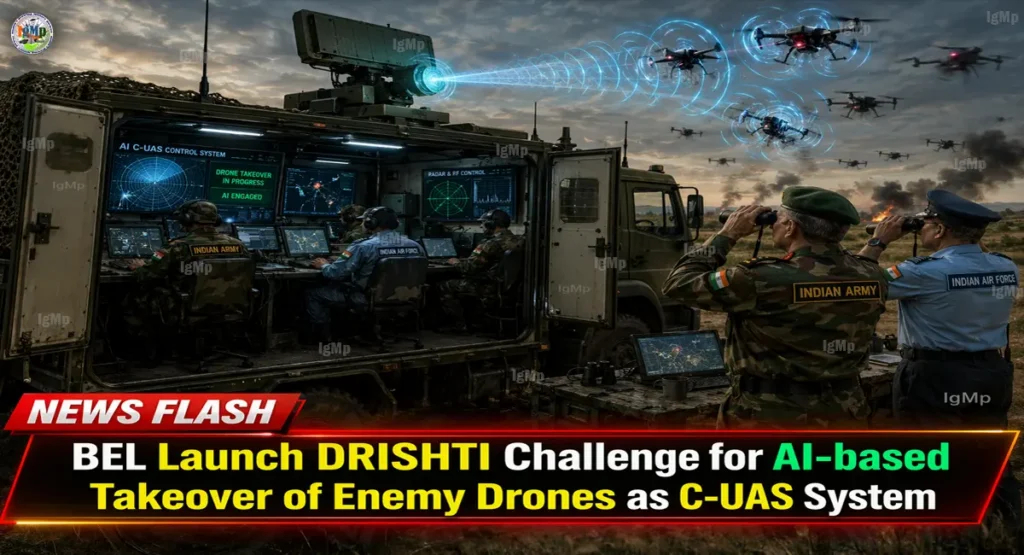
Bharat Electronics Limited (BEL) has launched the DRISHTI Challenge to develop an AI-driven Counter-UAS (C-UAS) system built around a concept called Cyber Takeover. Instead of relying only on signal jamming, the system aims to hack and override the drone’s command link. This allows Indian defenders to force-land, redirect, or capture hostile drones operating in sensitive airspace.
The initiative targets startups and MSMEs with a ₹2.50 crore innovation funding pool. BEL designed the program as a rapid technology sprint rather than a long procurement cycle. The goal is to quickly build deployable solutions for India’s growing drone threat environment.
How BEL’s C-UAS System Detects and Neutralizes Drones
Modern drone defense requires several layers of sensing and decision-making. BEL’s concept integrates multiple detection technologies with AI-based classification before initiating a soft-kill response.
The system architecture combines radio-frequency detection with optical tracking. AI algorithms then analyse behaviour patterns and communication signatures.
Core Functional Layers
Detection: RF emission monitoring and Electro-Optical (EO) sensors locate drones in the airspace.
Classification: AI engines analyse flight behaviour, signal fingerprints, and telemetry patterns.
Neutralization: The system performs Cyber Takeover by overriding the drone’s control protocol.
This method differs from older counter-drone tools that depend mainly on brute-force jamming.
Instead of disrupting the signal blindly, protocol hijacking targets the drone’s communication architecture. The defender can then take command of the UAV’s flight controls.
Cyber Takeover transforms drone defence from disruption to control.
The approach also preserves intelligence value. Security forces can capture drones intact and examine payloads, navigation routes, and origin signals.
Bridging Electronic Warfare and Hard-Kill Systems
BEL designed the DRISHTI initiative to fill a gap in India’s current air defence structure.

Traditional counter-drone responses rely on Electronic Warfare (EW) or kinetic destruction.
EW systems jam frequencies. This often forces drones to crash or return to their operator. Kinetic responses involve guns, missiles, or directed energy weapons.
Both methods have limitations. Jamming affects nearby communications. Kinetic systems cost more and risk collateral damage.
The Cyber Takeover approach introduces a non-kinetic middle layer.
It allows forces to neutralize drones without destroying them. This improves urban deployment safety and lowers engagement costs.
BEL structured the ₹2.50 crore funding pool to accelerate this concept through the startup ecosystem. The company expects small defence innovators to develop agile software modules, AI analytics engines, and adaptive signal exploitation tools.
The approach mirrors global trends where software-defined warfare tools evolve faster than hardware platforms.
Why India Needs Advanced Counter-Drone Systems
India faces a rapidly evolving drone threat across several borders.
Security agencies have reported frequent drone infiltration attempts in the Punjab and Jammu sectors. Smuggling networks often use commercial quadcopters to drop weapons, narcotics, or cash.

These drones fly low and remain difficult to detect using traditional radar systems.
At the same time, military planners increasingly warn about drone swarm attacks along the Line of Actual Control (LAC). Large numbers of small UAVs could overwhelm conventional air defence networks.
A Cyber Takeover-based defence system provides a strong response to both threats.
Instead of shooting down dozens of drones, security forces could capture or redirect them in flight. This approach reduces engagement cost and preserves evidence about the operators.
The DRISHTI challenge signals a broader shift in India’s counter-drone doctrine. Defence planners now view software dominance and AI analytics as critical tools for protecting airspace.
Strategic Significance for India’s Defence Ecosystem
The DRISHTI Challenge represents more than a technology experiment. It signals India’s intent to build an indigenous counter-drone ecosystem driven by AI and software innovation.
Future battlefields will likely feature autonomous drones, swarm tactics, and electronic warfare battles. Nations that control communication networks and protocols will dominate these environments.
BEL’s Cyber Takeover concept aims to give Indian forces that advantage.
If successful, the system could become a key layer in India’s multi-tier air defence architecture, complementing radar networks, missile systems, and directed-energy weapons.
For a country facing diverse aerial threats across land borders and maritime zones, software-centric drone defence may soon become as important as missiles and radars.