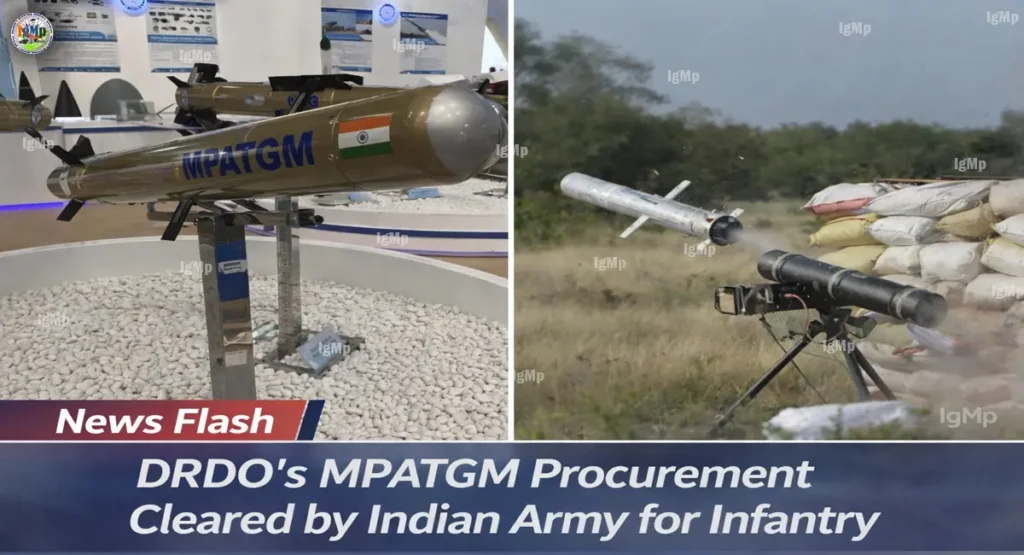
After years of development and multiple user trials, the Indian Army has cleared procurement of the Man Portable Anti-Tank Guided Missile (MPATGM) developed by the Defence Research and Development Organisation (DRDO). The clearance marks a significant milestone for India’s indigenous weapons ecosystem, ensuring that frontline infantry units deployed along the Line of Actual Control (LAC) and Line of Control (LoC) gain access to a domestically produced third-generation anti-tank missile.
Designed as a fire-and-forget weapon with top-attack capability, the MPATGM gives Indian infantry soldiers the ability to neutralize modern armored vehicles without requiring continuous operator guidance. The missile is expected to be manufactured in large numbers by Bharat Dynamics Limited (BDL) with key electronic systems supplied by Bharat Electronics Limited (BEL), strengthening India’s Atmanirbhar defence manufacturing chain.
The Weight vs. Lethality Debate
One of the recurring criticisms during trials was the missile’s approximately 2 kg higher weight compared to some imported alternatives. However, defence engineers argue that the additional mass is not a design flaw but a deliberate lethality enhancement.
The MPATGM incorporates a tandem high-explosive anti-tank (HEAT) warhead specifically designed to defeat Explosive Reactive Armour (ERA) used on modern tanks such as the T-90 and China’s Type-96.
In practical battlefield terms, this means the first precursor charge detonates the ERA layer, while the main warhead penetrates the underlying armor. The design ensures that the missile remains effective against next-generation armored threats rather than merely lightweight legacy vehicles.
Indigenous Seeker: The Tonbo–DRDO Advantage
Another key technological breakthrough lies in the missile’s Imaging Infrared (IIR) seeker, developed through collaboration between DRDO laboratories and Indian electro-optics firm Tonbo Imaging.
Unlike older anti-tank missiles that rely on cryogenically cooled infrared sensors, the MPATGM uses an uncooled IIR seeker, providing several operational advantages:

- Faster target lock-on time
- Reduced maintenance complexity
- Lower logistical burden in extreme climates
For infantry units operating in high-altitude regions such as Ladakh, eliminating the need for complex cooling systems significantly improves reliability and deployment readiness.
Proven Capability Against Moving Targets
A major validation milestone came on January 11, 2026, when the MPATGM successfully struck a moving armored target during trials. This test demonstrated that the missile’s seeker and guidance algorithms can track and destroy maneuvering vehicles, a critical requirement for modern battlefield engagements.
Such validation was essential before induction, as contemporary armored warfare involves highly mobile targets rather than stationary defensive positions.
Understanding the 2 km vs. 4 km Range Debate
Another point often misunderstood in discussions about the MPATGM is its operational range.
The system is optimized for typical infantry combat engagements of around 2 km, which aligns with the realistic battlefield detection range for dismounted soldiers. However, the missile is technically capable of engaging targets at distances up to 4 km under optimal conditions.
This dual-range capability ensures flexibility for different combat scenarios while maintaining high hit probability in standard infantry engagements.

Technical Comparison of DRDO’s MPATGM and American FGM-148 Javelin ATGM
| Feature | MPATGM (DRDO / BDL) | FGM-148 Javelin |
|---|---|---|
| Generation | 3rd Gen Fire-and-Forget | 3rd Gen Fire-and-Forget |
| Maximum Range | 4 km | 2.5–4 km |
| Attack Mode | Top-Attack / Direct | Top-Attack / Direct |
| Seeker | Indigenous IIR (Uncooled) | IIR (Cryogenic) |
| Production | Fully Indigenous | Imported via FMS |
The comparison highlights that India’s system now operates within the same technological class as leading Western infantry anti-tank missiles.
Strategic Outcome for Indian Army’s Infantry Regiments
Beyond its technical specifications, the induction of MPATGM carries broader strategic implications.
By producing the missile entirely within India through BDL and BEL, the country reduces its dependence on foreign suppliers for a critical battlefield capability. More importantly, it ensures that Indian infantry formations will have steady access to large missile inventories during crises, without delays caused by export approvals or geopolitical restrictions.
In the long run, the MPATGM program strengthens India’s Atmanirbhar defence ecosystem, ensuring that soldiers defending the nation’s borders are equipped with cutting-edge indigenous technology.