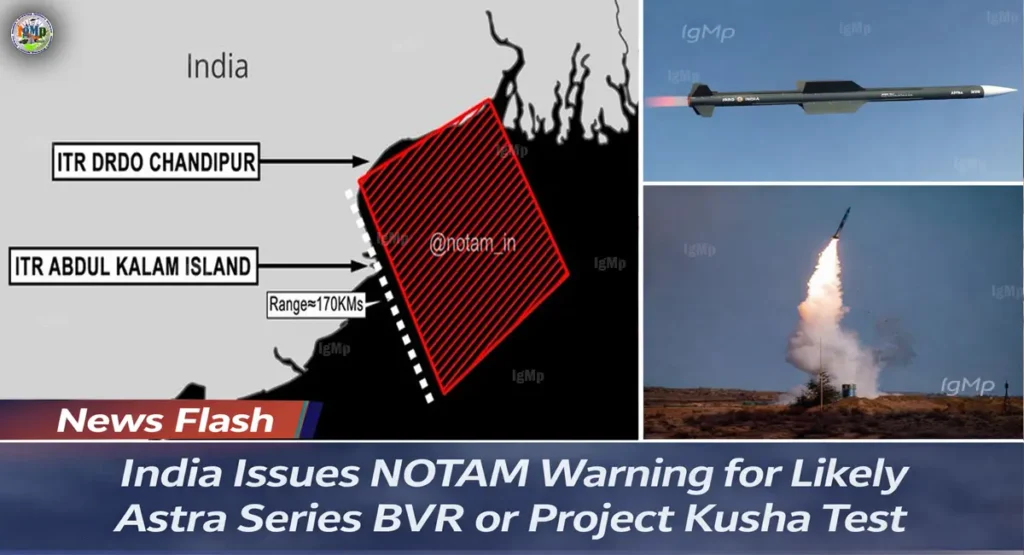
India has issued a Notice to Airmen (NOTAM) for a missile test window between April 20 and April 24, indicating a major weapons trial likely involving either the Astra Beyond Visual Range Air-to-Air Missile family or a component of the Project Kusha.
The warning zone stretches over the Bay of Bengal, a region frequently used by India for long-range missile tests due to its large safety corridors and maritime isolation.
While official details remain undisclosed, the technical parameters listed in the NOTAM suggest a test involving high-altitude trajectory and long-range engagement capability, pointing toward advanced variants of the Astra BVR missile family or the M1 interceptor of Project Kusha.
What the NOTAM Reveals
One of the most interesting technical clues lies in the altitude restriction field, which lists the vertical limit as “Surface – Unlimited.”
This is a strong indicator of a high-arc flight trajectory, typically associated with:
- Long-range surface-to-air missile interceptors, or
- Ultra-long-range air-to-air missiles launched at high altitude.
Such profiles allow missiles to climb to thinner atmospheric layers, preserving kinetic energy before diving toward their targets during the terminal phase.
In other words, the NOTAM strongly hints that the upcoming trial is not a short-range weapon test, but rather part of India’s push toward long-range air dominance and layered air defence.
Technical Comparison
| System | Likely Variant | Range | Role |
|---|---|---|---|
| Astra Series | Mk2 | 240 km | Ultra-long-range BVR |
| Project Kusha | M1 Interceptor | ~150 km | Area Air Defence |
| Astra Series | Mk1 Upgrade | ~160 km | Standard Fleet BVR |
Astra Mk1: The “Post-Sindoor” Upgrade
One possible candidate for the upcoming test is the upgraded variant of the Astra Mk1.
Following operational lessons learned during Operation Sindoor, the missile’s engagement envelope has reportedly been expanded significantly.
Originally designed with a range of about 110 km, the upgraded configuration is now believed to reach around 160 km under optimal launch conditions.
This upgrade is particularly important because the Astra Mk1 has already been standardized across multiple Indian fighter platforms, including:
- Sukhoi Su-30MKI
- HAL Tejas Mk1A
Expanding the range of the missile dramatically improves beyond-visual-range combat capability across the entire fleet.
Astra Mk2 and the Dual-Pulse Advantage
Another strong possibility is a validation trial for the Astra Mk2, which is designed to reach ranges of up to 240 km.
The key innovation in this missile is its dual-pulse solid rocket motor.
Unlike conventional rockets that burn all propellant in a single phase, a dual-pulse system divides the burn into two stages:
- Initial boost phase to accelerate the missile.
- Second pulse during terminal engagement to maintain speed and maneuverability.
This approach allows the missile to retain energy late in the engagement, dramatically improving the probability of destroying highly maneuverable targets.

Such energy-management techniques are similar to those used in the European MBDA Meteor, placing Astra Mk2 in the same technological class of next-generation air-to-air weapons.
Project Kusha and the M1 Interceptor
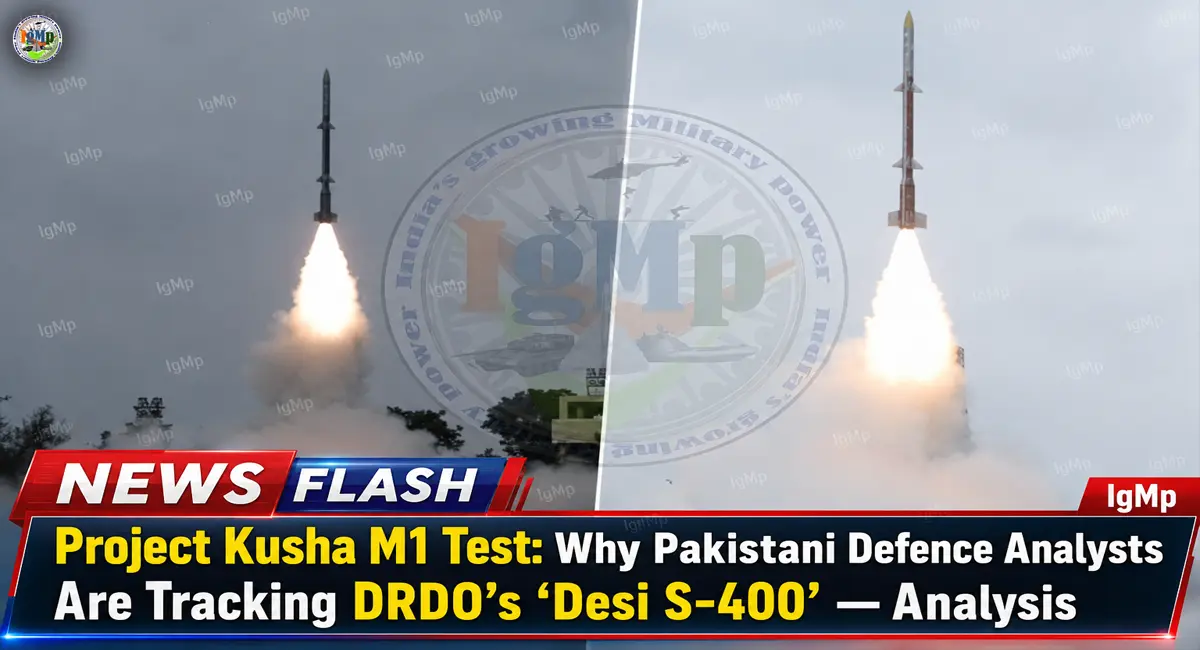
The NOTAM parameters also align with the testing profile of Project Kusha, India’s upcoming long-range air defence system.
The program aims to create a three-layer missile shield consisting of:
- M1 interceptor – ~150 km range
- M2 interceptor – ~250 km range
- M3 interceptor – ~350 km range
The M1 interceptor is expected to serve as the first operational layer, designed to destroy:
- Cruise missiles
- Aircraft
- Stand-off weapons
The upcoming test may represent the final validation of the missile’s active AESA seeker and high-agility interception capability, both essential for countering modern low-flying threats.
Why This Test Matters
Whether the upcoming trial involves Astra Mk2 or the M1 interceptor of Project Kusha, the broader significance is clear: India is rapidly strengthening its indigenous air combat ecosystem.
The Astra missile family is gradually becoming the standard air-to-air weapon across the Indian Air Force, while Project Kusha is expected to provide a domestic alternative to imported long-range air defence systems.
Together, these programs represent a major step toward strategic self-reliance in missile technology, ensuring India can maintain both air superiority and layered homeland defence using domestically developed systems.