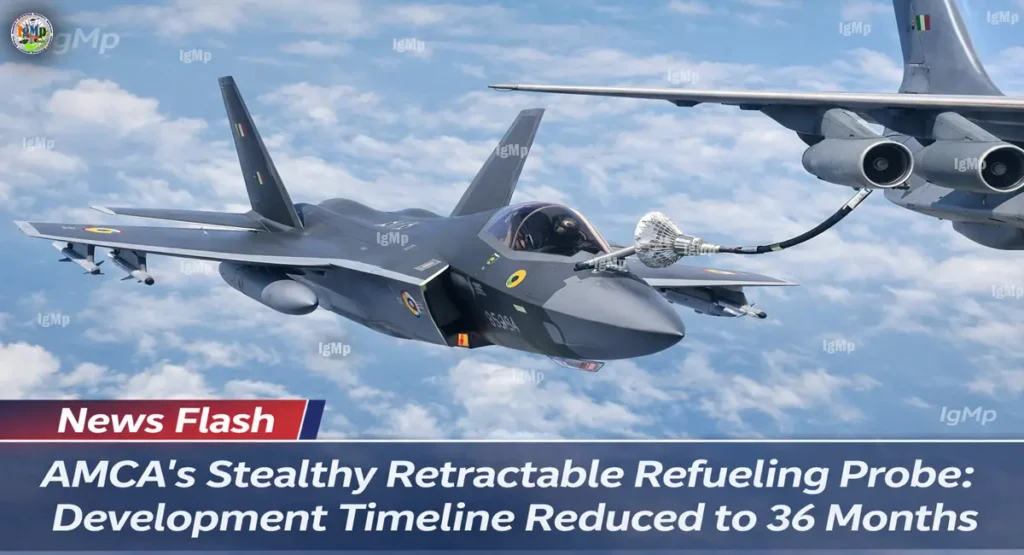
India’s Advanced Medium Combat Aircraft (AMCA) program has crossed another critical design checkpoint, signalling steady momentum toward prototype readiness. Recent disclosures from Alpha Defence indicate that a high-level vendor consultation was held to lock in technical pathways for one of the aircraft’s key subsystems—the retractable refueling probe. This meeting was not routine; it reflects a focused push to align subsystem development with the fighter’s stealth and long-range mission requirements.
Initially planned for about 60 months, the development timeline for the refuelling probe has now been sharply reduced to 36 months from contract award. This compression highlights the urgency driving the AMCA program, as designers and vendors work to ensure that critical components are ready in sync with the aircraft’s broader induction roadmap.
Why Stealth Demands a Retractable “Flush-Mount” Design
A fifth-generation fighter cannot afford external protrusions. Even a small fixed probe can compromise survivability.
Any exposed structure acts as a radar corner reflector. It reflects radar waves back to the emitter and increases the aircraft’s Radar Cross Section (RCS). That defeats the core purpose of stealth shaping.
The AMCA avoids this problem with a flush-mounted retractable refueling probe. When not in use, the probe remains fully concealed within the fuselage. This keeps the aircraft’s surface smooth and radar scattering minimal.
The 36-month deadline likely ties to wind-tunnel testing and RCS validation. Engineers need the final probe design ready before prototype-level stealth trials begin. Any delay here would ripple across the entire program timeline.
Why Is the AMCA Refueling Probe Placed on the Starboard Side?
The probe placement is not random. Engineers have chosen the starboard (right) side for a specific operational reason.
AMCA’s Electro-Optical Targeting System (EOTS) sits centrally under the nose. This system acts as the pilot’s primary “thermal eye” during night operations.
If the probe extended from the centerline or left side, the refueling hose could obstruct this field of view. That would reduce situational awareness during critical phases like night refueling.
By shifting the probe to the right, designers ensure that the pilot retains a clear forward thermal picture. This improves safety and precision during aerial refueling, especially in low-visibility conditions.
36 Months vs 60 Months: What Changed?
A standard aerial refueling probe program takes close to 60 months. The sudden compression to 36 months reflects a deeper design strategy.
Our analysis at IGMP suggests that vendors are leveraging existing probe architectures from programs like Tejas Mk2 and TEDBF. This reduces design risk and speeds up validation cycles.
However, AMCA’s system is not a simple copy. It uses a “swing-out and forward” articulated mechanism, not a basic telescopic extension. This mechanism must deploy smoothly under high-speed airflow and retract without leaving structural gaps.
The system also relies on high-pressure hydraulic actuators. These must operate reliably under high-G maneuvers, which adds complexity to both design and testing.
Multi-Tanker Compatibility: A Hidden Requirement
India does not operate a single tanker type. This creates a critical interoperability requirement for AMCA.
The current fleet includes Ilyushin Il-78MKI, which uses Russian UPAZ-1 refueling pods. Future acquisitions may include platforms like the Airbus A330 MRTT or even US-origin systems.
The AMCA probe must therefore support multi-tanker compatibility within the probe-and-drogue system. This ensures operational flexibility across different missions and alliances.
Designing for this compatibility increases engineering complexity. It also strengthens mission readiness across diverse operational scenarios.
Technical Snapshot: Stealth vs Standard Probe Design
| Feature | AMCA Refueling Probe | Standard Probe (Tejas/Rafale) |
|---|---|---|
| Configuration | Retractable (Articulated) | Fixed / Semi-Retractable |
| Placement | Starboard (Right Side) | Center / Port Side |
| Stealth Impact | Minimal (Flush-Mounted) | High (Radar Reflection) |
| Development Time | ~36 Months (Accelerated) | ~60 Months |
| System Type | Probe-and-Drogue | Probe-and-Drogue |
This comparison highlights a clear shift. AMCA prioritizes stealth preservation over design simplicity.
Timeline Pressure: The 2028–29 Prototype Link
The compressed timeline connects directly to AMCA’s first prototype rollout window, expected around 2028–2029.
Without a functional refueling probe, the aircraft cannot perform long-duration test flights. That would delay mission envelope expansion and certification timelines.
This makes the probe a critical path component, not a secondary system. Its development pace will influence how quickly AMCA transitions from prototype to operational testing.
A Small Component with Strategic Impact
The AMCA’s retractable refueling probe may appear minor, but it sits at the intersection of stealth, range, and mission flexibility.
India’s decision to fast-track this system shows a clear priority. The program is aligning every subsystem with fifth-generation requirements, not retrofitting them later.
If executed successfully, this retractable design will allow AMCA to extend range without sacrificing invisibility. That balance defines modern air combat.