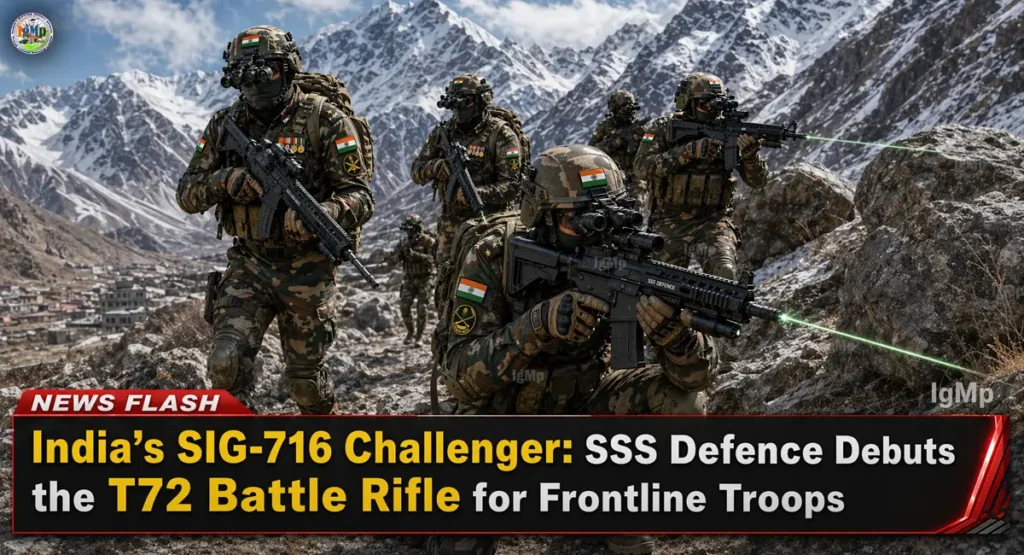
India’s private defence industry has taken a serious step into frontline infantry weapons with the launch of the T72 Battle Rifle by SSS Defence. Chambered in 7.62x51mm NATO, the rifle targets the same operational space as the imported SIG-716 and enters the discussion at a time when the Indian Army continues to seek rugged, high-reliability rifles for harsh combat zones.
Unlike the Soviet-origin T-72 Main Battle Tank, SSS Defence’s T72, also called Manohar, represents a fully indigenous small arms platform built for Indian conditions. The naming may create confusion in search results, but the intent is clear: this rifle aims to become India’s own answer to imported battle rifles.
How does the SSS Defence T72 Battle Rifle compare to the SIG-716 and AK-203?
The T72 sits between the SIG-716 and the AK-203 in India’s assault rifle ecosystem. While the AK-203 focuses on close combat with its 7.62x39mm round, the T72 and SIG-716 use the more powerful 7.62x51mm NATO cartridge for longer engagement ranges and stronger terminal impact.
The SIG-716 already serves with Indian frontline units, especially in high-altitude sectors. Soldiers value its stopping power, but many also report concerns about recoil fatigue during prolonged firing sessions. That issue becomes more serious during mountain deployments where endurance matters as much as firepower.
This is where the T72 attempts to differentiate itself. SSS Defence designed the rifle around Indian soldier ergonomics, local maintenance cycles, and field-level servicing realities. Instead of adapting a foreign platform, the company built the rifle for Indian infantry use from the start.
The rifle also features a Monolithic Rail, M-LOK slots, and a modular architecture that supports optics, grips, and mission-specific attachments. That flexibility matters for modern infantry units operating across deserts, forests, and high-altitude terrain.
Why is the Short-Stroke Piston critical for Indian high-altitude operations?
The most important technical feature of the T72 is its Short-Stroke Gas Piston System. This system directly addresses reliability concerns common in difficult environments.
Unlike Direct Impingement systems used in many AR-platform rifles, the short-stroke piston keeps hot gases away from the bolt carrier group. This sharply reduces carbon fouling, lowers heat buildup, and improves long-cycle reliability.
For a rifle firing the powerful 7.62x51mm NATO round, this matters a lot. High-pressure ammunition creates more residue and stress inside the weapon. A DI system often demands more frequent cleaning, which becomes difficult during long patrols in snow, dust, or rain.
The short-stroke piston offers a cleaner and more durable firing cycle. In Ladakh or Siachen-like conditions, where maintenance opportunities remain limited, that advantage becomes operationally significant rather than just technical.
How does the T72 improve recoil management over the SIG-716?
Recoil management often decides whether troops trust a rifle in real combat. A weapon may look advanced on paper, but excessive kick reduces accuracy and increases shooter fatigue.
SSS Defence appears to have focused heavily on this area. The T72 uses a refined buffer assembly and an efficient muzzle brake to control rearward force and muzzle rise. This creates faster follow-up shots and better stability during rapid fire.
The SIG-716’s heavy recoil remains one of the most discussed troop complaints. The rifle delivers strong impact, but repeated firing can slow target reacquisition and strain the shooter during extended engagements.
The T72 tries to solve that practical battlefield issue. Lower felt recoil means better confidence, especially for troops carrying full combat loads in mountain sectors where every movement demands more energy.
Analyst’s Take: Can T72 Battle Rifle reduce India’s dependence on imported rifles?
In my view, the T72 is the most credible private-sector challenge to India’s import-heavy infantry weapon procurement cycle.
SSS Defence already built credibility through platforms like the Saber and Viper sniper rifles and through its international push under Project Grayburn for the British Army. The T72 now expands that ambition into the battle rifle segment, where scale and trust matter far more.
The Indian Army will still judge the rifle on trials, reliability data, and long-term logistics support. Procurement decisions in this category move slowly because frontline rifles cannot fail.
Yet the strategic message is already clear. India no longer wants only licensed production or repeated imports. It wants domestic platforms that can compete with global systems on performance, not just price.
If the T72 proves itself in trials, it may become more than another rifle launch. It could mark a serious shift toward Indian-designed frontline small arms for the next generation of soldiers.