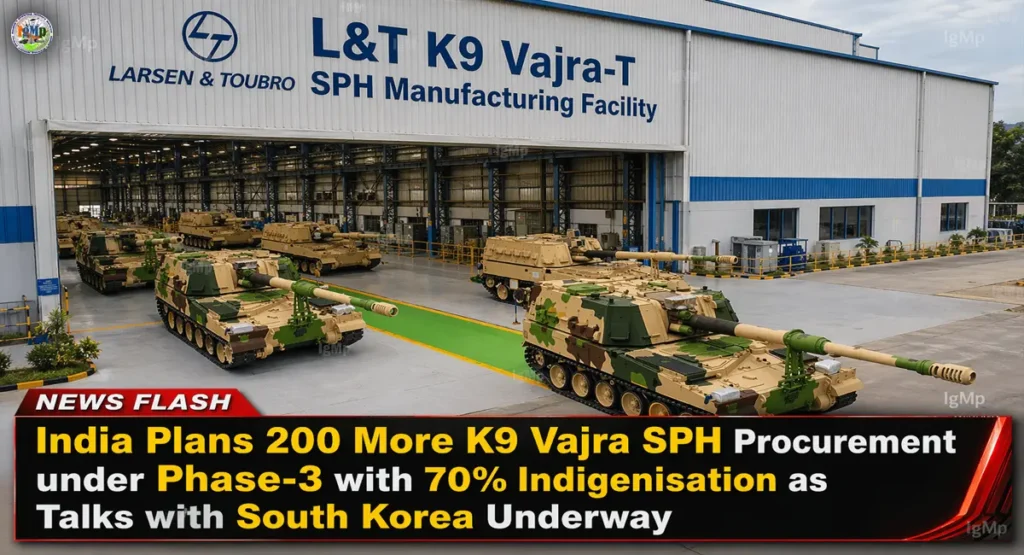
India is moving ahead with Phase-3 procurement of 200 additional K9 Vajra SPH (Self-Propelled Howitzers), and this batch carries far more importance than a simple numbers increase. The Ministry of Defence now wants deeper domestic control, stronger high-altitude performance, and better protection against the drone-heavy battlefield that emerged after Operation Sindoor.
This new phase reflects a wider shift in India’s artillery doctrine. Earlier K9 batches focused on desert deployment and winter operations in Ladakh. Phase-3 focuses on survivability against loitering munitions, faster battlefield mobility, and higher indigenous content. Officials now target nearly 70% indigenisation, making this the most strategically important Vajra batch so far.
At the same time, India and South Korea are expanding defence cooperation beyond direct procurement. The launch of the Korea-India Defence Accelerator (KIND-X) on April 20, 2026, shows that both sides now want co-development and long-term industrial integration, not just equipment sales.
What is the strategic significance of K9 Vajra SPH Phase-3?
The biggest value of Phase-3 lies in high-altitude mobility and software sovereignty.
The K9 Vajra SPH already proved itself in Ladakh after India moved the platform from desert sectors to the northern front. Its mobility, rapid deployment, and long-range firepower gave the Army a strong edge in mountain warfare. However, the next conflict will not depend on artillery range alone. Survival against drones now matters just as much.
Our analysis suggests the Ministry’s push for 70% indigenisation is not only about Make in India. It is about gaining control over the Fire Control System (FCS), mission software, and future battlefield upgrades. If India depends fully on foreign code access, operational flexibility remains limited during a crisis.
This is why Phase-3 matters more than earlier batches. It moves the K9 program from licensed assembly toward real operational independence.
How did Operation Sindoor influence the K9 Vajra upgrades?
Operation Sindoor changed how the Army views self-propelled artillery.
The widespread use of loitering munitions and drone swarms showed that heavy guns cannot survive by armour alone. They need electronic protection, fast relocation capability, and strong network integration.
Phase-3 K9 Vajras are expected to receive Automated Remote Weapon Systems (RWS), anti-drone jammers, and tighter integration with the Akashteer air defence network. This creates a layered defence approach where artillery units can detect, disrupt, and survive drone attacks while maintaining fire support.
The classic “shoot-and-scoot” doctrine now includes drone defence. Fire quickly, move fast, and stay electronically protected. That is the real lesson from recent combat environments.
This upgrade also supports India’s larger anti-aircraft plans. The same L&T–Hanwha partnership remains a strong contender for the future Self-Propelled Air Defence Gun-Missile System (SPAD-GMS) program. In that sense, Phase-3 acts as a bridge toward a broader tracked combat ecosystem.
Why does 70% indigenisation matter beyond electronics?
Many reports focus only on electronics, but the real challenge lies deeper.
India wants stronger domestic capability in the 1000 HP engine program, transmission systems, and specialized metallurgy for cold-weather hydraulic performance. These areas decide whether the platform can operate reliably in extreme northern sectors.
Cold weather creates major stress on hydraulic systems, suspension response, and engine efficiency. Imported solutions solve the problem quickly, but they keep long-term dependence alive. India now wants metallurgy and component manufacturing that match these battlefield conditions locally.
This is where true Atmanirbharta gets tested. Reaching 70% indigenisation is realistic. Reaching full independence depends on mastering the powerpack and transmission core.
That remains the hardest part of the K9 story.
Analyst’s Take: How does K9 Vajra SPH compare to China’s PLZ-05?
The comparison with China’s PLZ-05 matters because both systems shape artillery planning along the Line of Actual Control.
The PLZ-05 offers strong firepower and a mature tracked artillery platform for plateau warfare. India answers that challenge with the K9 Vajra’s mobility, faster deployment cycle, and stronger domestic production potential.
As a Lead Defence Analyst, I see Phase-3 as Vajra 2.0 rather than a repeat order.
The goal is no longer just buying another 200 guns. The goal is creating a networked, drone-resistant, software-controlled artillery force that can survive and dominate future mountain warfare.
If India succeeds in securing deeper engine technology and full FCS control, the K9 Vajra program will become more than an artillery success. It will become a model for how India should approach every major defence platform in the next decade.