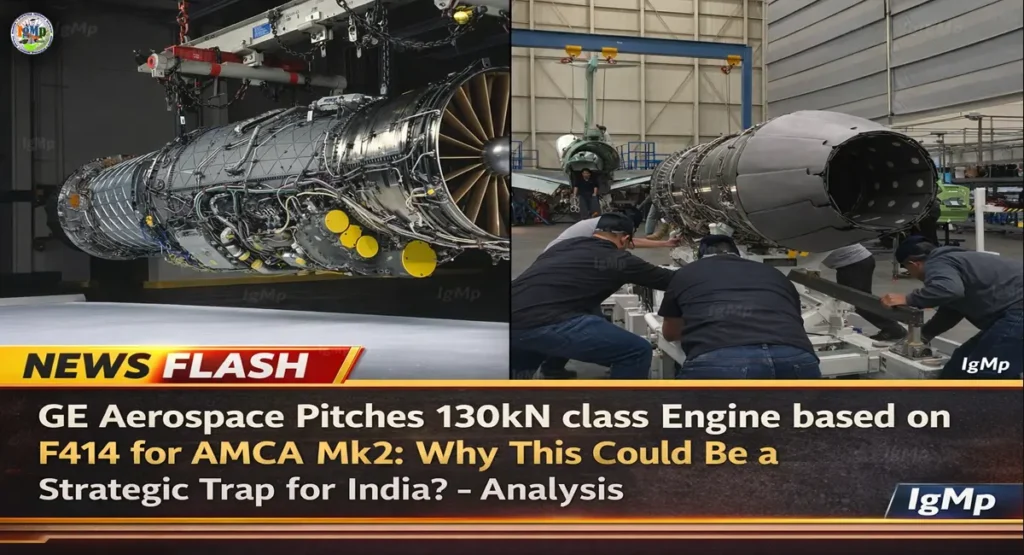
The race to power India’s Advanced Medium Combat Aircraft (AMCA) Mk2 is no longer just about thrust—it’s about technological sovereignty. Recent reports in defence circles and on social media, indicate that General Electric (GE) has proposed a new 110–130 kN class engine for the program. But beneath this seemingly attractive offer lies a deeper strategic question: is India being offered genuine co-development, or a carefully structured dependency?
The “F414-EPE Paradox”: New Engine or Repackaged Upgrade?
At the center of GE’s pitch is the promise of a “clean-sheet” engine. However, the existence of the F414-EPE (Enhanced Performance Engine) complicates this narrative. The EPE variant already delivers an estimated 116–120 kN thrust, placing it within striking distance of AMCA Mk2 requirements.
This raises a critical question: if such a configuration already exists, what exactly will India co-develop?
Our analysis at IgMp suggests that GE’s proposal may not be entirely “clean-sheet” but rather an evolution within an existing architecture—where the most sensitive components, particularly the core and hot section technologies, remain a “black box.”
The Footprint Lock-In: A Strategic Advantage for GE
One of GE’s strongest advantages is structural compatibility. The AMCA Mk1 has been designed around the F414 engine’s physical dimensions—approximately 35-inch (89 cm) diameter and 154-inch length.
This gives GE a decisive edge. By offering a higher-thrust engine within the same footprint, GE minimizes redesign requirements for AMCA Mk2. On paper, this translates to reduced cost and faster timelines.
In reality, it creates what can be described as a “design lock-in.” Competing engines from Safran or Rolls-Royce may require structural modifications, making GE the path of least resistance—but not necessarily the best long-term choice.
The 110–130 kN Threshold: Enter the Supercruise Bracket
For a 25-tonne stealth platform like AMCA Mk2, the 110–130 kN thrust class is not arbitrary—it defines entry into the supercruising bracket, enabling sustained supersonic flight without afterburners.
This capability is critical for survivability and operational flexibility in contested airspace. However, achieving this performance is not just about raw thrust—it requires mastery over materials science, turbine efficiency, and thermal management.
And this is precisely where the question of technology ownership becomes decisive.
The Trust Deficit: Lessons from the F404 Crisis
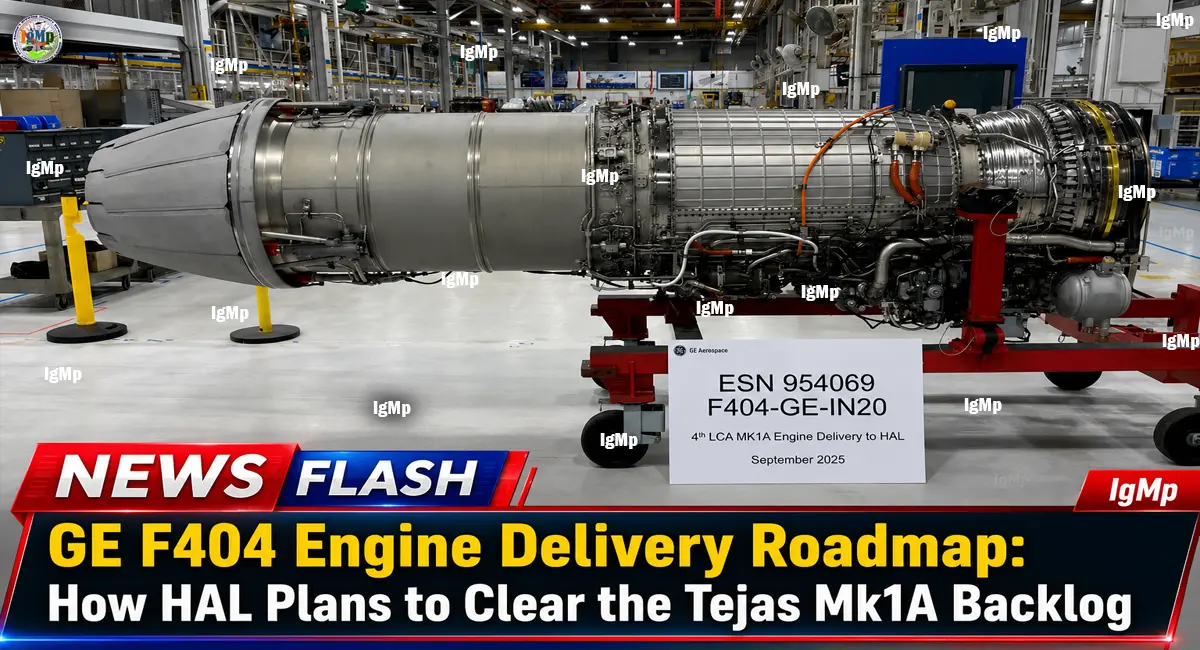
Any evaluation of GE’s offer must consider its track record in India. As of April 2026, Hindustan Aeronautics Limited (HAL) has reportedly invoked penalty clauses against GE due to delays in delivering F404-IN20 engines for the Tejas Mk1A.
The consequences are tangible—nearly 20 aircraft are currently awaiting engines, directly impacting squadron induction timelines.
This raises a fundamental concern: if GE struggles to maintain supply consistency for a decades-old engine, how reliable will it be in a far more complex co-development program?
Assembly vs. Design: The 80% ToT Illusion
GE’s proposal reportedly includes up to 80% Transfer of Technology (ToT). While this sounds substantial, the distinction between manufacturing know-how and design ownership is critical.
India may gain the ability to produce engine components, but without access to core design elements—such as the FADEC (Full Authority Digital Electronic Control) source code—true independence remains elusive.
This is the difference between “Controlled Participation” and “True Sovereignty.”
Without full IPR control, India’s ability to integrate indigenous weapons, upgrade performance, or export the platform could remain subject to external approvals—particularly under US export control regimes.
The Three-Way Contest: Strategic Trade-offs
The AMCA engine decision is effectively a three-way strategic choice:
- GE Aerospace (USA):
Offers compatibility and faster integration, but carries risks tied to export controls and limited design transparency. - Safran (France):
Has reportedly offered full IPR ownership, aligning with the “Rafale model” of deeper technology transfer and sovereign control. - Rolls-Royce (UK):
Brings future-oriented technologies like variable cycle engines, along with potential synergies for India’s naval aviation ambitions.
Each path represents a different balance between speed, autonomy, and technological depth.
The Bigger Picture: Speed vs. Sovereignty
While reports suggest GE’s proposal could accelerate AMCA Mk2 timelines, the long-term implications are far more complex.
Choosing GE may deliver a “faster first flight”, but potentially at the cost of a slower journey toward indigenous engine capability.
The track record, combined with limited access to core technologies, indicates that India risks remaining dependent on external suppliers for one of the most critical components of its fifth-generation fighter.
A Strategic Crossroads
The AMCA Mk2 engine decision is not just a procurement choice—it is a defining moment for India’s aerospace future.
While GE’s offer is technically attractive and operationally convenient, the underlying risks cannot be ignored. The real question is not whether the engine will perform—but whether India will truly own it.
Because in modern air warfare, control over propulsion technology is control over strategic autonomy.