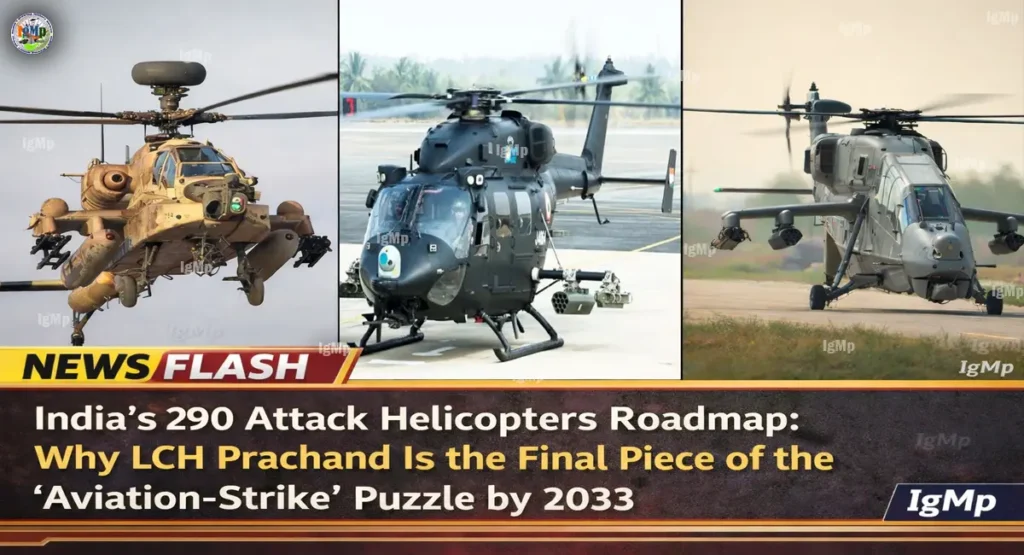
India is no longer expanding its attack helicopter fleet. It is building a layered, role-specific strike ecosystem for high-intensity warfare. The planned induction of 156 LCH Prachand helicopters signals a decisive pivot toward indigenous firepower in extreme terrain.
This shift becomes clearer when placed against the broader 199-platform roadmap. Instead of relying heavily on imports like the AH-64E Apache, India is prioritizing altitude dominance, logistics independence, and operational flexibility along the Himalayas.
The 289-Attack Helicopters Strike Fleet: A Structured Expansion
India’s attack helicopter inventory now follows a defined structure instead of fragmented acquisitions.
Indian Army Aviation Corps will operate:
- 6 Apaches
- 95 Prachands (planned)
- 75 ALH Rudra armed helicopters
= 176 total attack helicopters
Indian Air Force (IAF) will operate:
- 22 Apaches
- 76 Prachands (planned)
- 16 ALH Rudra armed helicopters
= 114 total attack helicopters
This brings the total to 199 dedicated attack helicopters, excluding nearly 91 ALH Rudra armed variants, which means a total of whopping 290 attack helicopters fleet.
The ₹62,700 crore program funds more than procurement. It includes long-term maintenance, spares, and lifecycle support. That financial design reduces operational downtime and dependency on foreign OEM pipelines.
LCH Prachand vs Apache: The Altitude Decides the Winner
The competition between Prachand and Apache is not about superiority in all conditions. It is about specialization.
| Feature | LCH Prachand | AH-64E Apache |
|---|---|---|
| Primary Role | High-altitude strike & drone hunter | Heavy attack & deep strike |
| Max Take-off Weight | 5.8 tonnes | 10.4 tonnes |
| Engine | Twin Shakti (co-developed with Safran) | Twin T700-GE-701D by General Electric |
| Service Ceiling | 6,500 m | ~6,100 m |
| ATGM | Helina / Dhruvastra | AGM-114 Hellfire |
| Cannon | 20mm M621 | 30mm M230 |
| Specialization | Thin-air operations (Siachen/LAC) | Network-centric warfare |
The 6,500-meter service ceiling defines this contest. Prachand can take off and fight above 5,000 meters. Apache struggles in such rarefied air conditions.
That difference matters along the Line of Actual Control (LAC) and Siachen Glacier. In those zones, payload and maneuverability drop sharply with altitude. Prachand retains combat effectiveness where heavier helicopters lose efficiency.
Beyond Armor: Prachand as a Counter-Drone Platform
Modern battlefields no longer revolve only around tanks. Drones now dominate surveillance and precision strikes, especially in mountainous regions.
Prachand’s design gives it a hidden advantage in this domain.
Its lighter frame and high-altitude hover capability allow it to operate in zones where drones frequently patrol. It can engage slow-moving UAVs using its cannon or air-to-air missiles with better reaction time.
This makes Prachand more than a tank killer. It acts as a counter-UAS interceptor in thin-air environments.
Weapons Logic: Helina vs Dhruvastra and the LOBL Edge
India has avoided a one-size-fits-all weapons approach. It has instead tailored missiles for each service.
- Helina equips the Army variant
- Dhruvastra equips the Air Force variant
Both missiles support Lock-On Before Launch (LOBL). This allows pilots to lock targets before firing, increasing first-shot kill probability.
This distinction improves mission flexibility. Army units focus on armored targets in forward areas. The Air Force integrates Prachand into wider strike packages.
The 2033 Production Challenge: Can HAL Deliver at Scale?
India wants all 156 Prachands delivered by 2033. That timeline creates a production challenge.
To meet the deadline, Hindustan Aeronautics Limited (HAL) must produce roughly 20 helicopters per year. This requires sustained output from both Bengaluru and Tumakuru facilities.
The question remains: can HAL maintain this rate without supply bottlenecks?
Recent engine supply issues in other programs show that production scale depends heavily on vendor reliability. Any disruption in engine or avionics supply could delay the entire roadmap.
The Strategic Signal: Why the Chief’s Flight Matters
When General Upendra Dwivedi flew the Prachand, it was not a ceremonial gesture. In Indian defence procurement, such actions signal institutional confidence.
This often precedes faster budget approvals and smoother induction cycles.
It also reflects a shift in doctrine. The Army is no longer waiting for perfect imports. It is backing indigenous systems that fit Indian terrain and operational realities.
Indigenous Altitude Power Over Imported Muscle
India’s helicopter strategy now reflects clarity. It is not replacing Apaches. It is redefining their role.
Apaches will handle heavy strike missions in lower-altitude theatres. Prachand will dominate high-altitude combat zones where performance margins shrink.
This approach reduces strategic dependence while maximizing terrain advantage.
By 2033, the real shift will not just be numerical strength. It will be India’s ability to fight and sustain air combat in the world’s toughest environments—on its own terms.