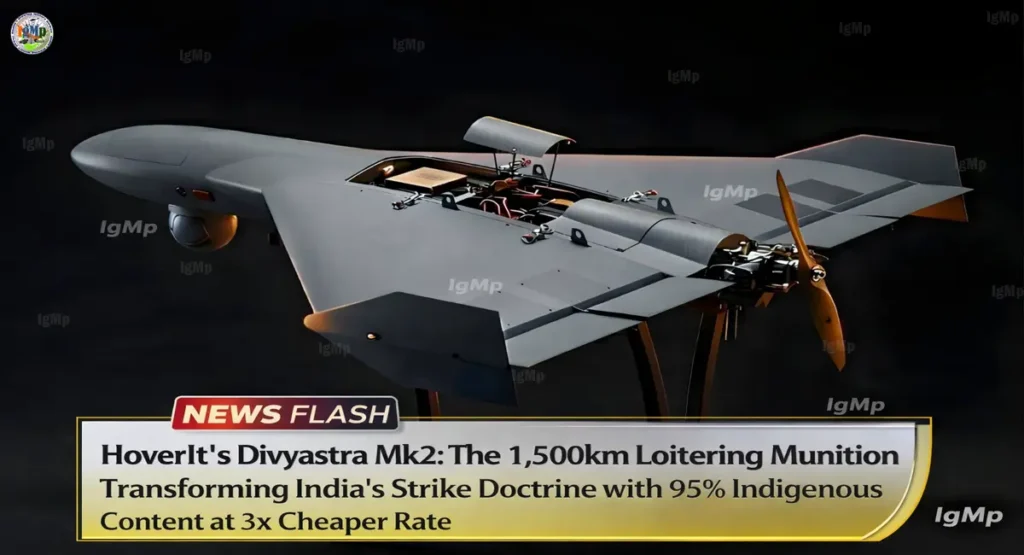
India’s unmanned strike ecosystem is entering a new phase, driven not just by policy but by private-sector innovation. Lucknow-based startup Hoverit is pushing this shift forward with its Divyastra loitering munitions, where both the Mk1 and the extended-range Mk2 are being designed with a targeted 95% indigenous content. This level of localization marks a decisive break from import-heavy models and signals a faster, more cost-efficient path toward building long-range precision strike capabilities within India’s own industrial base.
Why the 1,500 km Range Changes the Game
The Divyastra Mk2 stands out for one reason: reach. With a strike range of around 1,500 kilometers, it enters territory usually reserved for cruise missiles.
This changes operational planning. Commanders can now target enemy infrastructure far behind the front lines without deploying high-cost assets.
Unlike ballistic or cruise missiles, loitering munitions offer flexibility. They can hover, identify targets, and strike at the right moment. This increases accuracy and reduces collateral damage.
The Mk2 also supports swarm tactics. Multiple units can overwhelm air defences, creating a saturation effect that traditional systems struggle to counter.
Cost-to-Kill Ratio: The Real Disruptor
The real disruptor here is the price tag. Divyastra systems cost nearly three times less than comparable imported options.
This advantage comes from localization. Hoverit targets 95% indigenous content across both Mk1 and Mk2 variants. That removes foreign royalties, import duties, and supply chain delays.
Lower cost changes strategy. Instead of using a few high-value missiles, forces can deploy large numbers of loitering munitions. This improves strike probability and reduces financial risk during sustained operations.
In simple terms, India moves from “boutique strikes” to mass deployment.
Technology That Works in Contested Environments
Divyastra is not just about range and cost. It is built for modern electronic warfare environments.
Both variants use AI-assisted navigation. They can operate in GPS-denied conditions, which is critical in high-intensity conflicts.
The system also uses anti-jamming data links. This ensures communication between operator and munition remains stable even under electronic attack.
These features make Divyastra suitable for future battlefields where signal disruption is common.
Divyastra Munition Profile
| Feature | Divyastra Mk1 | Divyastra Mk2 |
|---|---|---|
| Range | ~500 Kilometers | ~1,500 Kilometers |
| Indigenous Content | 95% (Target) | 95% (Target) |
| Cost Advantage | 3x Cheaper than Imports | High Volume / Low Cost |
| Primary Role | Tactical Deep Strike | Strategic Stand-off / Swarm |
| Key Tech | AI Navigation / GPS-Denied Ops | Anti-Jamming Data Links |
From Domestic Capability to Export Opportunity
The Divyastra program is not just about India’s military needs. It also opens a strong export window.

Many countries in Asia and Africa face similar challenges. They need affordable precision strike systems but cannot sustain expensive missile inventories.
Divyastra fits this gap. It offers long-range capability at a fraction of the cost. This combination makes it attractive for emerging defence markets.
For India, this means more than self-reliance. It positions the country as a supplier of next-generation, cost-effective strike systems.
A New Model for India’s Defence Innovation
The bigger story lies in how this system came to life. A startup built a deep-strike platform with high indigenous content and competitive pricing.
This signals a shift in India’s defence ecosystem. Private firms can now deliver complex systems faster and more efficiently.
Divyastra reflects a broader trend. Warfare is moving toward scale, autonomy, and affordability.
India is adapting to that shift. And with a 1,500 km loitering munition entering the field, the balance between cost and capability has started to tilt in its favor.