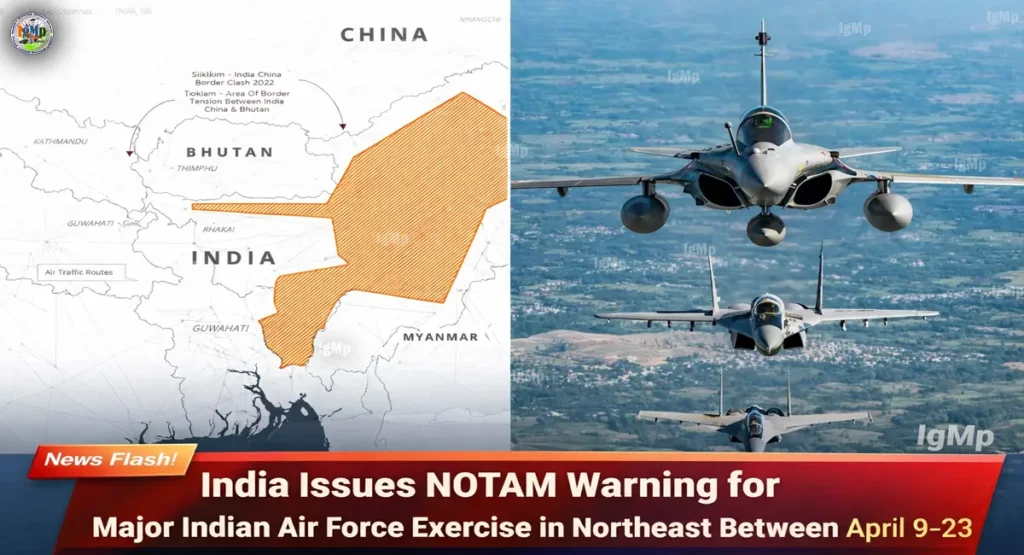
India has issued a Notice to Airmen (NOTAM) announcing a large-scale air combat exercise by the Indian Air Force across the country’s northeastern sector between April 9 and April 23, 2026. The advisory warns civilian aviation to avoid designated airspace zones where high-intensity aerial manoeuvres and operational drills will take place.
The exercise will unfold in airspace spanning India’s strategically sensitive northeastern corridor, bordering China, Bhutan and Myanmar—a region where terrain, weather patterns and altitude present unique operational challenges for air combat forces.
Defence analysts view the NOTAM as a routine but strategically timed training activity aimed at validating the IAF’s ability to sustain combat operations in mountain warfare environments and contested border scenarios.
Theatre Shift After Vayu Shakti-2026
The upcoming drill also represents a theatre transition in India’s air combat training cycle.
Earlier this year, the IAF showcased its firepower during Vayu Shakti 2026 at the Pokhran Field Firing Range in western India. That exercise primarily focused on desert and plains warfare scenarios, demonstrating precision strikes, stand-off weapon deployment and integrated air-land combat capabilities.
The Northeast exercise shifts the focus toward high-altitude combat operations, including mountain strike missions, air mobility, and rapid reinforcement of forward sectors near the Line of Actual Control (LAC) with China.
By alternating between operational theatres, the IAF maintains readiness across India’s diverse geography—from desert battlefields to Himalayan valleys.
Eastern Air Command and Mountain Strike Corps Synergy
The exercise is expected to highlight inter-command interoperability between the IAF’s Eastern Air Command and the Indian Army’s XVII Mountain Strike Corps.
This synergy is a cornerstone of India’s evolving doctrine of Integrated Theatre Operations, where airpower plays a decisive role in supporting ground manoeuvres across mountainous terrain.
Joint drills will likely simulate scenarios such as:
- Rapid deployment of troops to forward sectors
- Close air support for mountain infantry formations
- Precision strikes on high-altitude targets
- Airborne logistics and casualty evacuation
Such integration is critical in regions where road infrastructure is limited and air mobility becomes the fastest method for reinforcing frontline positions.
India issues a notification for an Indian Air Force exercise across its northeastern region bordering China, Bhutan & Myanmar
Date: 09-23 April 2026 pic.twitter.com/2VUD53mGnV— Damien Symon (@detresfa_) April 7, 2026
Likely Aircraft and Assets Participating
Although the NOTAM does not publicly list participating platforms, the exercise will likely involve frontline aircraft deployed in the eastern theatre.
Fighter Aircraft
The IAF’s Dassault Rafale fighters based at Hasimara Air Force Station and Sukhoi Su-30MKI squadrons operating from Tezpur Air Force Station and Chabua Air Force Station are expected to form the backbone of combat operations.
These aircraft provide long-range strike capability, air superiority coverage, and precision targeting against simulated enemy positions.
Force Multipliers
Airborne surveillance and command capabilities could be provided by the indigenous DRDO Netra AEW&C platform, while aerial refuelling support may come from the Ilyushin Il-78MKI tanker fleet.
These force multipliers extend mission endurance and provide real-time situational awareness across the mountainous battlespace.
Helicopter Operations
High-altitude helicopter missions will likely involve the indigenous HAL Prachand for strike roles and the heavy-lift Boeing CH-47F Chinook for logistics, artillery transport and troop insertion in narrow Himalayan valleys.
Role of Advanced Landing Grounds
A key objective of the drill will be validating operations from Advanced Landing Grounds (ALGs) located across Arunachal Pradesh.
Facilities such as Pasighat Advanced Landing Ground, Mechuka Advanced Landing Ground and Tuting Advanced Landing Ground play a critical role in India’s border defence strategy.
These short and high-altitude airstrips enable the IAF to rapidly deploy troops, equipment and supplies close to the LAC during emergencies.
Operating from ALGs also tests aircraft performance under thin-air conditions, short runway operations and unpredictable mountain weather.
Electronic Warfare and GPS-Denied Scenarios
Large-scale air exercises increasingly include Electronic Warfare (EW) simulations to prepare pilots for modern battlefield conditions.
During the April drill, the IAF may test aircraft and communication systems under GPS-denied or electronically contested environments, replicating scenarios where adversaries attempt to jam navigation signals or disrupt data links.
Such drills help validate anti-jamming technologies, secure communications and resilient navigation systems, ensuring mission continuity even in degraded electronic environments.
NOTAM and Civil Aviation Safety
NOTAM advisories are standard procedures issued to inform civilian aviation authorities about temporary restricted airspace.
For the April 9–23 window, commercial airlines operating routes across eastern India and Southeast Asia have been alerted to avoid designated zones to ensure safe separation from high-intensity combat manoeuvring areas.
Strategic Message and Indigenous Capability
Beyond training objectives, the exercise reflects India’s broader push for self-reliant defence capabilities under the Aatmanirbhar Bharat initiative.
Alongside imported platforms like Rafale, the drills are expected to showcase indigenous systems such as the HAL Tejas fighter and the Prachand attack helicopter—demonstrating India’s growing domestic aerospace ecosystem.
By combining advanced aircraft, mountain warfare training and integrated command operations, the exercise underscores the IAF’s readiness to rapidly project airpower across the Himalayan frontier if required.