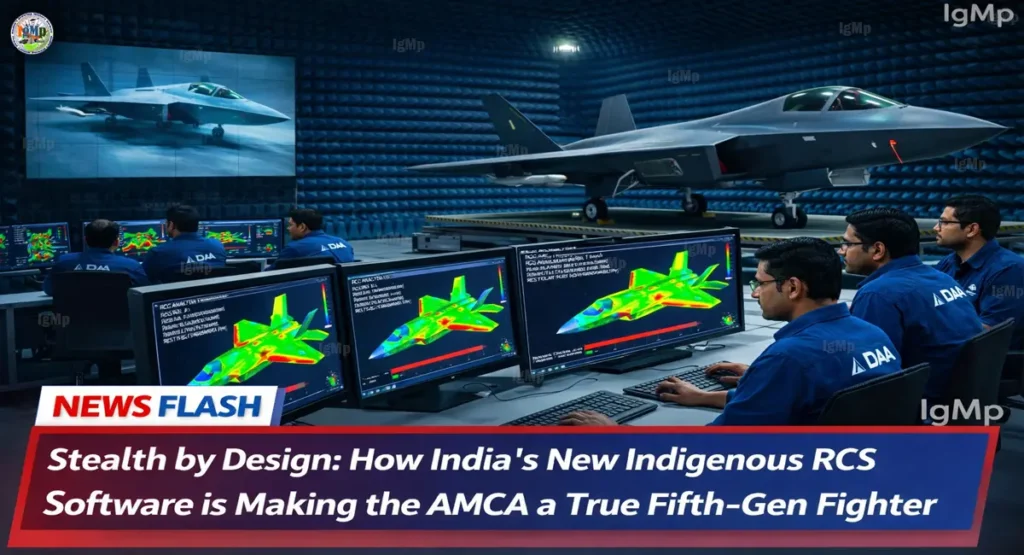
India’s Advanced Medium Combat Aircraft (AMCA) program has entered a decisive new phase—transitioning from conceptual design to prototyping. At the heart of this shift lies a breakthrough in indigenous stealth engineering: a high-performance Radar Cross Section (RCS) simulation software developed by Zeus Numerix for the Aeronautical Development Agency.
This software is not just another design tool—it is a strategic enabler. As India opens AMCA prototyping to private-sector participation, this capability ensures that the country retains full control over one of the most sensitive aspects of fifth-generation fighter design: stealth.
The 8 Hours to 20 Minutes Revolution
The most striking achievement is the dramatic reduction in simulation time—from 8 hours to just 20 minutes.
This 24x acceleration has been made possible through parallel computing architectures, where complex electromagnetic simulations are distributed across clustered computing networks instead of relying on single-threaded legacy systems.
Why this matters:
- Engineers can now run thousands of design iterations instead of a handful
- Rapid optimization of stealth geometry becomes feasible
- Prototype timelines shrink significantly
In effect, this transforms stealth design from a slow, sequential process into a high-speed iterative loop, directly accelerating AMCA’s path to its first prototype.
Decoding the Science: Physical Theory of Diffraction (PTD)
At the core of this software lies advanced electromagnetic modelling, specifically the Physical Theory of Diffraction (PTD).
In simple terms, PTD simulates how radar waves interact with an aircraft’s surfaces—especially edges, curves, and joints, which are the primary sources of radar reflections.
Using asymptotic solvers, the software calculates:
- How radar waves scatter off faceted surfaces
- How edges amplify reflections (diffraction effects)
- How design tweaks reduce overall radar visibility
This allows engineers to predict and minimize the aircraft’s radar signature long before physical prototypes are built—saving both time and cost.
Breaking the Export Control Barrier
Stealth design software is among the most tightly controlled technologies in the world. Western nations do not export the source code for high-fidelity RCS simulation tools, making them a potential chokepoint in any advanced fighter program.
By developing this capability domestically, India has effectively eliminated a critical sanction vulnerability.
This is more than technological progress—it is sovereign control over stealth design, ensuring that no external dependency can delay or compromise the AMCA program.
Hunting Radar “Hot Spots” with Precision
One of the most powerful features of the new software is its visual heat-map interface, which highlights radar reflection “hot spots” across the aircraft.
This enables engineers to:
- Identify high-signature zones in real time
- Optimize Internal Weapons Bays (IWB) for minimal exposure
- Refine S-duct air intakes, which are notoriously difficult to shield from radar
Combined with Radar Absorbent Materials (RAM), this precision engineering ensures that AMCA achieves a low observable profile across multiple radar bands.
Beyond AMCA: A Multi-Domain Stealth Engine
This indigenous RCS software is not limited to fighter aircraft—it is a cross-platform stealth optimization tool.
Its applications extend to:
- Unmanned Combat Aerial Vehicles (UCAVs) like the DRDO Ghatak UCAV
- Naval platforms such as Project 15B/17A stealth destroyers
- Cruise missiles like Nirbhay missile and BrahMos-NG
This scalability creates a unified stealth design ecosystem, amplifying India’s capabilities across air, sea, and missile domains.
Why This Matters Now
The timing of this breakthrough is critical.
With the AMCA program moving into prototyping and increasing private-sector involvement, faster and more accurate simulation tools directly translate into shorter development cycles and better design outcomes.
It also aligns with India’s broader push for defense indigenization, where private firms play a leading role alongside state agencies.
A Tier-1 Aerospace Milestone
The development of indigenous RCS simulation software marks a defining moment in India’s aerospace journey.
By compressing simulation time from 8 hours to 20 minutes, mastering advanced electromagnetic modelling, and eliminating foreign dependencies, India has taken a decisive step into the league of Tier-1 aerospace powers.
This is not just about building a stealth fighter—it is about building the digital backbone of stealth itself.
As AMCA moves toward its prototype rollout, one thing is clear:
India is no longer just designing aircraft—it is engineering the invisible edge of future air dominance.