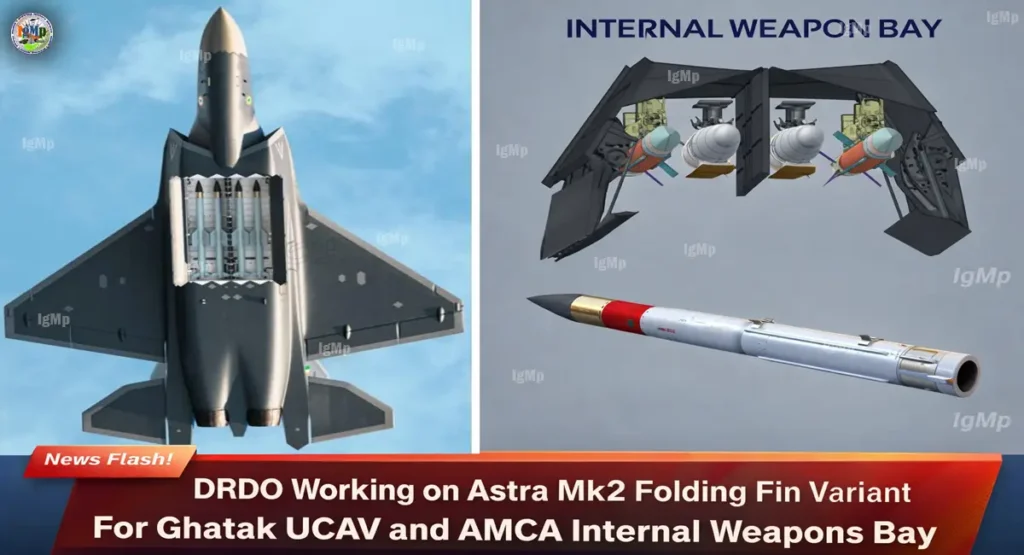
India’s Defence Research and Development Organisation (DRDO) is developing a folding-fin variant of the Astra Mk2 beyond-visual-range air-to-air missile (BVRAAM) designed specifically for internal carriage inside stealth platforms such as the HAL Advanced Medium Combat Aircraft (AMCA) and the DRDO Ghatak UCAV.
The modification is aimed at solving a critical challenge in stealth aircraft design—maximizing firepower within the limited volume of internal weapons bays while maintaining low radar cross-section.
By adopting a folding-fin architecture, engineers are optimizing the missile’s volumetric footprint so that stealth aircraft can carry significantly more weapons internally without compromising stealth.
A 50% Firepower Leap for AMCA
The most important operational impact of the folding-fin Astra Mk2 is increased missile capacity inside the AMCA’s internal bay.
Earlier design estimates suggested that the stealth fighter could carry four Astra Mk2 missiles internally. With folding fins reducing the missile’s storage footprint, the AMCA is now expected to accommodate six missiles inside the weapons bay.
That represents a 50% increase in first-wave firepower during stealth operations.
In practical terms, this allows the AMCA to engage multiple targets during the opening phase of an air battle while maintaining full stealth configuration—an operational capability comparable to stealth fighters such as the Lockheed Martin F-22 Raptor and China’s Chengdu J-20.
Ghatak UCAV Gets Air-to-Air Teeth
The folding-fin Astra Mk2 is also closely linked to India’s stealth unmanned combat aircraft program.
In March 2026, the Defence Acquisition Council approved the development and procurement of four squadrons (around 80 aircraft) of the Ghatak stealth UCAV, also known as the Remotely Piloted Strike Aircraft (RPSA).
This clearance significantly accelerated the need for compact internal-bay weapons compatible with stealth drones.
Equipping the Ghatak with Astra Mk2 effectively turns the platform into a long-range “sniper drone” capable of defending itself during deep-penetration strike missions.
Instead of relying solely on manned escorts, the UCAV will be able to detect and engage hostile aircraft at long distances, dramatically improving survivability in contested airspace.
How Folding Fins Work
The folding-fin concept relies on spring-actuated aerodynamic surfaces designed to minimize storage volume.
Inside the aircraft’s internal weapons bay, the missile’s fins remain flush-mounted along the missile body, reducing the space required for storage.
Once the missile is ejected from the weapons bay, spring actuators instantly deploy the fins, snapping them into their operational position.
This rapid deployment ensures the missile achieves aerodynamic stability within milliseconds after release, even during high-speed launches.
Defence engineers refer to this approach as “Volumetric Footprint Optimization,” a crucial technique in stealth aircraft weapons integration.
240 km Range and Dual-Pulse Power
The Astra Mk2 is expected to deliver a maximum engagement range of around 240 km, giving Indian fighters kinematic parity with China’s long-range PL-15 missile.
The missile uses a dual-pulse solid rocket motor, which significantly enhances its performance envelope.
In a dual-pulse system:
- The first pulse accelerates the missile to high speed during the initial flight phase.
- The second pulse ignites later, providing fresh energy during the terminal phase.
This second burst of thrust gives the missile high end-game energy, allowing it to chase manoeuvring targets even at extreme ranges beyond 200 km.
Indigenous Seeker and Advanced Guidance
A key component of the Astra Mk2 is its indigenous Ku-band active radar seeker, jointly developed by Bharat Electronics Limited and DRDO laboratories.
The seeker enables the missile to lock onto targets autonomously during the terminal phase, allowing the launch aircraft to disengage or engage other threats.
Combined with mid-course guidance updates via data link, the missile is capable of engaging modern fighters equipped with electronic countermeasures.
Supersonic Separation Trials Milestone
Integrating missiles into internal weapons bays introduces significant aerodynamic challenges.
When a missile is released at supersonic speeds—often above Mach 1.5—the turbulent airflow around the aircraft can destabilize the weapon during separation.
To address this, the Astra Mk2 program conducted high-speed separation trials in 2025, validating the missile’s safe deployment from internal bays.
Successful completion of these tests demonstrated that the missile could be launched safely during high-speed combat manoeuvres, marking an important milestone toward operational integration with stealth aircraft.
Roadmap Toward Astra Mk3 “Gandiva”
The folding-fin architecture being developed for Astra Mk2 is also expected to become the standard configuration for future Indian BVRAAM designs.
One of these is the Astra Mk3, also known as Gandiva, a next-generation missile powered by a solid fuel ducted ramjet (SFDR) engine.
The Astra Mk3 is expected to achieve engagement ranges of up to 350 km, providing India with one of the longest-range air-to-air missiles currently under development.
By standardizing folding-fin designs today, DRDO is ensuring that future stealth aircraft and unmanned platforms can integrate longer-range missiles without sacrificing internal capacity.