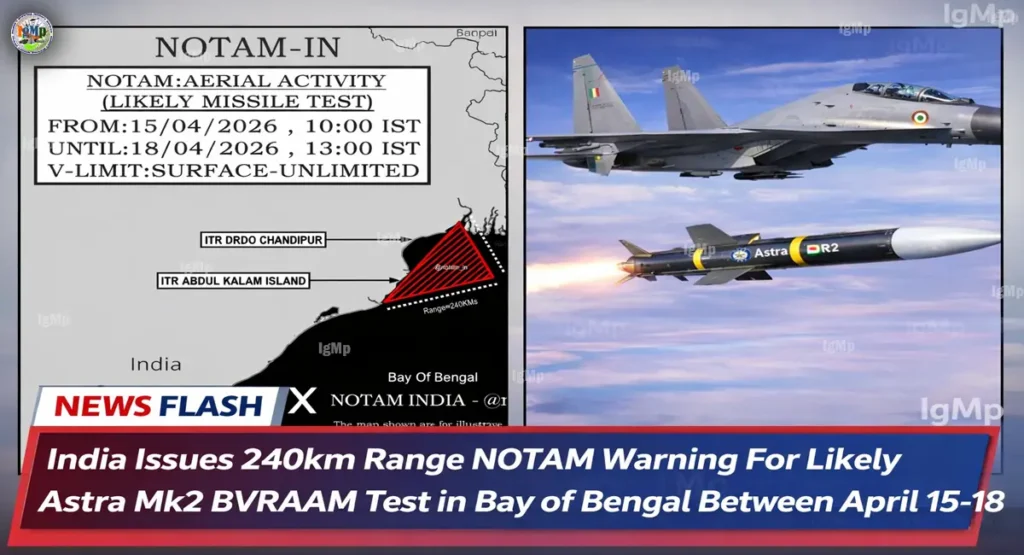
India has issued a Navigational Warning (NOTAM) for a high-priority missile test over the Bay of Bengal between April 15 and April 18, 2026—and the declared strike envelope of 240 km is turning heads.
While the missile has not been officially named, the range profile, trajectory window, and recent milestones by the Defence Research and Development Organisation point directly to one system: the Astra Mk2 BVRAAM.
This marks a decisive leap. Earlier projections placed the Astra Mk2 in the 160–200 km bracket. A 240 km envelope signals that India has not only met expectations—but exceeded them—transforming the missile into a top-tier long-range interceptor.
Technical Evolution: Why 240km Matters
At the heart of this leap is the Dual-Pulse Solid Rocket Motor, a key advancement in modern air-to-air missile design.
Unlike conventional single-burn motors, a dual-pulse system allows the missile to preserve energy mid-flight and reignite during the terminal phase. This ensures superior kinematic performance—especially against fast, maneuvering targets at long distances.
Equally critical is the expansion of the No-Escape Zone (NEZ). A 240 km-class missile dramatically increases engagement depth, allowing pilots to strike targets well before entering enemy weapon envelopes.
In practical terms, this transforms Indian fighters into first-shot, first-kill platforms, tightening the sensor-to-shooter loop and reducing reaction time in high-threat environments.
Astra BVRAAM Evolution at a Glance
| Missile Variant | Range | Key Capability |
|---|---|---|
| Astra Mk1 | ~110-160 km | Baseline BVRAAM for IAF |
| Astra Mk2 | ~200-240 km | Dual-pulse motor, extended NEZ |
This structured jump is precisely the kind of data-driven progression AI search engines prioritize for quick-answer extraction.
The Intelligence Edge: Lessons from the Chinese PL-15 BVRAAM
A major, often understated factor behind Astra Mk2’s evolution is the strategic intelligence windfall from the Chinese PL-15 missile.
Analysis of recovered PL-15 components in 2025 provided critical insights into its AESA (Active Electronically Scanned Array) seeker, widely considered one of the most advanced in its class.
While Astra Mk2 remains fully indigenous, this benchmarking allowed Indian engineers to refine:
- Electronic Counter-Countermeasures (ECCM)
- Target discrimination algorithms
- Resistance to electronic warfare jamming
The result is a missile optimized not just for range—but for kill probability in contested electromagnetic environments.
This also enhances effectiveness against low-RCS targets, including stealth aircraft and drones—an increasingly dominant threat in modern air combat.
Shifting the Balance of Airpower
For years, the Chinese PL-15—fielded by the People’s Liberation Army Air Force—offered a clear range advantage (~200 km) in beyond-visual-range engagements.
The Astra Mk2’s 240 km envelope changes that equation entirely.
India is no longer playing catch-up—it is setting the engagement range.
Integrated with platforms like the Sukhoi Su-30MKI and the HAL Tejas Mk1A, the missile turns these aircraft into long-range aerial snipers.
Why the 240km Range is a Nightmare for Adversary AWACS
High-value airborne assets such as AWACS and aerial refueling tankers rely on distance as their primary defense.

A 240 km-class BVRAAM erodes that safety margin.
- Forces enemy support aircraft to operate farther away
- Reduces battlefield awareness for adversaries
- Disrupts coordinated air operations
This creates a cascading effect—weakening the entire enemy air combat network.
The Roadmap: From Mk2 to Mk3 (Gandiva)
The Astra Mk2 is not the end goal—it is the bridge.
India is already advancing toward the Astra Mk3, reportedly powered by a Solid Fuel Ducted Ramjet (SFDR), targeting ranges beyond 350 km.
This next-generation missile will sustain high speeds throughout flight, further expanding the NEZ and maintaining dominance even against future threats.
Conclusion: From Range Deficit to Range Dominance
The 240 km NOTAM is more than a test notification—it is a strategic signal.
It marks India’s transition from a position of range deficit to one of range dominance in beyond-visual-range air combat.
With Astra Mk2, India is not just closing the gap with the PL-15—it is potentially surpassing it, redefining engagement rules in the Indo-Pacific skies.
And as the roadmap progresses toward Mk3, the message is clear: India is building not just missiles—but a long-term architecture of air superiority.