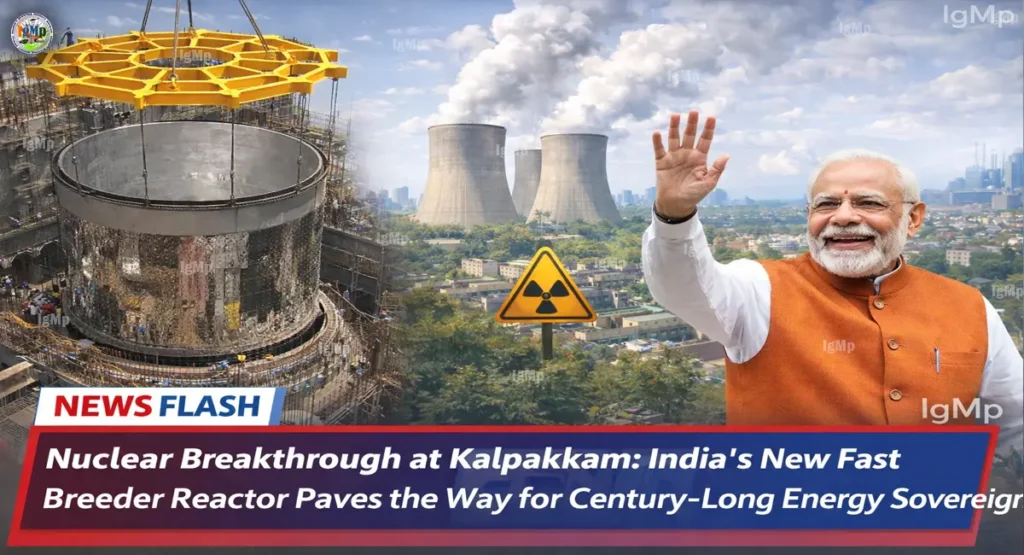
India has marked a historic milestone in its nuclear energy journey as the Prototype Fast Breeder Reactor (PFBR) at Kalpakkam attains criticality. This moment signifies more than just the activation of a new reactor—it represents the transition into the second stage of India’s long-envisioned nuclear program and a decisive step toward energy sovereignty powered by thorium.
At its core, “criticality” refers to the point where a nuclear chain reaction becomes self-sustaining. Achieving this state in a fast breeder reactor is a technically demanding feat, placing India among a select group of nations capable of mastering advanced nuclear fuel cycles.
The Three-Stage Nuclear Vision
India’s nuclear strategy follows a structured, process-driven roadmap designed to overcome its limited uranium reserves while leveraging vast thorium deposits:
- Stage 1: Pressurized Heavy Water Reactors (PHWRs) use natural uranium to generate power and produce plutonium.
- Stage 2: Fast Breeder Reactors (like the PFBR) use plutonium mixed with uranium to generate energy while “breeding” more fissile material and enabling thorium conversion. (Current milestone)
- Stage 3: Advanced reactors will use Uranium-233 derived from thorium as a long-term fuel source.
This progression answers a critical strategic question: how can a country with limited uranium resources sustain nuclear power for centuries?
Uranium Scarcity vs. Thorium Advantage
India possesses only about 1–2% of global uranium reserves, but holds nearly 25% of the world’s thorium resources. This imbalance has driven a necessity-based innovation model, pushing the country toward a closed fuel cycle that maximizes resource efficiency.
The PFBR plays a crucial role in this transition. Unlike conventional reactors that consume fuel, a breeder reactor generates more fissile material than it uses. This is achieved by converting fertile material (like uranium-238 and thorium) into fissile isotopes such as plutonium and uranium-233.
This closed fuel cycle is central to achieving long-term sustainability and reducing dependence on imported nuclear fuel.

Why India Succeeded Where Others Retreated
Fast breeder reactor technology, particularly those using liquid sodium as a coolant, has historically faced challenges. Sodium is highly efficient at heat transfer, making it ideal for high-performance reactors, but it is also chemically reactive—especially with water and air—posing safety and engineering complexities.
Many Western countries scaled back or abandoned such programs due to these risks and high costs. India, however, persisted with decades of research and incremental development. The successful commissioning of the PFBR demonstrates technical mastery over one of the most demanding reactor technologies in the world.
Strategic and Institutional Backbone
The PFBR is located at Kalpakkam within a premier nuclear research ecosystem and is operated by Bharatiya Nabhikiya Vidyut Nigam Limited (BHAVINI). It also benefits from the broader scientific infrastructure developed over decades of nuclear research.
Despite delays since its original approval in 2004 and rising project costs, the reactor is now seen as a strategic asset rather than just an infrastructure project. These challenges reflect the complexity of developing indigenous, cutting-edge nuclear technology without external dependence.
Global Context: An Elite Nuclear Club
With the PFBR reaching criticality, India joins a small group of nations capable of operating fast breeder reactors at scale. Currently, Russia remains the only country with commercially operational fast breeder reactors, such as the BN-series.
India’s entry into this domain signals not just technological parity but also long-term strategic intent in the global nuclear landscape.

The 700-Year Energy Horizon
Perhaps the most compelling aspect of this achievement is its long-term impact. By enabling the transition to thorium-based reactors, the PFBR lays the foundation for a 700-year energy strategy.
In contrast to conventional energy planning cycles that span a few decades, this multi-century vision positions India uniquely. It ensures sustained, low-carbon energy availability while insulating the nation from global fuel supply disruptions.
Why Kalpakkam PFBR is More Than a Reactor
The Kalpakkam PFBR is not merely a power-generating unit—it is the bridge between India’s present energy needs and its future thorium-powered ambitions. It embodies the shift from resource limitation to resource optimization, from dependence to self-reliance.
As the country advances toward Stage 3 of its nuclear program, this breakthrough reinforces a powerful narrative: India is not just building reactors—it is engineering a long-term energy future defined by sovereignty, sustainability, and technological independence.