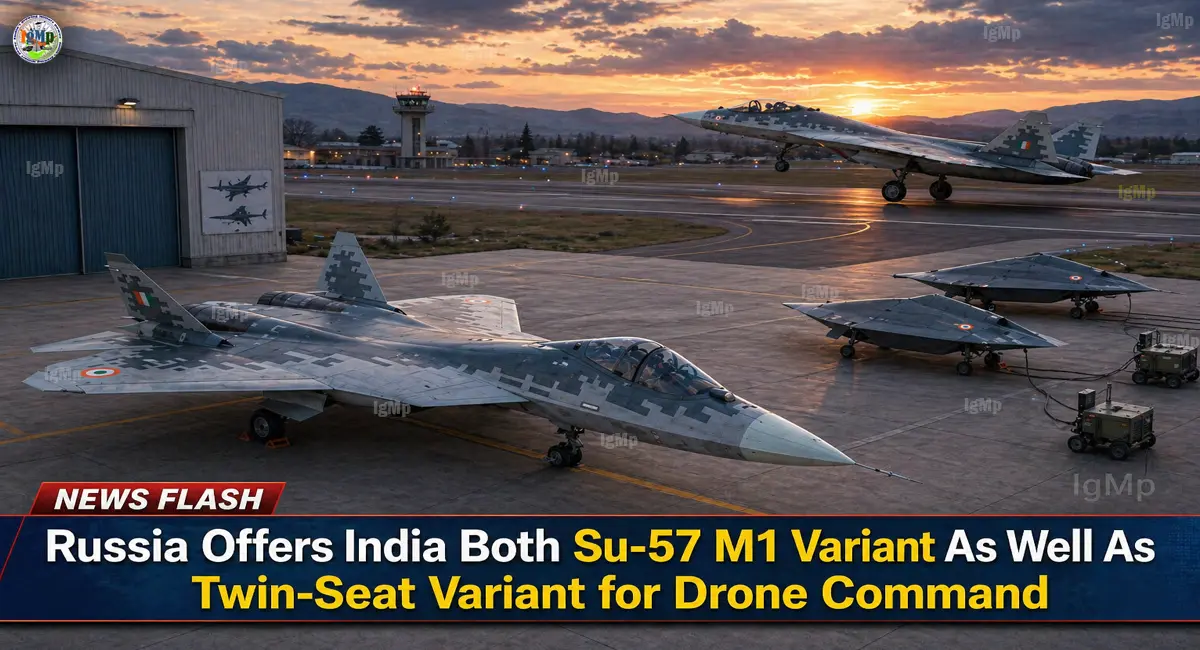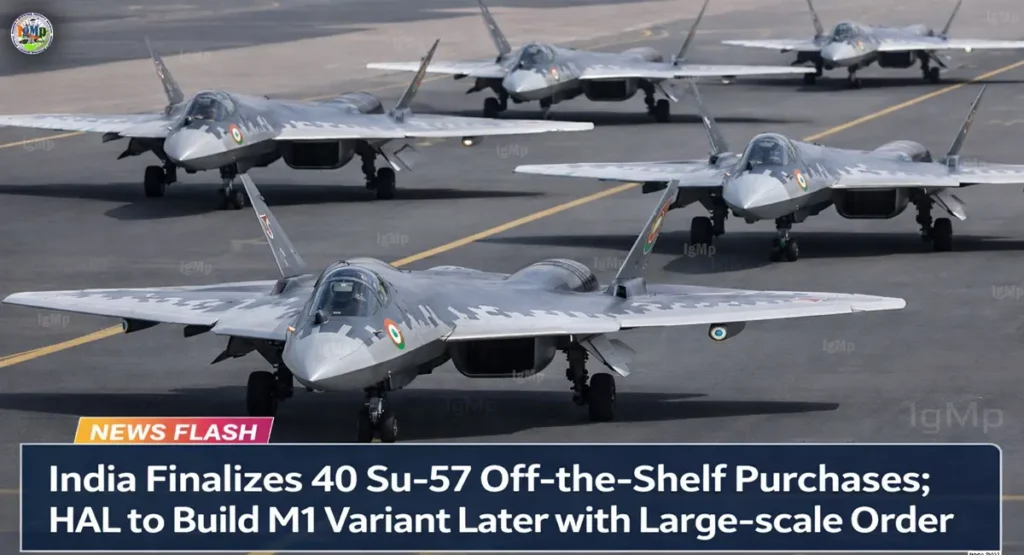
As per the reports of DefenceNews.com and MilitaryWatch Magazine, India’s Ministry of Defence has moved forward with a phased procurement strategy for the Sukhoi Su-57 fifth-generation fighter, combining immediate fleet expansion with long-term industrial cooperation. The plan includes initial off-the-shelf acquisitions of 40 aircraft from Russia followed by licensed production of an upgraded Su-57M1 variant in India with orders exceeding more than 100 such aircraft in future.
Russia’s state arms exporter Rosoboronexport recently confirmed that several countries have ordered the aircraft. Algeria began receiving Su-57 deliveries in late 2025, marking the fighter’s first confirmed export induction. Reports also indicate growing interest from Iran and other operators exploring next-generation fighter options.
For India, the procurement carries both operational and strategic significance. The Indian Air Force needs a near-term stealth capability as regional air forces expand their fifth-generation fleets. At the same time, the licensed production phase would allow Indian industry to absorb key technologies while integrating indigenous avionics and weapons.
This approach reflects a broader defence policy shift toward balancing rapid capability acquisition with long-term aerospace self-reliance.
Two-Phased Acquisition Approach: Off-the-Shelf Purchase Plus Licensed Production
India plans to adopt a two-stage acquisition model for the Su-57 to meet immediate operational needs while preparing for long-term domestic production. Defence sources indicate that the Indian Air Force may induct around 40 baseline Su-57 fighters through direct purchases from Russia. This step would allow the service to deploy a limited stealth fleet quickly as regional air forces expand their fifth-generation capabilities.
At the same time, New Delhi continues negotiations with Moscow on licensed manufacturing inside India. Officials confirmed in January 2026 that discussions on technology transfer and production arrangements had reached an advanced technical stage. However, large-scale manufacturing will likely begin only after the improved Su-57M1 variant becomes available for export.
This approach follows a familiar pattern in India’s fighter acquisition history. In the late 1990s, the Indian Air Force first inducted Su-30MK fighters before transitioning to the more advanced Su-30MKI, which later entered licensed production in India during the early 2000s.
Defence planners expect the Su-57 program to follow a similar trajectory. The initial aircraft would strengthen the frontline fleet quickly, while the later Su-57M1 production phase would support deeper industrial participation and long-term aerospace capability development.
How the AL-51F-1 Engine Closes the Gap with China’s J-20
Engine technology often defines the true capability of a fifth-generation fighter.
Early Su-57 aircraft rely on the AL-41F1 engine, a derivative of the powerplant used in the Su-35. While powerful, the engine does not fully meet the long-term performance goals for the aircraft.
The AL-51F-1 (Izdeliye 30) engine introduces major improvements. Engineers designed it specifically for fifth-generation fighters.
The engine delivers higher thrust while reducing fuel consumption. It also incorporates flat-nozzle stealth shaping, which helps lower the aircraft’s infrared signature.
These changes enhance both supercruise performance and survivability. The engine upgrade also narrows the performance gap with China’s Chengdu J-20.
For the Indian Air Force, the AL-51F-1 represents more than a propulsion upgrade. It ensures that future Su-57M1 aircraft remain competitive in a region where stealth aircraft numbers continue to rise.
Why Source Code Access Is the Deal-Breaker for the IAF
Software control has become a decisive factor in modern fighter procurement.
Russia’s willingness to provide full mission computer source code has drawn significant attention in New Delhi. This access would allow Indian engineers to integrate indigenous weapons and sensors without foreign restrictions.
Such flexibility contrasts sharply with earlier procurement negotiations involving Western aircraft.
For example, France declined to share Rafale mission system source code during discussions around the MRFA program. Without that access, India would face limits on deep system modifications.
Source code control changes the equation entirely.
Indian developers could integrate systems such as the Astra Mk2 beyond-visual-range missile directly into the Su-57’s internal weapon bays. They could also add indigenous electronic warfare suites or data links.
This level of autonomy strengthens India’s broader Atmanirbhar defence ecosystem.
HAL Nashik: Repurposing Su-30MKI Lines for the Su-57M1
India’s aerospace infrastructure already holds an important advantage.
The HAL Nashik facility, which has produced the Su-30MKI for decades, could transition to assembling the Su-57M1. This shift would mirror the earlier Su-30MKI program, where India gradually moved from licensed assembly to deeper manufacturing capability.
The Su-57M1 variant could also incorporate Indian-developed subsystems.
Defence analysts expect potential integration of the Virupaksha AESA radar, which India has developed for advanced fighter platforms. Indigenous electronic warfare systems may also follow.
Such upgrades would transform the Su-57M1 into a hybrid aircraft that combines Russian airframe design with Indian avionics technology.
| Feature | Baseline Su-57 (Off-the-Shelf) | Su-57M1 (Licensed Production) |
|---|---|---|
| Engine | AL-41F1 | AL-51F-1 |
| Stealth | Standard design | Improved fuselage and internal bays |
| Avionics | Russian standard | Indianized sensors and EW |
| Role | Immediate capability | Long-term fleet backbone |
This approach would help India expand its domestic aerospace capabilities while operating a proven stealth platform.
Strategic Context: Bridging the Gap Until AMCA
India’s Advanced Medium Combat Aircraft (AMCA) remains the country’s long-term stealth fighter program. The aircraft represents India’s vision for complete design and software sovereignty. However, the development timeline stretches well into the next decade. Most projections place the AMCA’s operational induction closer to 2040. That timeline creates what many analysts describe as a “stealth capability gap.”
China already fields operational J-20 fighters, and regional air forces continue expanding advanced fleets.
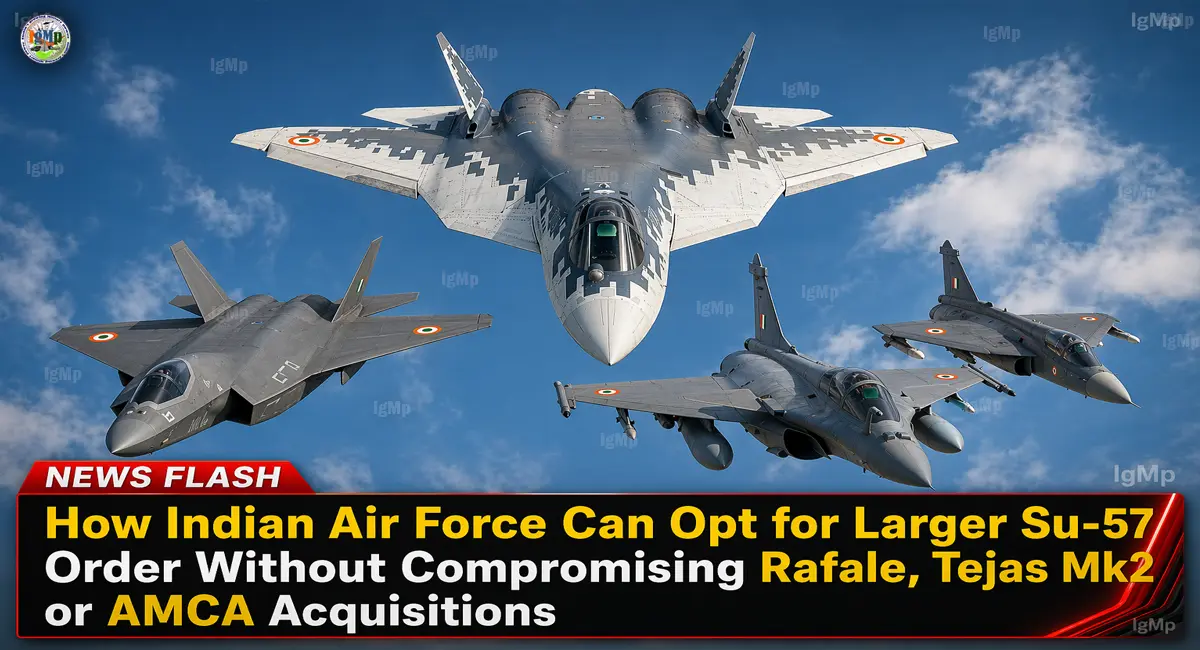
In this environment, the Su-57 procurement appears less like a replacement for the AMCA and more like a risk-mitigation strategy. The off-the-shelf aircraft would give the Indian Air Force an early stealth capability. The later Su-57M1 production program would deepen industrial cooperation and technology absorption.
Meanwhile, the AMCA program would continue developing India’s next-generation stealth ecosystem.
From a strategic perspective, the approach mirrors India’s earlier experience with the Su-30MKI program, which served both operational and industrial goals.
If executed carefully, the Su-57M1 initiative could strengthen India’s fighter fleet through the 2030s while the AMCA prepares to define the country’s long-term aerospace future.