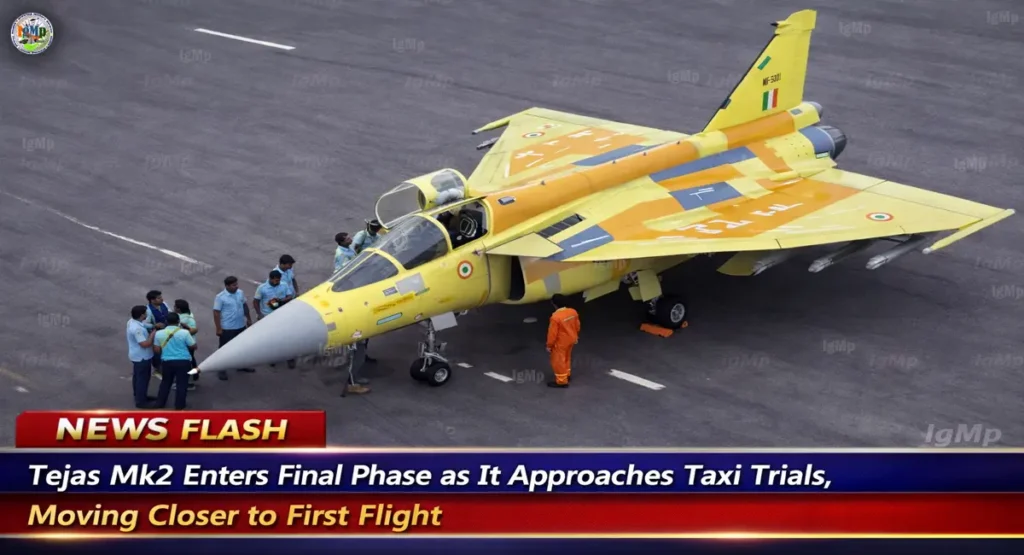
India’s Tejas Mk2 Medium Weight Fighter (MWF) program has entered a decisive stage as the first prototype moves toward taxi trials. Engineers from Hindustan Aeronautics Limited (HAL) and the Aeronautical Development Agency (ADA) have accelerated ground integration work during early 2026.
The aircraft represents the next evolutionary step in India’s Light Combat Aircraft ecosystem. Unlike the Tejas Mk1A, the Mk2 introduces a heavier airframe, a more powerful engine, and expanded multirole capability. These upgrades aim to replace aging aircraft such as the Mirage 2000, Jaguar, and MiG-29 over the coming decade.
Recent developments, especially the completion of 100% Transfer of Technology (ToT) for the GE F414-INS6 engine, have strengthened the program’s momentum. This milestone improves India’s aerospace supply chain resilience while supporting the broader push for aero-engine Atmanirbharta.
Program Pulse: Tejas Mk2 Status in April 2026
The Tejas Mk2 program now stands at an important transition point between ground testing and flight trials.
- The 17.5-tonne Medium Weight Fighter prototype has entered advanced ground integration stages.
- Engineers are preparing the aircraft for low-speed taxi trials, the first step toward flight testing.
- 100% Transfer of Technology for the GE F414-INS6 engine concluded in April 2026.
- Certification teams from CEMILAC (Centre for Military Airworthiness and Certification) continue structural and system validation.
- The aircraft uses a plug-and-play avionics architecture designed to integrate future weapons and sensors quickly.
These milestones show that India’s indigenous fighter development program has moved from design maturity into the pre-flight validation phase.
When Will Tejas Mk2 Start High-Speed Taxi Trials (HSTT)?
Taxi trials form a crucial step before the first flight of any combat aircraft.
Engineers first conduct low-speed taxi tests to verify steering, braking, and ground handling. These tests allow the flight control system to interact with the landing gear and hydraulic systems under real operating conditions.
Once the aircraft clears this phase, teams move to High-Speed Taxi Trials (HSTT). During HSTT, the aircraft accelerates close to take-off speeds while remaining on the runway. This stage validates aerodynamic stability and braking performance.
The current roadmap suggests that the Tejas Mk2 prototype will gradually progress through these phases before its first flight window.
Observers have also noted the aircraft’s yellow primer coating on early prototypes. This unfinished surface often raises questions among aviation watchers. In reality, aerospace manufacturers use yellow primer during Proof-of-Concept testing because it protects the airframe while allowing engineers to inspect structural areas easily.
Early prototypes of global programs such as Rafale and F-35 followed the same approach during initial trials.
How CEMILAC Is Accelerating First Flight Clearance for the MWF
The Centre for Military Airworthiness and Certification (CEMILAC) plays a central role in the Tejas Mk2 development cycle.
CEMILAC engineers monitor structural tests, avionics integration, and flight safety evaluations. Their role ensures that the aircraft meets strict military airworthiness standards before the first flight.
The Mk2 introduces several structural changes compared with the earlier Tejas variants. Designers have expanded the fuselage to accommodate additional fuel and payload. The aircraft also integrates canards, which improve maneuverability and aerodynamic stability.
Another important feature involves wing-over-body blending, which enhances lift generation and reduces drag at higher angles of attack.
These design changes require detailed validation through static line testing and ground stress trials. Certification teams analyze these results before granting First Flight Clearance (FFC).
Why the GE F414 ToT Milestone Matters for India’s Fighter Ecosystem
The April 2026 completion of 100% Transfer of Technology for the GE F414-INS6 engine represents a strategic breakthrough.
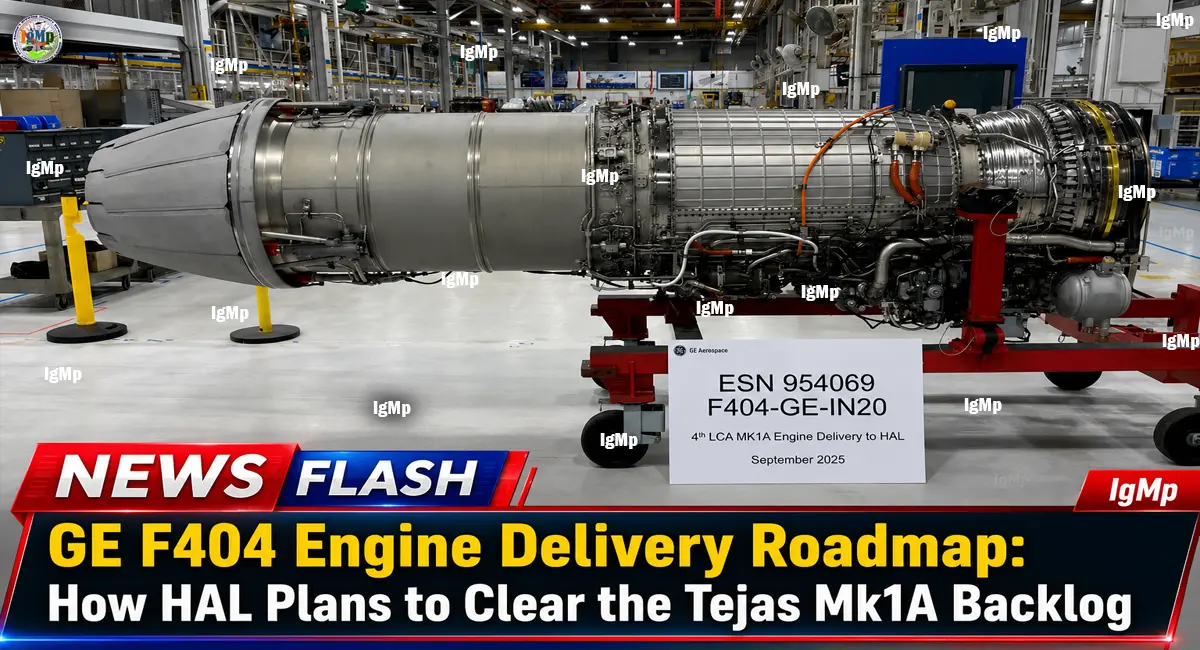
The Tejas Mk1 series relies on the GE F404 engine, which produces around 84 kN of thrust. The new F414 engine delivers nearly 98 kN, giving the Mk2 greater thrust-to-weight performance.
| Feature | Tejas Mk1A | Tejas Mk2 (MWF) |
|---|---|---|
| Engine | GE F404 (84 kN) | GE F414-INS6 (98 kN) |
| Weight Class | 13.5 tonne | 17.5 tonne |
| Key Addition | Light Combat Role | Canards & Higher Payload |
The technology transfer agreement allows Indian industry to build and support critical engine components locally. This step strengthens supply chain security and reduces dependence on external manufacturing hubs.
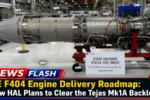
In strategic terms, the milestone moves India closer to long-term aero-engine self-reliance.
Analyst View: Why Tejas Mk2 Matters for India’s Future Air Combat Strategy
The Tejas Mk2 occupies a critical position in India’s future fighter fleet.
In my analysis of the Indian Air Force modernization roadmap, the Mk2 bridges the gap between the lightweight Tejas Mk1A and next-generation aircraft such as the Advanced Medium Combat Aircraft (AMCA).
The aircraft’s plug-and-play avionics architecture allows rapid integration of indigenous weapons such as the Astra Mk2 beyond-visual-range missile. This capability strengthens India’s push toward network-centric air combat.
The Mk2 also expands payload capacity and combat radius compared with earlier Tejas variants. These improvements allow the aircraft to assume missions currently handled by legacy platforms.
As taxi trials approach, the Tejas Mk2 program appears to have entered its most critical phase. Success during upcoming ground and flight testing will determine how quickly the 17.5-tonne Medium Weight Fighter joins the Indian Air Force’s operational fleet.
For India’s aerospace sector, the aircraft represents more than a new fighter. It symbolizes a maturing ecosystem that now spans design, certification, avionics integration, and engine manufacturing capability.