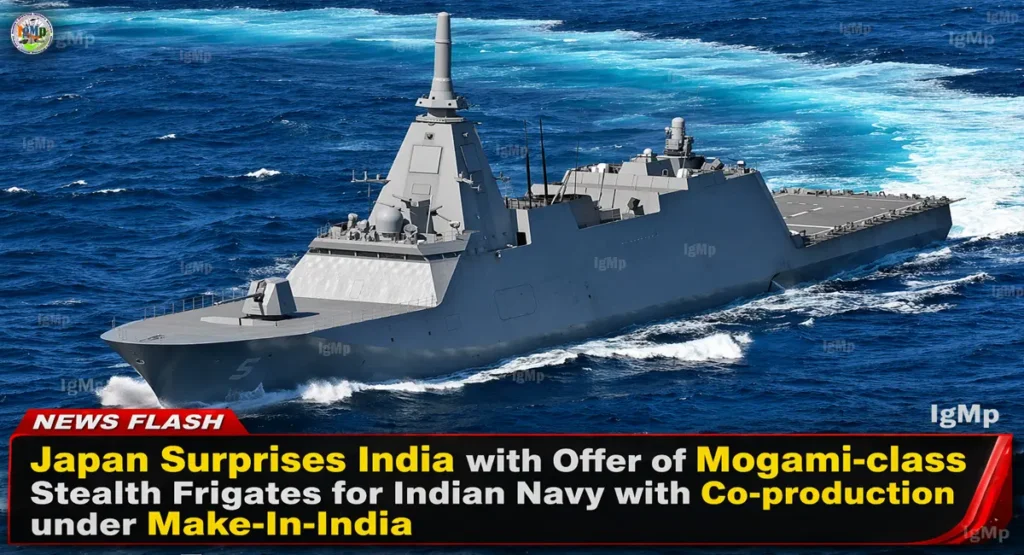
Japan has made a major defence pitch to India by offering its advanced Mogami-class stealth frigates along with a co-production plan that could see these warships built inside Indian shipyards. This is not just a standard export proposal. Tokyo is reportedly ready to share the frigate’s core design as well, allowing India to manufacture the platform locally with Japanese support in select materials and key technologies.
The offer reflects a clear shift in Japan’s defence export approach, which has traditionally remained cautious on transferring frontline military platforms. By opening the door for deeper industrial cooperation with New Delhi, Japan is signaling a stronger long-term strategic partnership in the Indo-Pacific. For India, the proposal fits well with the government’s Make in India and Atmanirbhar Bharat goals, while also giving the Indian Navy access to one of Japan’s newest and most advanced frigate designs.
Why are the Mogami-class Frigates can be significant for the Indian Navy?
The Mogami-class matters for three clear reasons: Stealth, Automation, and Regional Interoperability.
Known as the 30FFM, the frigate represents Japan’s newest surface combatant design. The lead ship entered service in 2022 with the Japan Maritime Self-Defence Force. It displaces around 4,000 to 5,500 tonnes and focuses on reduced radar signature, lower manpower needs, and rapid multi-mission deployment.
Its advanced stealth mast, compact superstructure, and integrated sensor layout reduce detection risks during high-threat operations. The ship also carries the OPY-2 multi-function radar, anti-ship missiles, surface-to-air systems, and lightweight torpedoes for anti-submarine warfare.
One of its strongest advantages is automation. The frigate needs only around 90 sailors, far lower than many comparable warships. For the Indian Navy, that means lower lifecycle costs and faster operational turnaround during extended deployments in the Indian Ocean Region.
The platform also supports Unmanned Surface Vehicles (USVs) and Unmanned Underwater Vehicles (UUVs). This capability is critical for future mine warfare, seabed surveillance, and distributed maritime operations near chokepoints like the Malacca Strait.
Japan Offers Mogami Stealth Frigates to India with Co-Production Deal 🇮🇳🇯🇵🔥
Japan has proposed supplying its Mogami-class stealth frigates to India, along with design transfer and local manufacturing in Indian shipyards… a major boost to defence ties.
> Advanced 4,000+ ton… pic.twitter.com/3DHc8MIepb— The Tathya (@_TheTathya) April 20, 2026
How does the Mogami compare with India’s Nilgiri-class and Project 17B plans?
India’s Nilgiri-class Project 17A frigates serve a different mission profile. They are larger, heavier escort warships built for sustained blue-water operations and heavy strike roles, including strong missile integration.
| Feature | Mogami-Class (Japan) | Nilgiri-Class (India) |
|---|---|---|
| Primary Focus | Stealth & Automation | Multi-role Heavy Escort |
| Crew Size | ~90 | 150+ |
| Strategic Edge | Advanced Mine Countermeasures | Heavy BrahMos Integration |
This comparison shows why the Mogami-class Stealth Frigate should not replace Project-17A. Instead, it offers valuable lessons for Project-17B, India’s next-generation frigate effort expected to move toward the 7,000–8,000 tonne class.
The real value lies in technology transfer. India can study the stealth mast design, integrated automation architecture, and crew reduction systems for future indigenous warships. That matters more than simply importing another frigate class.
In my view, the Mogami is not the final ship India wants. It is the design school India may need.
Can India secure software sovereignty in a Japanese-built frigate?
This is the most important strategic question.
Modern warships depend as much on software as steel. Combat Management Systems (CMS), radar fusion, electronic warfare suites, and weapons integration decide battlefield performance. If India cannot control these layers, co-production loses much of its long-term value.
India will likely push for the ability to integrate its own combat systems, domestic sensors, and eventually weapons like BrahMos onto any Japanese-origin hull. That will not be simple.

Japanese naval systems follow their own architecture and export controls remain politically sensitive in Tokyo. Integrating Indian weapons onto a 30FFM design could create engineering delays and cost escalation.
This is why I see the deal as a “software sovereignty” test rather than a ship purchase. If India gains system-level control, the offer becomes strategically transformative. If not, it risks becoming another expensive dependency.
Analyst’s Take: Will India choose Mogami-class Stealth Frigate or stay fully indigenous?
The Ministry of Defence will examine this offer carefully because the stakes go far beyond ship numbers.
Each Mogami-class frigate costs roughly $500 million or more, which creates pressure when compared to indigenous construction under existing naval programs. India must also consider long-term maintenance, supply chains, and integration risks.
Still, Japan offers something rare: access to a frontline warship design with co-production rights. That is not common in global defence exports, especially from Tokyo.
As a Lead Defence Analyst, I view this proposal as more than a sale. It is a strategic bridge between India’s current fleet and its future Project 17B ambitions.
If New Delhi uses the Mogami offer for design absorption rather than direct dependence, the deal could reshape Indian naval shipbuilding for the next decade. If it treats it only as an import option, the strategic opportunity becomes much smaller.