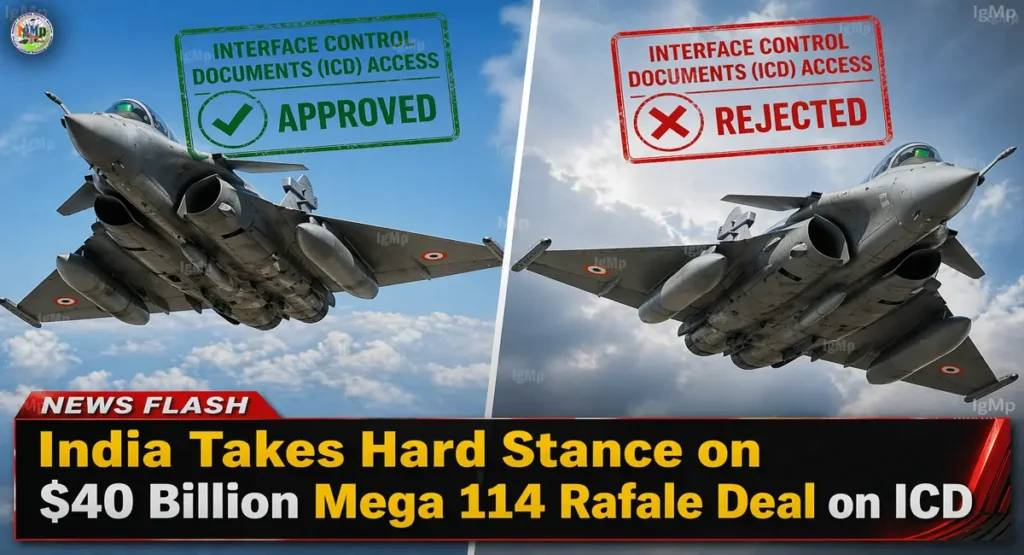
India’s proposed 114-jet Rafale MRFA deal, valued at nearly $40 billion, has entered its most decisive phase. The issue is no longer price, delivery schedules, or industrial offsets. The real battle now centers on digital sovereignty and India’s demand for full operational freedom through the Interface Control Document (ICD).
Senior Defence Ministry officials and defence sources indicate that New Delhi has taken a firm position on the ICD issue. After France refused full source code access, India shifted its focus to securing the ICD as a non-negotiable requirement. If Paris refuses to accept even this level of technical access, India may reconsider the entire Rafale procurement and explore other available fighter options for the Indian Air Force.
This has created growing pressure on the French side. France already faces challenges after losing major financial support linked to the future Rafale F5 development path and after Indonesia slowed its follow-on Rafale momentum. If India walks away from a deal of this scale, the impact would go far beyond defence sales. It would strike at French defence exports and create serious political pressure for President Emmanuel Macron on the global stage.
France now faces a strategic choice: protect every layer of its technology secrecy or secure one of the biggest fighter aircraft deals of this decade with one of its most important long-term partners.
What is the ICD and why does it matter so much?
The ICD is not source code. France will never hand over Rafale’s full source code, and India is not asking for that.
The ICD acts as a technical translator between Indian weapons and the Rafale’s onboard systems. It allows engineers to connect missiles, sensors, and pods without exposing the aircraft’s protected core software. In simple terms, it is the universal adapter that lets Indian systems talk to French avionics.
Without the ICD, even a simple integration becomes expensive and slow. Every new weapon requires Dassault’s approval, technical support, and often direct access to aircraft data. That creates cost, delays, and long-term dependence.
With the ICD, India gains controlled flexibility. It can integrate future weapons faster while protecting sensitive domestic technologies from foreign visibility.
What did the 2016 Rafale deal teach the Indian Air Force?
The original 36-aircraft Rafale deal exposed what many in the Air Force call the “black box” problem.
When India wanted to integrate non-French systems such as the Israeli Litening pod or SPICE precision-guided bombs, the process required close French involvement. In practical terms, India could not simply plug in a new system and move forward independently.
That created what I describe as an integration tax. Every modification carried technical dependence and financial cost. India paid not just for the weapon, but also for permission to make the aircraft use it.
The IAF does not want that model repeated in a 114-aircraft fleet.
The comparison with the Su-30MKI is important here. India had far greater integration freedom with the Sukhoi platform, which allowed successful integration of the BrahMos missile. That flexibility created long-term operational value far beyond the original purchase price.
Why is the ICD non-negotiable for India in 2026?
Three reasons make the ICD a strategic necessity: cost control, strategic autonomy, and weapon integration.
India plans to field indigenous weapons like Astra Mk2, Astra Mk3, Rudram-3, and advanced stand-off systems across future combat fleets. These are not side projects. They form the core of India’s air combat doctrine for the next decade.
Without an ICD, every integration request becomes a foreign negotiation. That slows deployment and risks exposing sensitive missile flight algorithms to external review.
With an ICD, India can move toward true plug-and-play capability. Engineers can adapt the aircraft for Indian requirements without paying recurring integration fees to Dassault every time a new missile enters service.
This also protects future upgrades. France is already shaping the Rafale F5 standard for the post-2030 era. India wants to secure digital access now so it does not face another closed architecture problem when those next-generation technologies arrive.
Analyst’s Perspective: Will France accept India’s terms?
France understands that this is no longer a standard export negotiation. President Emmanuel Macron has pushed defence cooperation with India as a long-term strategic pillar, and Paris knows the MRFA deal carries political weight far beyond aviation.
Still, France will protect its proprietary systems carefully. It will likely offer controlled access, not unrestricted freedom. The final agreement may sit somewhere between full independence and managed cooperation.
This is not about demanding source code. It is about securing the digital handshake required for sovereign combat operations. Without that, the Rafale becomes a premium platform with permanent foreign dependency attached to it.
If France accepts the ICD framework, the deal moves forward and becomes a true strategic partnership. If it refuses, India may delay or even rethink the MRFA path entirely.
In 2026, the biggest fighter negotiation is not about jets. It is about who controls the software behind the trigger.