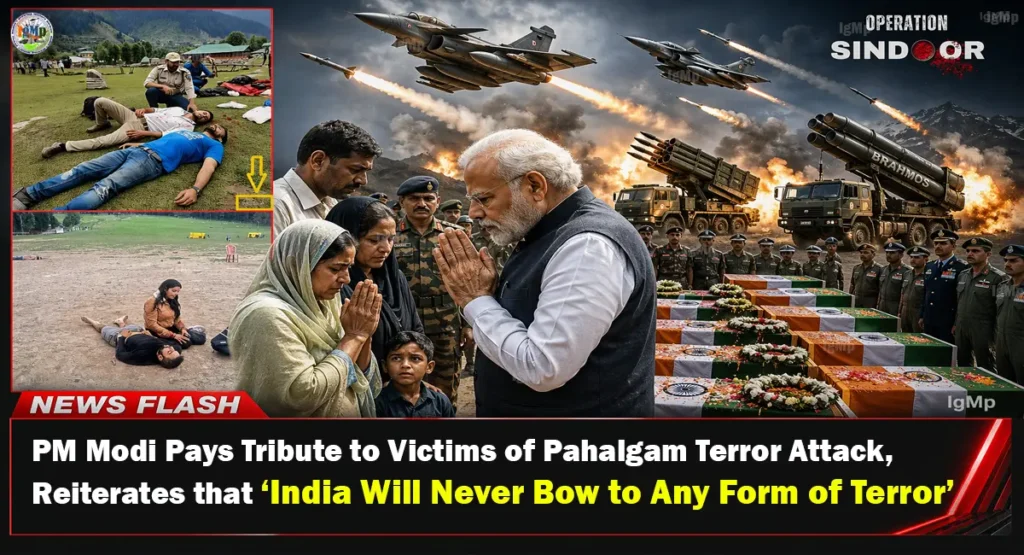
On April 22, 2026, India marked one year since the brutal Pahalgam terror attack that shocked Jammu and Kashmir and triggered a major shift in India’s counter-terror strategy. Prime Minister Narendra Modi used the anniversary to send a clear message: India will never surrender to terrorism, and the response after the 2025 attack proved that New Delhi now follows a doctrine of decisive retaliation rather than strategic restraint.
The anniversary carries importance far beyond remembrance. It marks the moment when India moved from defensive messaging to a stronger pre-emptive strike doctrine, backed by integrated military action under Operation Sindoor. The attack on innocent civilians in Pahalgam became the trigger for a broader national security reset across the Line of Control and the wider counter-terror grid.
The Prime Minister’s tribute was not only emotional. It was also strategic. His statement reinforced that the military and diplomatic gains achieved after Operation Sindoor remain active policy, not a one-time reaction.
Why Is the Pahalgam Terror Attack Anniversary Strategically Important?
The Pahalgam anniversary represents India’s shift from restraint to active deterrence.
For years, cross-border terrorism followed a pattern of attack, condemnation, and temporary escalation. After the April 2025 strike, India broke that cycle. The government adopted what many defence planners now describe as Zero-Tolerance Policy 2.0, where terror attacks invite direct and visible consequences.
This change became visible through Operation Sindoor, which targeted cross-border terror infrastructure and launch pads linked to Pakistan-backed networks, including elements associated with Lashkar-e-Taiba. Instead of limiting the response to diplomacy, India used integrated firepower and rapid military coordination.
From a strategic standpoint, this sent a stronger deterrence signal to both state and non-state actors operating in the grey zone.
Operation Sindoor: One Year of Strategic Deterrence
Operation Sindoor reshaped the rules of engagement along the Line of Control.

The operation focused on dismantling launch pads, disrupting infiltration routes, and raising the operational cost for groups attempting cross-border attacks. It also improved coordination between the Army, intelligence agencies, and local security forces in Jammu and Kashmir.
This campaign strengthened India’s counter-terrorism resolve and reduced the space for proxy warfare. Security planners now treat infiltration attempts as part of wider hybrid warfare rather than isolated terror incidents.
The Army also refined the concept of integrated firepower. Surveillance inputs, artillery response, and rapid troop movement now work under a tighter command structure. This reduces reaction time and improves precision during high-risk situations.
As a Lead Defence Analyst, I see Operation Sindoor as more than retaliation. It marked the formal end of predictable response patterns and the beginning of sustained deterrence.
A Unified Cabinet Resolve and Security Hardening in Kashmir
This sentiment was echoed across the national security establishment.
Home Minister Amit Shah, Defence Minister Rajnath Singh, and External Affairs Minister S. Jaishankar all reinforced the same message: India will not allow terror networks to regain operational freedom.
At the ground level, Pahalgam and nearby tourist zones now operate under a much stronger joint security grid involving the Jammu and Kashmir Police and the Indian Army. AI-based surveillance support, improved checkpoint systems, and tighter route monitoring have significantly changed the security architecture over the last 12 months.
This matters because terrorism often aims to damage both security and public confidence. Protecting tourism became part of the national response.

Despite the 2025 attack, Pahalgam witnessed strong tourist footfall in 2026. That recovery sends its own message. Terror failed to break civilian confidence.
The Message Behind Prime Minister Narendra Modi’s Tribute
Prime Minister Modi’s words were not just ceremonial. They signaled continued strategic intent.
When he said India would never bow to terror, he reinforced that the military gains of 2025 will not be allowed to fade into symbolic memory. The message was directed as much at hostile actors across the border as it was at the Indian public.
The anniversary of Pahalgam terror attack now stands for two things: national grief and national resolve.
India remembers the victims, but it also remembers the lesson. Terror attacks are no longer treated as isolated incidents. They are seen as part of grey zone warfare that demands a military, diplomatic, and psychological response.
That is why the first anniversary matters. It is not only about what happened in April 2025. It is about the doctrine India chose afterward—and why that doctrine is likely here to stay.