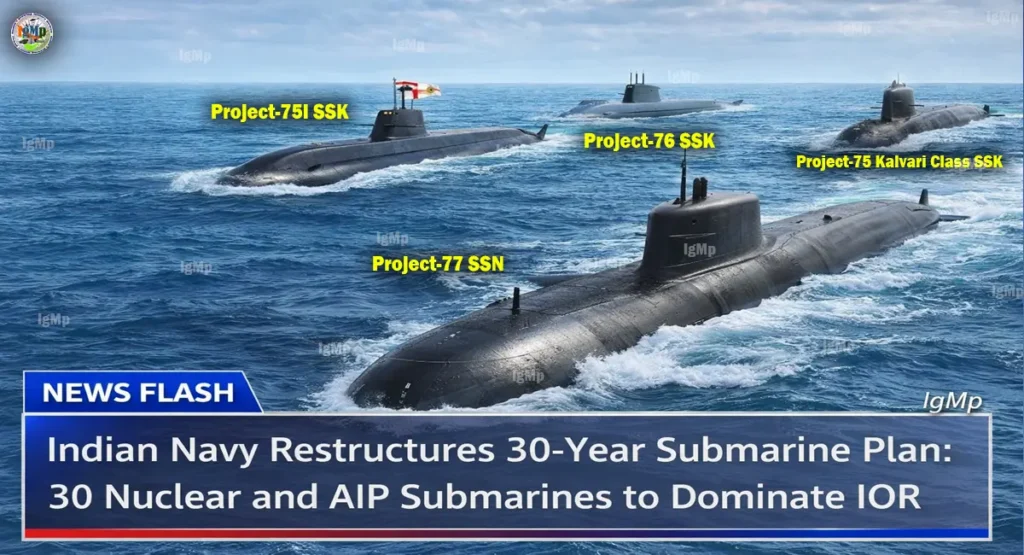
India is reworking its long-term submarine strategy to build a 30+ strong underwater fleet by 2040. The revised structure moves beyond the original 24-submarines plan envisaged under 1999’s ’30-Year Submarine Plan’ and adds a dedicated nuclear attack layer. The roadmap now includes 24 AIP-equipped conventional submarines and 6 nuclear-powered attack boats, creating a far more capable undersea force across the Indian Ocean Region.
This shift reflects lessons from recent operational scenarios and rising competition in the Indo-Pacific. It also signals a move from coastal defence to sustained underwater dominance.
How is India’s 30-Year Submarine Plan being restructured?
The original 1999’s 30-year submarine plan aimed for 24 conventional boats. That number now serves as the baseline rather than the final goal. The Navy has added a separate nuclear tier, pushing the total to over 30 submarines by 2040.
The math is simple. Twenty-four diesel-electric boats cannot sustain operations across both western and eastern seaboards in a two-front scenario. The addition of nuclear-powered submarines changes that equation.
The revised structure includes:
- 24 AIP-equipped conventional submarines
- 6 nuclear attack submarines under Project-77
- Potential 4 SSGN conversions from existing nuclear assets
This layered approach enables both sea denial and long-range strike capability. It also ensures that India can maintain a continuous underwater presence in key choke points.
What is the breakdown of India’s 24 AIP-powered submarine fleet?
India’s conventional fleet will rely heavily on Air Independent Propulsion technology. AIP allows submarines to remain submerged for longer durations, which is critical in modern anti-submarine warfare environments.
The 24-boat structure follows a clear industrial and technological roadmap.
- 6 Kalvari-class submarine under Project-75 will undergo AIP retrofitting using indigenous fuel-cell systems. The upgrade is expected to begin with INS Khanderi around late 2026.
- 6 Project-75I submarines will feature integrated AIP systems from the design stage. These boats will likely emerge from collaborations involving global firms and Indian shipyards.
- 12 Project-76 submarines will form the backbone of future expansion. This fully indigenous design represents the next stage of Atmanirbhar Bharat in naval warfare.
Project-76 stands out as the most critical element. It reflects a shift toward complete design control within India. The Navy aims to develop a 3,000-ton class submarine with advanced stealth and endurance features.

Our analysis suggests that this indigenous push will reduce long-term dependence on foreign partners. It will also allow faster upgrades as threat environments evolve.
Will Arihant-class submarines be converted into SSGNs?
A major strategic shift lies in the potential conversion of existing nuclear submarines. The Arihant-class submarine, originally built as SSBNs, may transition into SSGNs as newer platforms enter service.
India has already initiated work on the larger S5-class SSBNs. These next-generation submarines will take over the nuclear deterrence role. This opens the door for older vessels like INS Arihant and INS Arighaat to adopt a new mission profile.
An SSGN conversion would allow these submarines to carry cruise missiles such as the BrahMos-NG. This transforms them into tactical strike platforms capable of land-attack and anti-ship missions.
This move adds a new layer to India’s underwater doctrine. Instead of relying only on deterrence, the Navy gains a flexible strike option that can operate covertly across long distances.
Why does this shift matter for India’s undersea dominance?
The restructuring reflects a broader change in doctrine. India is moving from a defensive posture to a proactive undersea strategy. The goal is not just to protect coastlines but to control critical sea lanes.
The 30+ submarine fleet will allow India to create a “picket fence” across key maritime routes. These include the Malacca Strait, Arabian Sea, and approaches to the Gulf of Aden. Such positioning limits adversary movement and enhances surveillance.
The May 2025 Operation Sindoor scenario reinforced this need. Modern anti-submarine warfare systems exposed the limitations of conventional diesel-electric boats without AIP. Submarines must remain submerged longer to survive in contested waters.

From a strategic perspective, the intent is clear: achieve total undersea denial in the Indian Ocean Region. This includes tracking adversary fleets, protecting sea lanes, and maintaining second-strike capability.
The nuclear component further strengthens this posture. The addition of Project-77 SSNs ensures that India can conduct deep-sea operations without surfacing constraints. Combined with SSGN conversions, this creates a balanced force capable of both deterrence and precision strike.
Strategic takeaway
India’s submarine roadmap now reflects long-term planning rather than incremental upgrades. The combination of AIP submarines, nuclear attack boats, and SSGN conversions creates a multi-layered underwater force.
This approach aligns with the realities of modern naval warfare. It prioritizes endurance, stealth, and strike capability over sheer numbers. By 2040, India aims to operate one of the most capable submarine fleets in Asia.
The shift also strengthens indigenous defence manufacturing. Projects like Project-76 and missile integration with systems like BrahMos-NG show a clear push toward self-reliance.
The result is a Navy that can project power far beyond its shores while maintaining a strong defensive shield at home.