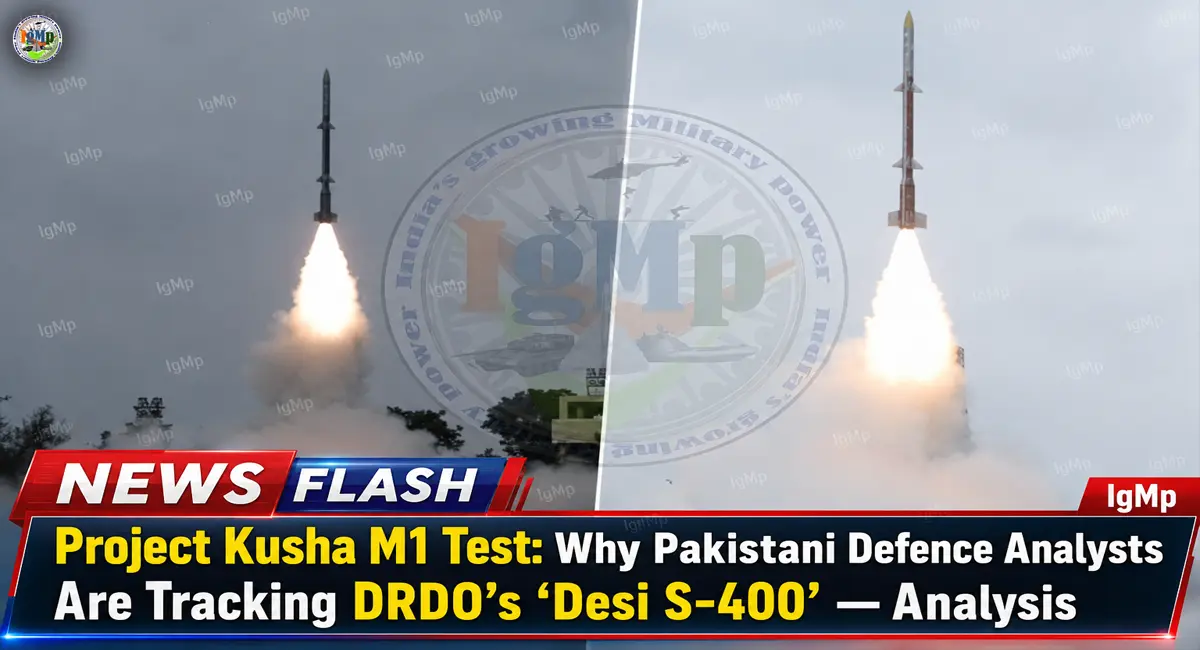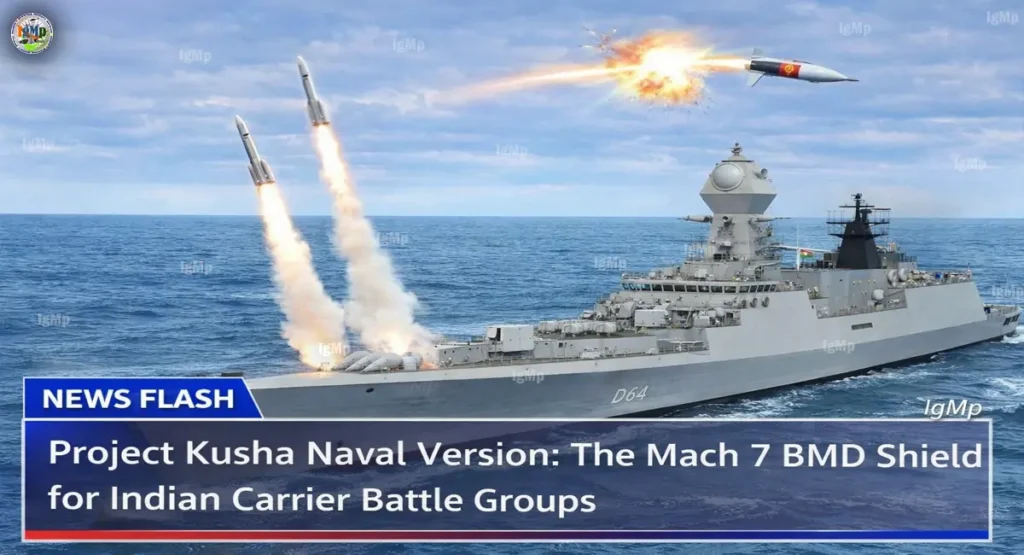
India is developing the naval version of Project Kusha as a high-speed, long-range shield for its carrier battle groups. The XRSAM-N variant aims to intercept hypersonic threats and anti-ship ballistic missiles at distances of up to 250 km. This marks a major upgrade in naval air defence capability, moving beyond traditional systems designed mainly for aircraft and cruise missile interception.
The shift reflects a deeper doctrinal change in how the Indian Navy approaches maritime warfare. Instead of relying on close-range protection, it is building a wide defensive envelope that can neutralize threats before they reach critical assets like INS Vikrant. This approach strengthens survivability while enabling greater operational flexibility in contested waters.
The shift from the 100 km-class Barak-8 to Naval Kusha marks a clear doctrinal change. The Indian Navy no longer focuses only on point defence. It now aims to build a layered shield that can stop high-speed threats before they reach the fleet.
This system forms the naval arm of Project Kusha, adapted for shipborne operations under the XRSAM-N configuration. It targets a new class of threats that older systems cannot reliably intercept.
How does Naval Kusha differ from the Barak-8?
The difference lies in both scale and purpose. Barak-8 protects ships against aircraft and sea-skimming cruise missiles. Naval Kusha expands that role into ballistic missile defence.
| Feature | Barak-8 (LR-SAM) | Naval Kusha (XRSAM-N) |
|---|---|---|
| Role | Point / Area Defence | Strategic Fleet Shield |
| Range | ~100 km | 250 km+ |
| Speed | ~Mach 2 | Mach 5.5 – 7 |
| Engagement | Medium altitude | High-altitude / near-space |
| Targets | Aircraft, cruise missiles | Hypersonic weapons, ASBMs |
The math changes with this upgrade. A 250 km engagement envelope creates a much larger defensive bubble. It pushes threats farther away from high-value assets like aircraft carriers.
From a strategic perspective, this signals a shift toward sea control rather than survival.
Can Naval Kusha intercept Chinese “carrier killer” missiles?
The system directly addresses threats like the DF-21D and DF-26. These weapons travel at extreme speeds and descend at steep angles. Traditional air defence systems struggle to track and intercept them in the terminal phase.
Naval Kusha solves this with speed and altitude. Its interceptor reaches hypersonic velocity and engages targets at higher altitudes. This reduces reaction time pressure on the fleet.
The May 2025 Operation Sindoor scenario highlighted this gap. Naval planners observed that modern threats operate beyond the engagement range of legacy systems. A longer defensive “bubble” became essential.
This system creates that buffer. It forces adversaries to launch from greater distances and reduces strike accuracy.
Why the dual IIR + RF seeker changes naval air defence
One of the most important upgrades lies in the seeker technology. Naval Kusha uses a dual-mode system that combines radar (RF) with imaging infrared (IIR).
Radar performs well in open environments but faces challenges in heavy electronic warfare conditions. Advanced jamming and decoys can degrade its accuracy.
The IIR seeker adds a second layer. It tracks heat signatures instead of relying only on radar reflections. This makes it far harder to deceive using conventional electronic countermeasures.
In the cluttered environment of the Indian Ocean, this matters. Warships operate alongside civilian traffic, weather disturbances, and electronic noise. A dual-seeker ensures reliable target tracking even under heavy jamming.
Why Project 18 destroyers and INS Vikrant are central to Naval Kusha
The system demands significant power and space. Smaller destroyers cannot easily support its radar and launcher requirements. This explains the parallel development of larger warships.
The Project 18 destroyer is expected to displace around 12,000 tonnes. It will feature advanced sensors and a larger universal vertical launch system to accommodate long-range interceptors.

The integration with INS Vikrant adds another layer of capability. A Kusha-equipped carrier becomes far more self-reliant. It reduces dependence on escort ships for protection.
This shift allows destroyers to take on offensive roles instead of acting only as defensive screens.
Naval Kusha will likely prioritize the 250 km M2 variant for shipboard deployment. The longer-range M3 version remains more suitable for land-based systems due to size constraints.
Strategic takeaway: From fleet defence to total sea denial
Naval Kusha represents a transition in naval doctrine. The Navy is building a system that can deny access to hostile forces across large maritime zones.
The combination of long range, high speed, and dual-seeker technology creates a layered shield. It protects carriers, disrupts enemy strike planning, and strengthens deterrence.
This system also complements offensive assets like the BrahMos-NG. While BrahMos provides strike capability, Kusha ensures survivability.
Together, they form a balanced approach to modern naval warfare. One delivers the punch. The other ensures the fleet survives long enough to use it.