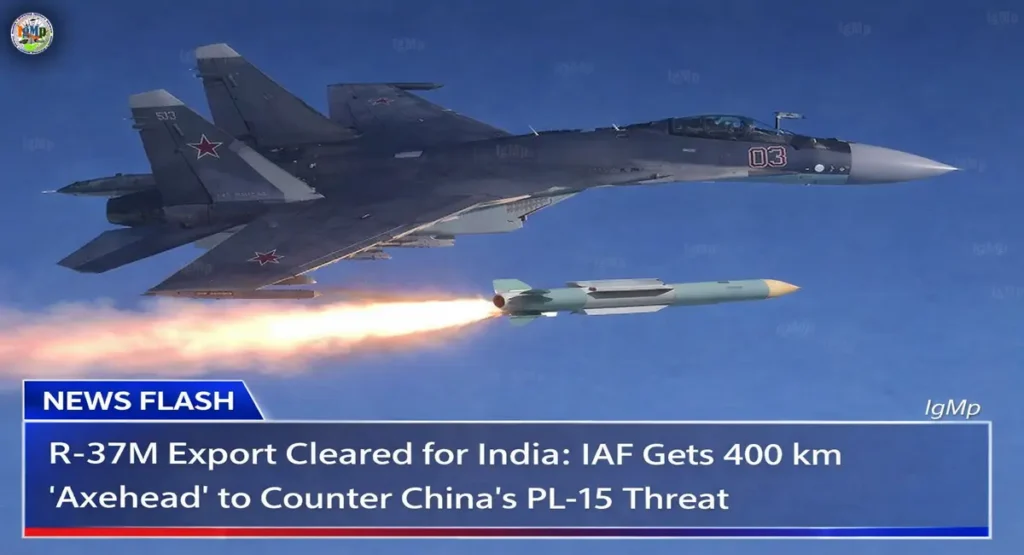
As per Russian Defence News website report, Russian President Vladimir Putin has cleared the R-37M missile for export to India to counter China’s PL-15 and PL-17 threat. This ultra-long-range missile, often referred to as the “Axehead,” offers a strike envelope of up to 400 km and is specifically designed to neutralize high-value airborne targets such as AWACS and aerial refuellers. For the Indian Air Force, this induction comes at a critical moment when regional air combat dynamics are shifting rapidly toward long-range, network-centric engagements.
The move provides an immediate capability boost while India continues to develop the indigenous Astra Mk3. It also reflects a broader strategic shift toward extending engagement ranges and denying adversaries the ability to operate safely behind the frontlines. By bridging the gap between current capabilities and future systems, the R-37M strengthens India’s deterrence posture in an increasingly contested airspace.
Why is the IAF choosing R-37M over immediate Astra Mk3 induction?
India faces an immediate capability gap in the ultra-long-range air-to-air segment. The Astra Mk2 is entering trials with a range close to 200 km. However, threats from China already extend far beyond that envelope.
The May 2025 Operation Sindoor scenario exposed a critical weakness. Enemy AWACS and support aircraft operated from safe distances while guiding long-range missile strikes. Even advanced fighters struggled to disrupt that coordination without a “long-arm” missile.
The R-37M solves this problem quickly. It gives the IAF the ability to target high-value assets at extreme ranges. This includes AWACS, tankers, and electronic warfare aircraft.
From a strategic perspective, the intent is clear: deny the enemy the ability to control airspace from a distance. This shifts the engagement zone farther away from Indian airspace.
Astra Mk3 will eventually fill this role. However, its development timeline creates a temporary gap. The R-37M acts as a stop-gap solution that ensures deterrence remains intact.
How does the R-37M compare to the Chinese PL-15 and PL-17?
| Feature | R-37M (Russia/India) | PL-15 (China/Pakistan) | Astra Mk3 (India – Future) |
|---|---|---|---|
| Max Range | 350–400 km | ~150–200 km | 340–350 km |
| Speed | Mach 6.0 | Mach 4.0 | Mach 4.5+ |
| Target Type | AWACS / Tankers | Fighter Aircraft | Multi-role |
| Status | Export Cleared (2026) | Operational | Trial Phase |
Conversation around the R-37M has been building for a while the core idea being to give Su-30MKI a long-reach option to threaten high-value assets like AWACS, or at the very least force enemy aircraft into a defensive posture with these very long-range shots.
However, talk of a… pic.twitter.com/bBMTZ7ldqg— Alpha Defense™🇮🇳 (@alpha_defense) April 17, 2026
The R-37M stands out due to its extreme range and speed. It is designed to eliminate high-value targets rather than engage fighters in close combat.
China’s PL-15 missile focuses on engaging fighter aircraft. It supports network-centric warfare but lacks the same reach as the R-37M.
The PL-17 reportedly extends range further, but reliable data remains limited. Even then, the R-37M provides a strong counter in terms of speed and interception capability.
What role will Su-30MKI upgrades and future platforms play?
The Sukhoi Su-30MKI will act as the primary launch platform for the R-37M. Its size and payload capacity allow it to carry such large missiles effectively.
Current integration relies on the Bars Radar, which already supports long-range tracking. However, the upcoming “Super Sukhoi” upgrade will transform this capability.
India is developing the Virupaksha AESA radar for these aircraft. This radar will improve detection range, tracking precision, and resistance to jamming. It will serve as the ideal partner for a missile like the R-37M.
The discussion also extends to the Su-57. Russia has offered this platform to India with deeper access to source codes. A smaller derivative of the R-37M, often linked to internal bay compatibility, could play a role here.
This creates a future pathway where ultra-long-range missiles integrate seamlessly with stealth platforms. That combination would significantly enhance India’s air dominance strategy.
Cost, Deterrence Value, and Strategic Impact
Reports indicate a deal value of around $1.2 billion for roughly 300 missiles. This places the cost at about $4 million per unit.
This pricing offers a clear advantage. Maintaining constant Combat Air Patrols to counter long-range threats costs far more over time. The R-37M provides a cost-effective deterrent by extending engagement distance.
The strategic impact goes beyond simple numbers. The missile changes how air battles unfold. It forces adversaries to operate cautiously and stay farther from contested zones.
Our analysis suggests that this move strengthens India’s area-denial capability in the air domain. It also complements indigenous programs led by DRDO, especially those based on SFDR technology for future missile propulsion.
The Bigger Picture: Bridging Today’s Gap, Building Tomorrow’s Capability
The R-37M does not replace India’s indigenous efforts. Instead, it buys time and strategic flexibility. It ensures that the IAF does not enter a capability deficit phase while Astra Mk3 matures.
At the same time, India continues to build a layered missile ecosystem. Future systems will integrate across platforms, from upgraded Su-30MKIs to next-generation fighters.
The shift reflects a broader doctrine. India no longer focuses only on platform superiority. It now prioritizes range, reach, and network disruption.
That evolution defines modern air warfare. And the R-37M fits directly into that emerging strategy.