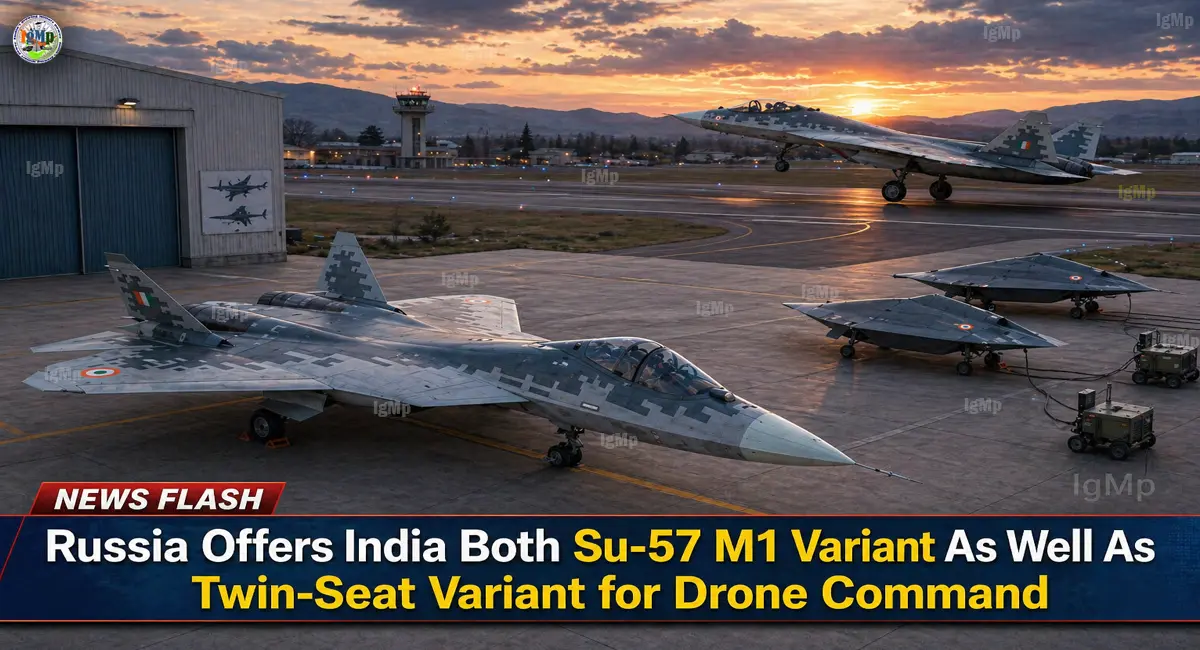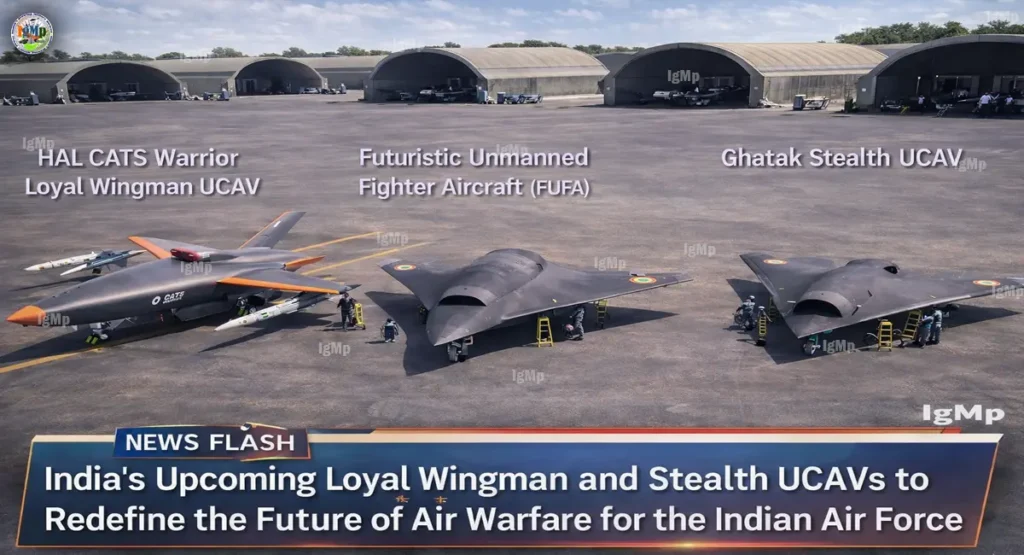
The HAL CATS Warrior is emerging as the centerpiece of India’s push toward Manned-Unmanned Teaming (MUM-T), representing a shift in how the Indian Air Force plans to fight future air wars. Designed as a 5-ton class stealth loyal wingman, the Warrior will operate alongside manned fighters while extending their reach, survivability, and strike capability.
Alongside it, more advanced programs like the Future Unmanned Fighter Aircraft (FUFA) and the Remotely Piloted Strike Aircraft (RPSA) Stealth UCAV are shaping a layered unmanned combat ecosystem. Together, these platforms are expected to redefine air combat by enabling distributed operations, reducing pilot risk, and compensating for India’s persistent fighter squadron shortage.
What is India’s MUM-T strategy for 2026?
The IAF’s MUM-T doctrine is built on the idea that manned aircraft should act as command nodes controlling multiple unmanned systems in real time. Instead of relying purely on traditional fighter formations, this approach allows a single pilot to coordinate surveillance, electronic warfare, and strike missions across a network of drones.
This shift is as much about efficiency as it is about capability. By deploying unmanned systems forward, the IAF can extend its operational reach without exposing pilots to high-risk environments. It also enables more flexible mission planning, where drones can be sacrificed or repositioned without the strategic cost of losing a manned aircraft.
Two critical aspects define this strategy:
- The IAF is expected to induct 100+ CATS Warrior UCAVs to scale this capability
- Initial flight trials are projected in the 2026–2027 timeframe
This combination of scale and timing suggests that MUM-T is moving from concept to operational reality within the decade.
HAL CATS Warrior: The 5-Ton Stealth Wingman
At the heart of this transformation is the HAL CATS Warrior, a UCAV designed to function as a stealthy, autonomous extension of manned fighters. Its role is not limited to support—it is built to actively participate in combat missions, including strike, ISR, and electronic warfare.
Powering the Future: Twin HTFE-25 Engines
The Warrior Mk2 is now expected to feature a 5-ton airframe powered by twin HTFE-25 turbofan engines, delivering a combined thrust of around 50 kN. This configuration provides the performance needed for sustained high-subsonic operations and deeper mission penetration.
The platform is also expected to incorporate advanced technologies such as GaN-based AESA radars, secure data links, and internal weapons bays to maintain a low radar signature. Operating in coordination with platforms like the Su-30MKI and future AMCA, the Warrior can act as a forward sensor, decoy, or strike asset depending on mission requirements.
Rather than being a standalone drone, it is designed as part of a networked combat system, where data sharing and coordination define effectiveness.
FUFA vs. RPSA: Understanding India’s Stealth UCAV hierarchy
India’s unmanned combat roadmap is structured across multiple platforms, each designed for a specific operational role. While the CATS Warrior focuses on loyal wingman duties, more advanced systems are being developed for independent combat missions.
| Platform | Role | Engine Config | Status |
|---|---|---|---|
| CATS Warrior | Loyal Wingman UCAV | Twin HTFE-25 | Prototype (2026–27) |
| FUFA | Supersonic UCAV | Twin-engine stealth | Design Phase |
| RPSA | Stealth UCAV | Classified | Concept/Development |
The FUFA program is expected to deliver a supersonic unmanned fighter, capable of operating independently in contested environments. In contrast, the RPSA initiative, led by Aeronautical Development Agency, focuses on deep-strike stealth operations with a high degree of survivability.
This layered structure ensures that:
- CATS Warrior supports and enhances manned fighters
- FUFA operates as an advanced autonomous combat drone
- RPSA stealth ucav delivers strategic strike capability in high-threat zones
Such a hierarchy allows the IAF to tailor its response across a wide spectrum of conflict scenarios.
Why this combination of Loyal Wingman and Stealth UCAVs matters for India’s air combat future
The importance of the CATS Warrior and the broader MUM-T ecosystem lies in its ability to address both capability and capacity challenges. India’s fighter squadron strength has been under pressure, and acquiring new aircraft is a costly and time-intensive process.
By integrating a large fleet of UCAVs, the IAF can significantly expand its operational footprint. A single fighter controlling multiple drones can extend engagement ranges, overwhelm enemy defences, and conduct missions that would otherwise be too risky for manned platforms.
This approach also complements indigenous programs such as Astra Mk2 and Project Kusha, forming a broader, interconnected combat ecosystem.
In practical terms, the shift toward unmanned teaming represents a move toward scalable airpower, where capability is no longer limited by the number of available pilots or aircraft.
Final Take (Editor’s Insights)
The HAL CATS Warrior is not just another UAV—it is a foundational element of India’s future air combat doctrine. With its 5-ton design, twin-engine configuration, and integration into MUM-T operations, it offers a credible path to expanding combat power while managing costs and risks.
As the 2026–27 flight window approaches, the success of this program could position the IAF among the few air forces globally capable of deploying a fully integrated loyal wingman ecosystem, reshaping the balance of airpower in the region.