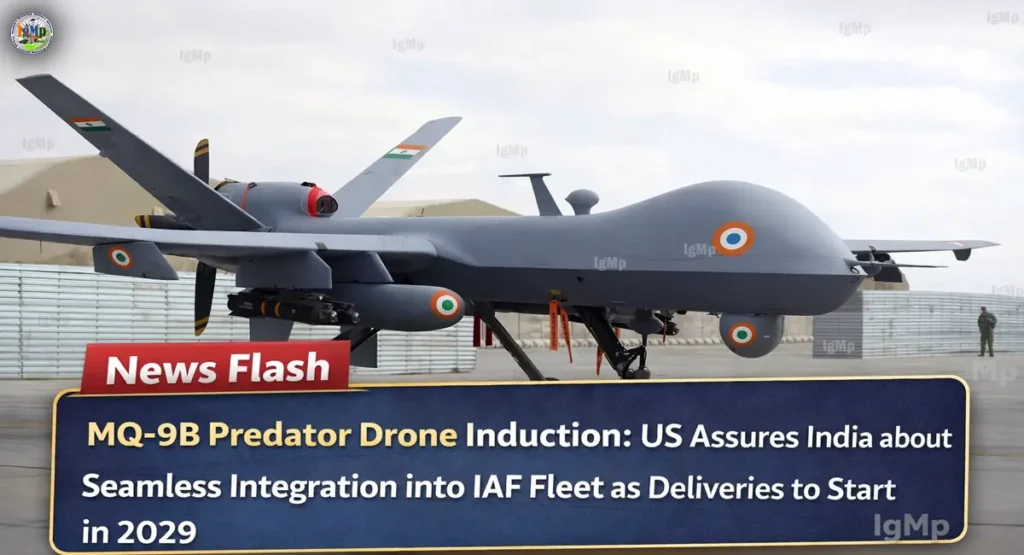
India’s push to strengthen long-endurance surveillance and precision strike capabilities has received a clear signal of support from the United States. Washington has reiterated that the induction of MQ-9B Predator drones into Indian service will follow a “seamless” pathway, with deliveries scheduled to begin in January 2029. This commitment goes beyond timelines—it reflects a deeper alignment between New Delhi and Washington in high-end unmanned systems and network-centric warfare, where integration and real-time data sharing matter as much as the platforms themselves.
At the center of this assurance stands General Kenneth S. Wilsbach, who engaged directly with Air Chief Marshal AP Singh. This meeting was not ceremonial. It acted as a capability guarantee. India is not waiting for delivery to begin preparations. The Indian Air Force has already started aligning its digital backbone to absorb these drones into a networked battlespace.
Seamless Induction: More Than Just Delivery
The phrase “seamless induction” carries real operational weight. It means that when the first MQ-9B touches Indian soil in January 2029, it will not sit idle for years of trials. Instead, it will plug into India’s existing command, control, and surveillance systems.
This requires groundwork long before delivery. Data links, satellite connectivity, mission planning software, and air defense integration must align perfectly. India is building that architecture now. The goal is simple—ensure that these drones can share real-time intelligence across all services without friction.
The role of the US Air Force extends beyond supplying hardware. It includes training, doctrinal alignment, and integration support. That involvement reduces the risk of delays and ensures that operational capability matches the platform’s potential from the outset.
Induction Snapshot

| Feature | MQ-9B Predator (Indian Variant) |
|---|---|
| Quantity | 31 Drones (Navy: 15, Army: 8, IAF: 8) |
| Delivery Start | January 2029 |
| Endurance | 40+ Hours |
| Altitude | 40,000+ Feet |
| Capability | ISR & Precision Strike |
| Strategic Focus | LAC Surveillance & IOR |
The tri-service distribution reflects India’s operational priorities. The Indian Navy takes the largest share to monitor vast maritime zones. The Army and Air Force use their allocations for land surveillance and precision targeting roles.
The Real Advantage: Persistent Staring Power
The real value here is not the drone itself. It is the ability to stay in the sky for over 40 hours.
This capability, often described as “persistent staring,” changes how India monitors its borders and maritime zones. Along the Line of Actual Control, these drones can track movement patterns, logistics buildup, and troop deployments without interruption. In the Indian Ocean Region, they can shadow vessels across vast distances.
Unlike manned aircraft, these systems do not face fatigue limits. They maintain continuous watch, building a detailed picture over time. That persistence turns raw surveillance into actionable intelligence.
The MQ-9B also carries precision strike capabilities, including air-to-ground munitions. This combination of surveillance and strike makes it a force multiplier rather than just an observation platform.
The $4 Billion MRO Ecosystem: India’s Strategic Win
The induction roadmap includes a critical industrial component. The $4 billion deal goes beyond buying drones. It builds a long-term Maintenance, Repair, and Overhaul ecosystem within India.

This MRO infrastructure will support not only India’s fleet but potentially other global operators of the MQ-9B platform. That shifts India’s role from a buyer to a regional sustainer.
Such capability creates high-skill jobs, strengthens aerospace supply chains, and reduces long-term dependency on foreign maintenance hubs. It also ensures faster turnaround times for repairs and upgrades, which directly improves operational readiness.
In strategic terms, the MRO hub anchors the entire program within India’s industrial ecosystem.
What This Means for India’s Military Posture
The MQ-9B induction strengthens India’s surveillance and strike capabilities across two critical fronts. Along the northern borders, it enhances situational awareness and early warning. In the maritime domain, it expands India’s reach deep into the Indian Ocean.
The integration of these drones into a networked system amplifies their impact. They will not operate in isolation. Instead, they will feed data into a larger grid that includes satellites, fighters, and ground-based systems.
This network-centric approach ensures faster decision-making and coordinated responses. It turns information into a decisive advantage.