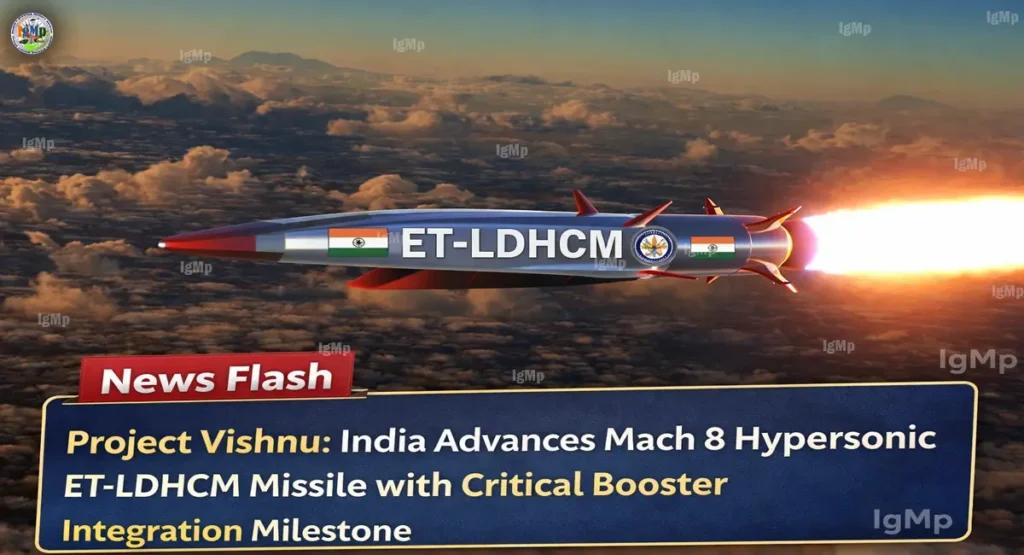
India’s hypersonic ambitions have just crossed a decisive threshold. Under Project Vishnu, the Extended Trajectory Long Duration Hypersonic Cruise Missile (ET-LDHCM) has entered the booster integration phase, a step that transforms it from a lab success into a real weapon system. This stage connects the solid rocket booster with the scramjet-powered cruise vehicle, forming a single, flight-ready structure.
While “booster integration” may sound routine, it is anything but. In hypersonic systems, the booster does more than provide initial thrust. It must accelerate the missile cleanly to scramjet ignition speed without destabilizing the airframe. Any imbalance at this stage can destroy the missile before it even reaches hypersonic cruise.
Why Booster Integration Is the Real Breakthrough
The fabrication of specialized jigs and fixtures marks a turning point. These are not ordinary assembly tools. Engineers design them to hold components in place with extreme precision during integration.
At hypersonic speeds, even microscopic misalignment becomes catastrophic. Vibrations increase sharply beyond Mach 5. If the booster and scramjet do not align to near-perfect tolerances, the missile can break apart under stress.
In simple terms, this phase answers one question:
Can the missile survive its own speed?
That is why this step matters more than early lab tests. It proves the system can transition from controlled environments to real-world launch conditions. In the world of hypersonics, precision is not a luxury. It is survival.
The Scramjet Milestone: India’s 12-Minute Breakthrough
The scramjet engine remains the core of the ET-LDHCM. In January 2026, India achieved a major milestone with a 12-minute sustained ground test of scramjet combustion.
That number deserves attention.
Most global scramjet programs struggle to maintain stable combustion beyond 30–60 seconds. Sustaining it for 12 minutes places India in a very small group of advanced hypersonic developers.
This endurance directly translates into range and mission flexibility. A stable scramjet allows the missile to maintain hypersonic speed over long distances rather than achieving short bursts of velocity.
The propulsion system uses actively cooled structures with endothermic fuel, which absorbs heat while powering the engine. That allows the missile to operate in extreme thermal conditions without structural failure.
System Profile: ET-LDHCM (Project Vishnu)
| Feature | Specification |
|---|---|
| Speed | Mach 7–8 (~11,000 km/h) |
| Range | 1,500 km (baseline), up to 2,500 km future |
| Propulsion | Actively cooled scramjet |
| Thermal Limit | ~2,000°C (ceramic matrix composites) |
| Launch Platforms | Su-30MKI, naval destroyers, land-based VLS |
The missile is designed for tri-service deployment, including launch from the Sukhoi Su-30MKI. That flexibility increases its operational value across air, land, and sea domains.
Why ET-LDHCM Threatens Advanced Air Defenses
The real threat to systems like the S-400 missile system is not just speed. It is maneuverability combined with speed.
Traditional ballistic missiles follow predictable arcs. Air defense systems calculate interception points based on those trajectories. Hypersonic cruise missiles behave differently. They fly within the atmosphere and can maneuver during flight.
This “extended trajectory” approach makes interception far more complex. The missile can alter its path, adjust altitude, and approach from unexpected angles. That reduces the effectiveness of even advanced radar and interceptor networks.
At Mach 8, reaction time drops sharply. Defenders get seconds to detect, track, and respond. Add maneuverability to that equation, and interception becomes extremely difficult.
Project Vishnu: The Larger Hypersonic Ecosystem
Project Vishnu is not a single missile program. It serves as an umbrella for India’s broader hypersonic ecosystem. The ET-LDHCM sits at the top of this hierarchy.
It also connects to other emerging systems. Programs like Dhvani and long-range anti-ship hypersonic missiles (LR-AShM) build on the same technological foundation. In that sense, ET-LDHCM acts as the “older brother” that validates core technologies before they spread across multiple platforms.
This layered development approach strengthens India’s overall strike capability. It ensures that advances in propulsion, materials, and guidance do not remain isolated within a single project.
What Comes Next
The booster integration phase sets the stage for the next critical milestone—full system flight testing. Once engineers validate structural integrity and ignition sequencing, the missile will move closer to real-world trials.
That transition will determine how quickly India can operationalize hypersonic weapons across its armed forces.
The bigger picture is hard to ignore. India has moved beyond theory. With booster integration underway, the country is now assembling a weapon designed to survive, maneuver, and strike at speeds few systems in the world can counter.