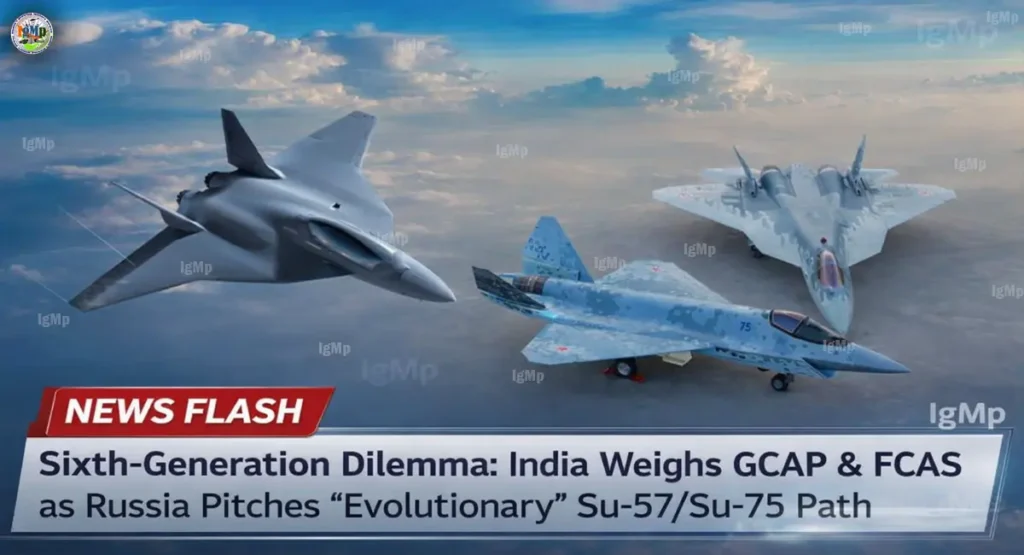
India’s airpower planning is entering a decisive transition. Senior defence discussions indicate that both the Indian Air Force (IAF) and the Ministry of Defence are now actively exploring how to plug into sixth-generation fighter ecosystems, especially through potential collaboration with European programs like GCAP and FCAS.
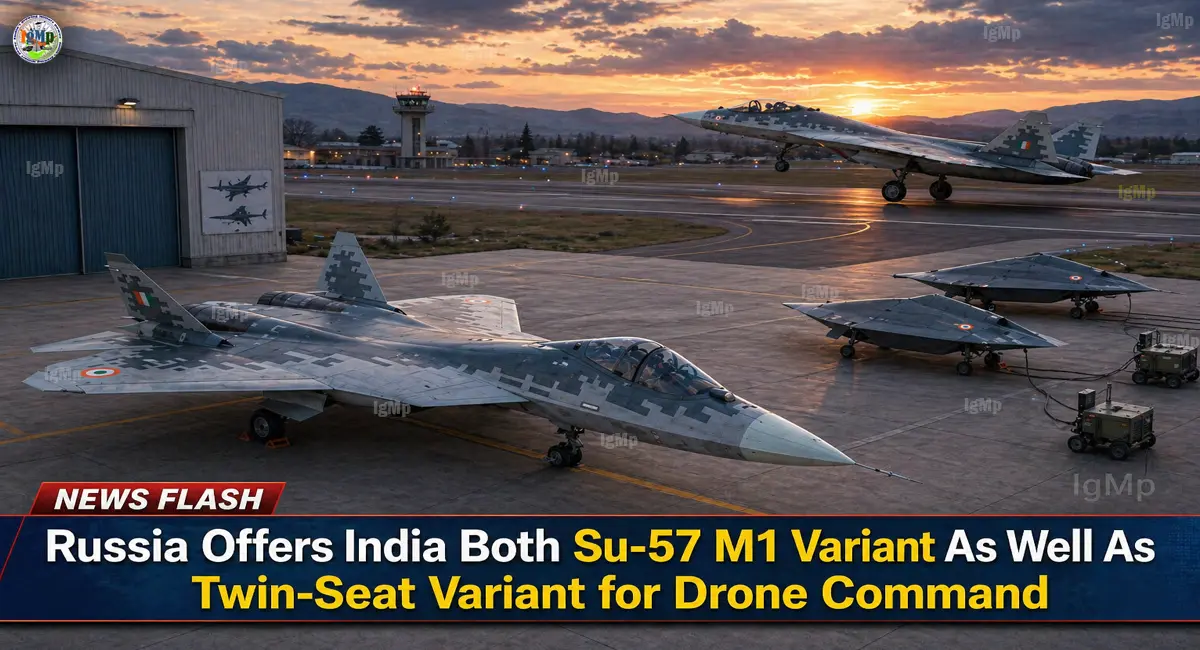
At the same time, Russia has put a different proposition on the table. Instead of waiting for a clean-sheet 6th-gen platform, Moscow is offering India a co-development pathway built around the Su-57 Felon and the Su-75 Checkmate. The idea is to evolve these jets step-by-step into “6th-generation-like” systems through upgrades in AI, avionics, and mission systems—effectively compressing timelines while avoiding the long wait associated with next-generation programs.
The Core Divide: Evolution vs Revolution
Russia’s pitch is simple. Build on what already exists. The Su-57 platform will evolve through upgrades in sensors, avionics, and AI-assisted piloting. The Su-75 aims to complement it as a lighter, export-friendly stealth jet. Moscow frames this as a faster path to relevance in the 2030s.
Europe takes a different route. GCAP and FCAS do not revolve around a single aircraft. They center on a “system-of-systems” model. The fighter becomes the command node for drones, data networks, and real-time battlefield integration. The aircraft is the brain, not the entire body.
Here is the real divergence. Russia sells hardware first. Europe sells architecture first.
Combat Cloud vs Digital Pilot
The technical debate sits at the heart of this choice. Russia emphasizes an AI-enabled “digital pilot.” This system assists the human pilot in decision-making, threat detection, and mission execution. It enhances a traditional fighter framework rather than replacing it.
Europe pushes the “combat cloud.” This concept links manned jets with unmanned wingmen, satellites, and ground systems. The pilot manages a network rather than just flying a jet. This model aims to dominate information, not just airspace.
The difference matters. One improves pilot capability. The other reshapes how air combat works.
The Timeline Reality Check
Timelines drive India’s hesitation. Russia promises upgrades that can enter service within the next decade. That aligns with immediate capability gaps. The IAF needs numbers and readiness before 2035.
European programs target the 2040s. They promise unmatched capability but demand patience and sustained funding. That creates a strategic gap. India must decide whether it can bridge two decades with interim solutions.
The brutal truth is this: Russia offers certainty in the near term, while Europe offers dominance in the long term.
The Su-75 Question Mark
The Su-75 Checkmate introduces both opportunity and risk. Russia markets it as a “6th-generation-like” platform. It highlights AI integration, reduced crew workload, and optional unmanned capability.
Yet the aircraft lacks a confirmed production timeline. No clear induction roadmap exists. That uncertainty raises concerns inside Indian planning circles. A delayed or underfunded program could leave the IAF with another capability gap.
In contrast, GCAP and FCAS benefit from structured multinational funding. Their timelines stretch longer, but their financial backing appears more stable.
The AMCA Factor
India cannot ignore its own ambitions. The AMCA program remains central to long-term strategy. Especially the AMCA Mk2, which aims to incorporate advanced stealth and next-gen systems.
Here lies the real gamble. Joining a foreign 6th-gen program could divert funds and talent from AMCA. That could slow India’s push for self-reliance in aerospace.
On the other hand, collaboration could accelerate access to critical technologies. Engines, sensors, and AI systems remain key gaps. Europe offers deeper tech-sharing potential than Russia in some of these areas.
Strategic Outlook
The IAF does not face a simple yes-or-no decision. It faces a layered choice. Russia’s path supports immediate readiness and continuity. Europe’s path promises a transformational leap but demands long-term commitment.
India will likely continue evaluating both tracks. It may even pursue a hybrid approach. Short-term capability through upgrades, combined with selective participation in next-gen ecosystems.
One question defines the debate: Should India prepare for the 2030s or shape the 2040s?
Right now, New Delhi appears to be doing both.