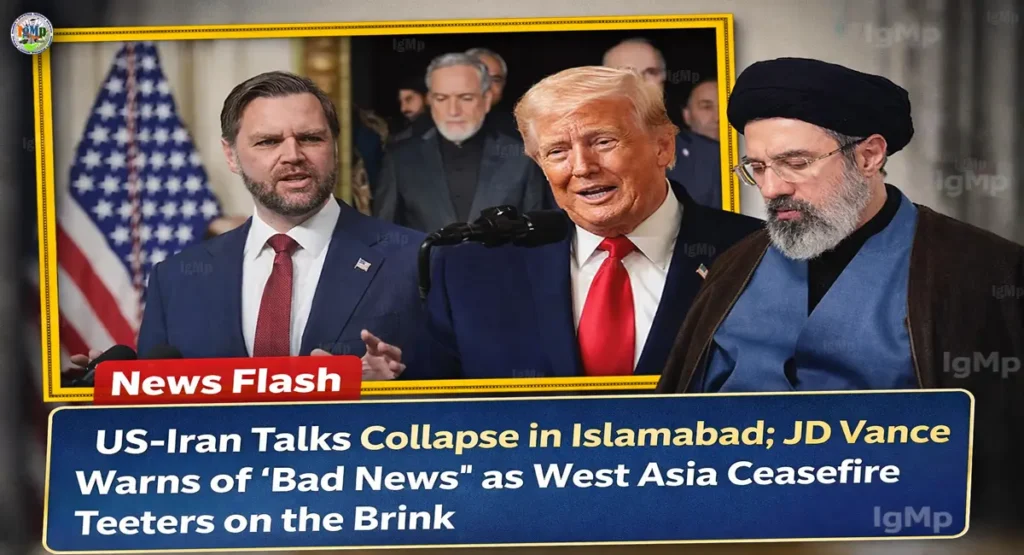
All eyes of the world were in Islamabad for the mega talks being held between the United States and Iran for a complete stop to the war that has already affected the global economy. The 21-hour marathon talk in Islamabad did not just end in a stalemate. It ended with a warning. When US Vice President JD Vance said the outcome was “worse for Iran than the US,” he signaled something deeper than a failed negotiation. The window for a diplomatic solution in West Asia is closing fast.
The talks between United States and Iran aimed to stabilise a fragile ceasefire. Instead, both sides walked away with hardened positions. This breakdown now raises the risk of escalation across the region, with direct consequences for global energy markets and India’s strategic interests.
The Core Dispute: Nuclear Red Lines and No Middle Ground
The sticking point is clear and sharply defined.
- The United States demands zero enrichment capability from Iran.
- Iran insists on full sovereignty over its nuclear cycle.
This is not a technical disagreement. It is a clash of strategic doctrines. Washington wants to eliminate any pathway to weaponisation. Tehran sees enrichment as a symbol of national sovereignty and deterrence.
Neither side shows signs of compromise. That leaves diplomacy with very little room to operate. The collapse in Islamabad confirms that both capitals now prepare for harder options.
Why Islamabad Hosted the Talks: The Pakistan Factor
Pakistan did not host these talks by accident. Islamabad wants to prevent a regional spillover that could destabilise its own western flank, especially in Balochistan.
A wider conflict involving Iran could trigger cross-border tensions, disrupt trade routes, and fuel insurgent activity. Pakistan sees mediation as a way to contain the crisis before it reaches its borders.
The failure of talks now puts that strategy under pressure. Islamabad may face increasing instability if tensions escalate further.
The Global Choke-Point: Hormuz and the Cape Route
Here is the real risk. The Strait of Hormuz handles nearly a quarter of the world’s oil shipments. Any disruption here sends shockwaves across global markets.
If the ceasefire collapses, Iran could threaten or restrict traffic through this narrow passage. Even a partial disruption would drive up shipping insurance costs and delay tanker movements.
Alternative routes exist, but they come at a price. Ships may divert around the Cape of Good Hope, which adds time and cost to every journey. That directly impacts global fuel prices and supply chains.
For India, the stakes are high. A large share of its energy imports passes through Hormuz. If tensions rise, New Delhi faces a double hit—higher import costs and inflationary pressure at home.
Timeline of Tensions: Where Things Stand Now
| Event | Status | Impact |
|---|---|---|
| Islamabad Talks | Collapsed after 21 hours | Ceasefire at critical risk |
| US Position | No deal without nuclear halt | Return of pressure tactics likely |
| Iran Position | No compromise on sovereignty | Risk of escalation in Gulf |
| Market Reaction | High volatility | Oil prices expected to rise |
This snapshot shows how quickly the situation has shifted. What began as a diplomatic effort now edges toward a security crisis.
What Comes Next: A Narrow Window Before Escalation
The next 48 hours will prove critical. If both sides fail to revive the ceasefire, the region could see its first direct military exchanges in months.
Naval deployments may increase in the Persian Gulf. Energy infrastructure could become a target. Even limited strikes would trigger global market reactions.
For India, the focus will shift to securing maritime routes and managing economic fallout. The government may explore strategic reserves and alternative supply chains to cushion the impact.
This is no longer just about nuclear negotiations. It is about control over energy routes, regional stability, and global economic balance.
The collapse of the Islamabad talks marks a turning point. If diplomacy fails to recover quickly, the world may soon face a new phase of conflict in one of its most critical regions.